Shoulder pain is common, but a painful shoulder does not automatically mean frozen shoulder.
Frozen shoulder, also called adhesive capsulitis, causes pain and stiffness together with a progressive loss of shoulder movement. Research shows that it occurs more often in people with diabetes, although that association does not mean diabetes caused the condition in any individual person.
Understanding that distinction helps separate what researchers know from what they are still trying to explain.
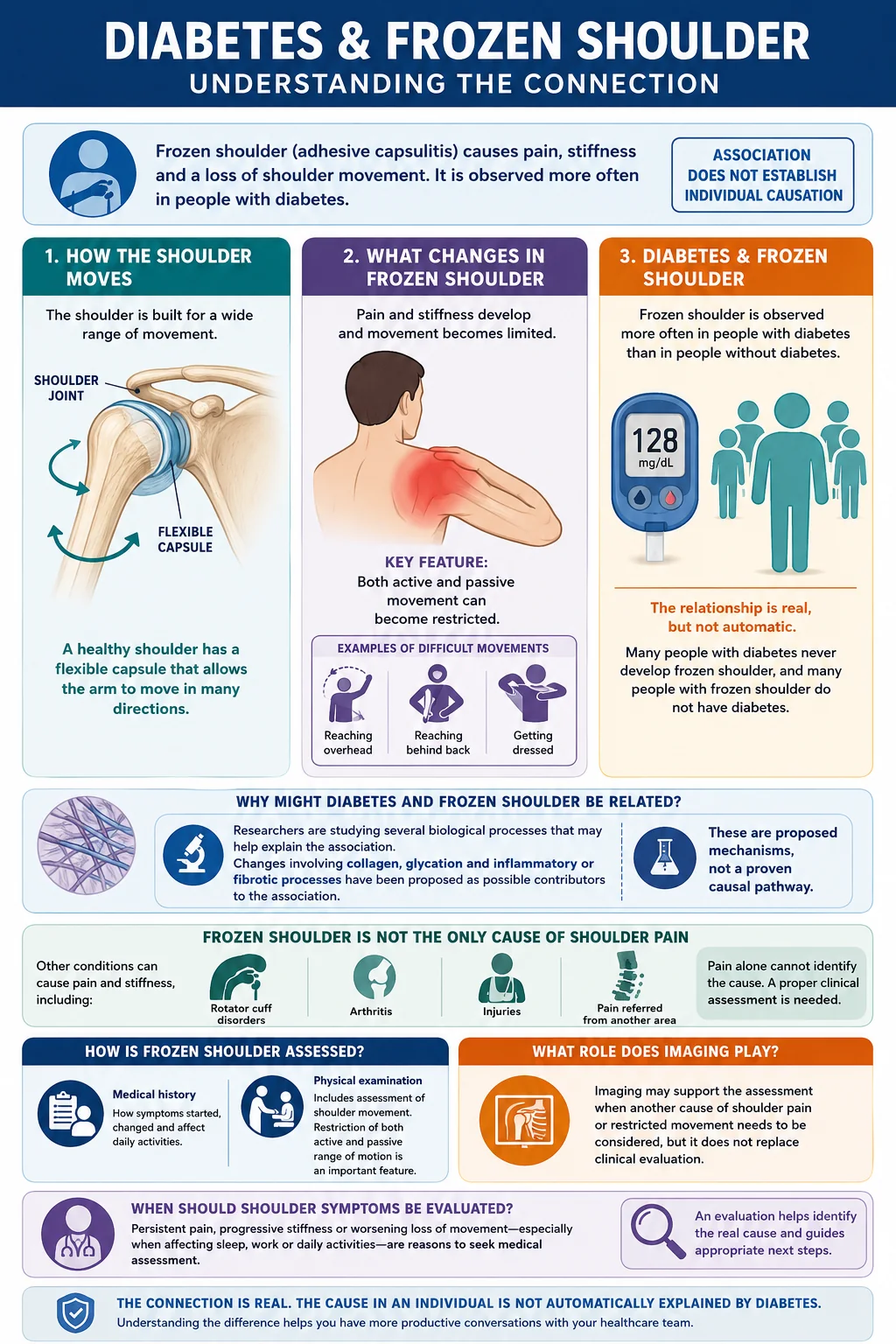
How Does a Healthy Shoulder Move?
The shoulder is built for a wide range of movement. The joint is surrounded by a flexible capsule made of connective tissue that helps support the joint while allowing the arm to move in many directions.
When that movement becomes increasingly painful and restricted, clinicians look at the pattern of symptoms rather than pain alone.
What Is Frozen Shoulder?
Frozen shoulder affects the shoulder capsule and is characterized by pain, stiffness and restricted range of motion.
Everyday movements such as reaching overhead, getting dressed or reaching behind the back may become difficult.
One feature clinicians consider is restriction of both active and passive movement. Active movement is produced by the person using their own muscles; passive movement occurs when the arm is moved with assistance, such as during an examination.
Both can become restricted in frozen shoulder.
Many conditions can cause shoulder pain. The pattern of restricted movement is an important part of the clinical picture.
What Is the Connection Between Diabetes and Frozen Shoulder?
Frozen shoulder is observed more often in people with diabetes than in people without diabetes.
The association is well recognized, but it needs to be interpreted carefully. Many people with diabetes never develop frozen shoulder, and frozen shoulder also occurs in people who do not have diabetes.
Population-level association therefore cannot tell us why the condition developed in one particular person.
An association with diabetes does not establish individual causation.
Why Might Diabetes and Frozen Shoulder Be Related?
Researchers are still studying why the two conditions are associated.
The shoulder capsule contains connective tissue, including collagen. Changes involving collagen, glycation and inflammatory or fibrotic processes have been proposed as possible contributors to the association.
These mechanisms are biologically plausible, but they should not be presented as a proven sequence from diabetes to shoulder disease.
There is no need to imagine an inevitable pathway in which diabetes automatically leads to capsular damage and frozen shoulder. The relationship is more complex, and no single mechanism fully explains it.
Frozen Shoulder Is Not the Only Cause of Shoulder Pain
Frozen shoulder and arthritis can both produce pain and stiffness, but they are different conditions and require different clinical assessment.
Other problems, including rotator cuff disorders, injuries and pain referred from another area, can also produce shoulder symptoms.
This is why pain alone cannot identify the cause.
Progressive stiffness and loss of movement can provide useful clues, but distinguishing frozen shoulder from other shoulder conditions requires appropriate clinical assessment.
How Is Frozen Shoulder Assessed?
Assessment usually begins with a person's medical history and a physical examination.
A healthcare professional may consider how the symptoms started and changed, which movements have become difficult, whether an injury occurred and whether other health conditions could be relevant.
The examination typically includes assessment of shoulder movement. Restriction of both active and passive range of motion can be an important feature when frozen shoulder is suspected.
The findings are interpreted together rather than used as a do-it-yourself diagnostic test.
What Role Does Imaging Play?
Frozen shoulder is primarily assessed through clinical history and physical examination.
Imaging may support the assessment when another cause of shoulder pain or restricted movement needs to be considered, but it does not replace clinical evaluation.
When Should Shoulder Symptoms Be Evaluated?
Persistent shoulder pain, progressive stiffness or worsening loss of movement are reasons to consider medical assessment, especially when symptoms begin interfering with sleep, work or ordinary activities.
Because several conditions can produce similar symptoms, an evaluation can help determine what is actually causing the problem rather than assuming that diabetes—or frozen shoulder—is responsible.
Understanding the Diabetes–Frozen Shoulder Connection
A painful shoulder is not necessarily frozen shoulder. Frozen shoulder involves a characteristic pattern of stiffness and restricted movement, including limitation of both active and passive motion.
Diabetes is associated with a higher occurrence of frozen shoulder, but that does not establish the cause of the condition in an individual.
Although researchers are investigating connective-tissue and metabolic mechanisms that may help explain the association, those mechanisms do not form a proven, inevitable chain.
Sources & Medical References
- Diabetes Care — Upper-Limb Complications in Diabetes: A Narrative Review
- Clinical Practice Guidelines for Diagnosis and Non-Surgical Treatment of Primary Frozen Shoulder
- International Orthopaedics — Systematic Review and Meta-analysis of Diabetes and Adhesive Capsulitis
- American Diabetes Association — Standards of Care in Diabetes—2026
Published: September 2, 2026 · Last reviewed: September 2, 2026