Obstructive sleep apnea is common among people with type 2 diabetes. But the relationship between the two conditions is not a simple one-way path.
Sleep apnea affects breathing during sleep. Type 2 diabetes affects how the body regulates glucose. The conditions are different, yet they can share risk factors and interact through some of the same metabolic pathways.
Understanding that connection starts with what happens to breathing during sleep.
How Does Breathing Normally Work During Sleep?
During normal sleep, air continues to move through the upper airway and into the lungs.
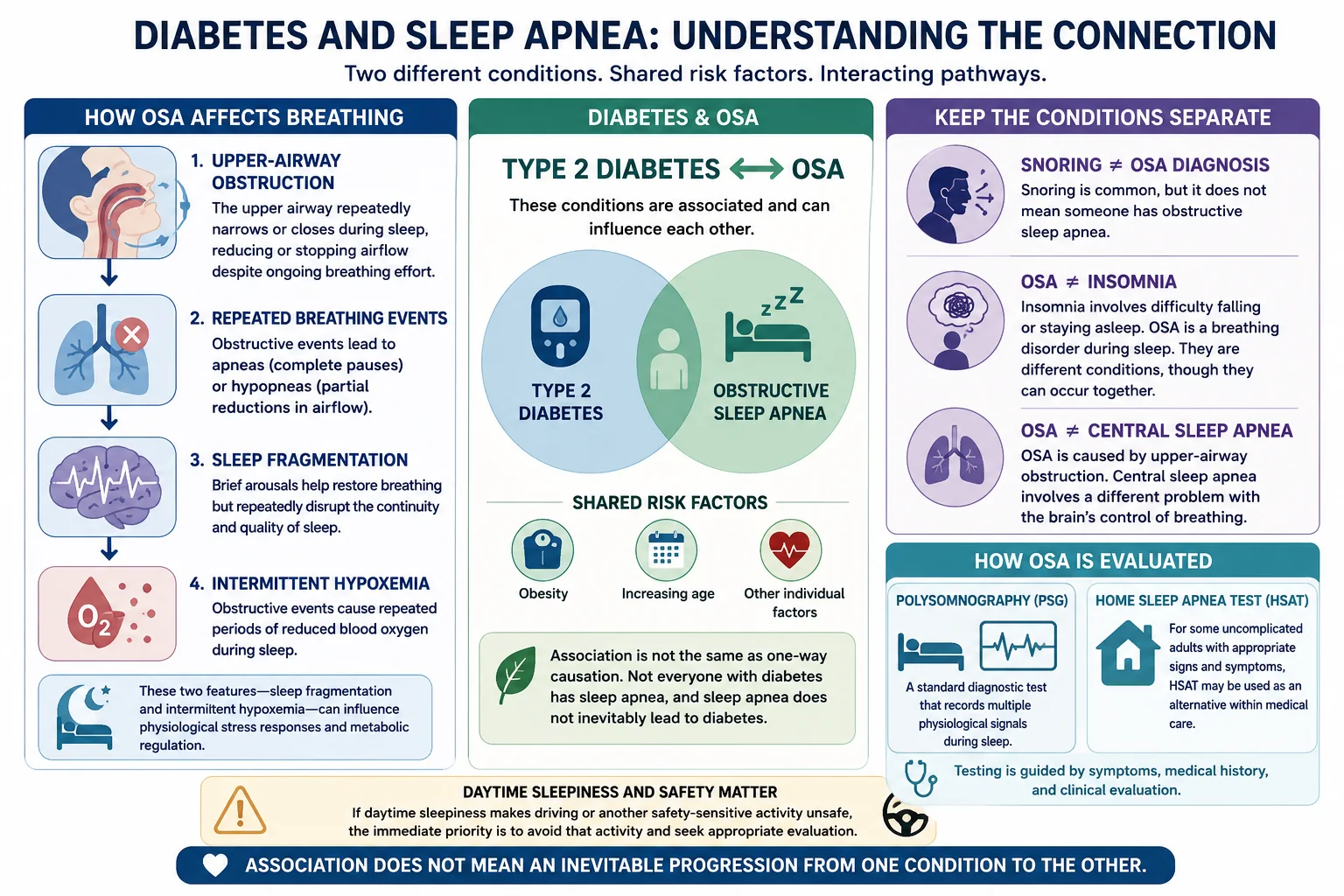
In obstructive sleep apnea (OSA), the upper airway repeatedly narrows or closes during sleep, reducing or stopping airflow while breathing effort continues.
Sleep studies describe complete and partial reductions in breathing as apneas and hypopneas.
Sleep Fragmentation
Breathing interruptions can trigger brief responses that help restore airflow but disrupt the continuity of sleep.
This repeated disruption is called sleep fragmentation. A person may therefore spend many hours in bed while their sleep is repeatedly interrupted.
Intermittent Hypoxemia
Obstructive breathing events can also cause repeated periods of reduced blood oxygen, known as intermittent hypoxemia.
Sleep fragmentation and intermittent hypoxemia are different physiological features of OSA, although both may occur during the same night.
What Is the Connection Between Type 2 Diabetes and Sleep Apnea?
OSA is common among people with type 2 diabetes, but prevalence estimates vary substantially depending on the population being studied.
That association does not mean everyone with type 2 diabetes develops OSA, or that OSA inevitably leads to type 2 diabetes.
The conditions can share risk factors and interact with metabolic processes.
Shared Risk Factors Matter
Obesity is an important shared risk factor for both OSA and type 2 diabetes, but neither condition requires obesity to be present. Age and other individual factors can also influence risk.
Association is not the same as one-way causation.
How Might OSA Affect Metabolic Regulation?
Repeated sleep fragmentation and intermittent hypoxemia can activate physiological stress responses that influence glucose regulation and insulin sensitivity.
But the biology should not be reduced to:
as though everyone follows the same sequence.
The relationship involves multiple interacting factors.
What Are Common Signs of Obstructive Sleep Apnea?
- loud snoring
- breathing pauses noticed by another person
- gasping or choking during sleep
- excessive daytime sleepiness
Symptoms can raise suspicion for OSA, but they do not establish the diagnosis.
Does Snoring Mean Someone Has Sleep Apnea?
No. Snoring is common in OSA, but someone can snore without having obstructive sleep apnea.
Diagnosing OSA requires more than recognizing a single symptom.
Is Sleep Apnea the Same as Insomnia?
No. OSA is a sleep-related breathing disorder.
Insomnia involves difficulty initiating or maintaining sleep or related difficulty obtaining satisfactory sleep despite an opportunity to sleep.
They can occur in the same person, but they are different sleep disorders.
Is OSA the Same as Central Sleep Apnea?
No. In obstructive sleep apnea, airflow is repeatedly blocked through the upper airway.
In central sleep apnea, breathing interruptions result from a different problem involving the brain's control of breathing.
How Is Obstructive Sleep Apnea Evaluated?
Evaluation begins with symptoms, medical history and factors that may increase the likelihood of OSA.
A healthcare professional may ask about snoring, breathing pauses, gasping during sleep and daytime sleepiness. Information from someone who regularly observes the person's sleep may also be useful.
When OSA is suspected, objective sleep testing may help establish the diagnosis.
Polysomnography and Home Sleep Apnea Testing
Polysomnography (PSG) is a standard diagnostic test for suspected OSA. It records multiple physiological signals during sleep, including breathing and oxygenation.
For some uncomplicated adults with appropriate signs and symptoms, a home sleep apnea test (HSAT) may be used as an alternative within medical care.
An HSAT is not a general do-it-yourself screening test. Its appropriateness should be determined through medical evaluation and the test should be ordered and interpreted within appropriate clinical care.
Symptoms raise suspicion. Sleep testing provides objective information used in diagnosis.
When Should Possible Sleep Apnea Be Assessed?
Persistent loud snoring accompanied by other suggestive symptoms, witnessed breathing pauses, gasping or choking during sleep, or excessive daytime sleepiness are reasons to discuss possible OSA with a healthcare professional.
The Bigger Picture: Diabetes and Sleep Apnea
The respiratory side of OSA can be understood as:
But that sequence should not simply be extended to:
The relationship between diabetes and OSA is better represented as:
with shared risk factors and interacting physiological pathways.
OSA ≠ INSOMNIA
OSA ≠ CENTRAL SLEEP APNEA
Association does not mean an inevitable progression from one condition to the other.
Sources & Medical References
- American Diabetes Association — Standards of Care in Diabetes—2026: Comprehensive Medical Evaluation and Assessment of Comorbidities
- American Diabetes Association — Standards of Care in Diabetes—2026: Facilitating Positive Health Behaviors and Well-being
- NHLBI — Sleep Apnea: Causes
- NHLBI — Sleep Apnea: Diagnosis
- American Academy of Sleep Medicine — Clinical Use of a Home Sleep Apnea Test: Updated Position Statement
- American Academy of Sleep Medicine — Diagnostic Testing for Adult Obstructive Sleep Apnea
Published: September 2, 2026 · Last reviewed: September 2, 2026