Stiff hands can have many causes. In people with diabetes, one pattern clinicians may encounter is limited joint mobility of the hand, also called stiff hand syndrome or diabetic cheiroarthropathy.
The classic pattern is often described as painless stiffness of the hands and fingers, with increasing difficulty fully straightening the fingers. This can make everyday hand movements harder.
Diabetes is associated with limited joint mobility, but having diabetes does not explain every case of hand stiffness. Other joint, tendon and nerve conditions can produce similar problems.
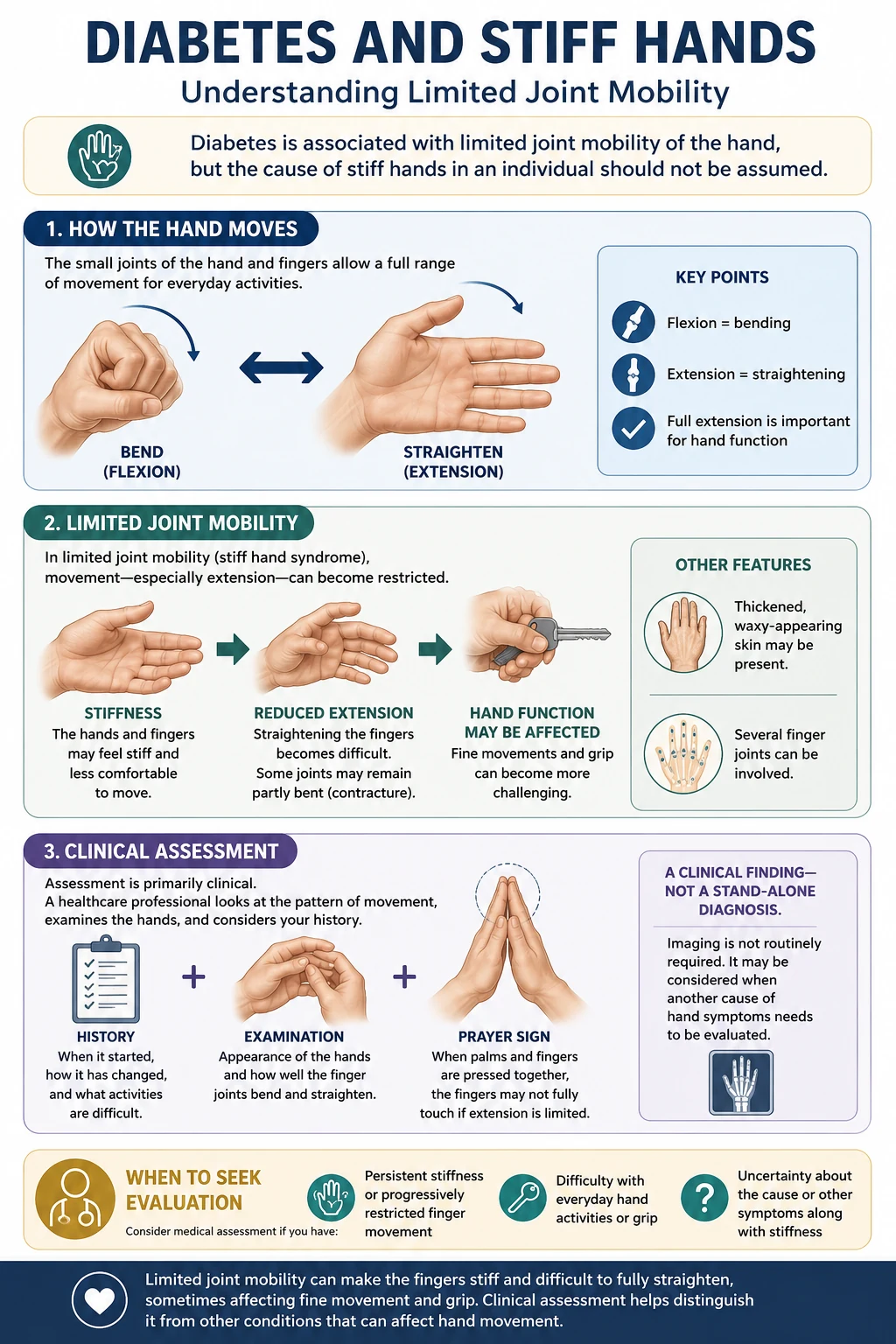
How Do the Hands and Fingers Normally Move?
The small joints of the hands and fingers allow the fingers to bend and straighten through the range needed for everyday activities.
Bending the fingers is called flexion. Straightening them is extension.
When joint mobility becomes restricted, full extension can become difficult. That loss of movement—not stiffness alone—is an important part of understanding limited joint mobility.
What Is Limited Joint Mobility of the Hand?
Limited joint mobility affects movement of the hand and finger joints.
The fingers may become stiff and increasingly difficult to straighten. Some joints can remain partly bent, a pattern described clinically as a flexion contracture.
Some people also have thickened, waxy-appearing skin over the hands or fingers.
The condition can involve several finger joints, but its appearance and severity are not identical in everyone. Hand stiffness alone is not enough to determine its cause.
What Is the Connection With Diabetes?
Limited joint mobility of the hand is a recognized musculoskeletal condition associated with diabetes.
That association is meaningful, but it does not mean that everyone with diabetes will develop stiff hands—or that diabetes is automatically responsible when stiffness occurs.
Reported frequency varies between studies and populations, which is one reason a single prevalence number can be misleading.
The more useful point is simpler: limited joint mobility occurs in association with diabetes, while the cause of hand stiffness in an individual still requires clinical interpretation.
Why Might Diabetes and Limited Joint Mobility Be Related?
The biological mechanisms behind limited joint mobility are not fully understood. Several explanations have been proposed, but current evidence does not establish a simple pathway showing why the condition develops in a particular person.
How Can Limited Joint Mobility Affect Hand Function?
Restricted finger movement can interfere with tasks that depend on precise hand motion.
Fine movements such as fastening buttons, handling keys or manipulating small objects may become more difficult when the fingers cannot move normally.
Grip can also be affected. Reduced finger mobility may make it harder to position the hand around objects, and reduced grip strength has been described in people with limited joint mobility. The degree of difficulty varies from person to person.
Stiff Hands Can Have Other Causes
Limited joint mobility is not the only condition that can affect hand movement.
Arthritis, trigger finger, Dupuytren disease and carpal tunnel syndrome can also affect hand movement or function. They are distinct conditions, which is one reason stiffness alone cannot identify what is causing a person's symptoms.
Diabetes may be relevant to the clinical picture, but it does not replace evaluation of other possible explanations.
How Is Limited Joint Mobility Assessed?
Assessment is primarily clinical.
A healthcare professional may consider when the stiffness began, how it has changed and which activities have become difficult. Examination can include the appearance of the hands and assessment of how well the finger joints bend and straighten.
Clinicians may also use a finding called the prayer sign as part of the assessment. When the palms and fingers are brought together, restricted finger extension may prevent their opposing surfaces from making full contact.
The prayer sign should be interpreted in clinical context rather than used as a stand-alone self-diagnosis.
Imaging is not routinely required to recognize limited joint mobility, although it may be considered when another cause of hand symptoms needs to be evaluated.
When Should Hand Stiffness Be Evaluated?
Persistent stiffness, progressively restricted finger movement or difficulty performing ordinary hand activities are reasonable reasons to seek medical assessment.
Evaluation can also be useful when the cause is uncertain or when stiffness occurs with other symptoms.
The purpose is to understand the pattern rather than assume that a new hand problem is caused by diabetes.
Understanding Stiff Hands in Diabetes
Limited joint mobility can make the fingers stiff and difficult to fully straighten, sometimes affecting fine movement and grip.
It is a recognized condition associated with diabetes, but hand stiffness has several possible causes. The association with diabetes does not establish the cause in an individual.
Clinical assessment helps distinguish limited joint mobility from other conditions that can affect hand movement.
Sources & Medical References
- Diabetes Care — Upper-Limb Complications in Diabetes: A Narrative Review
- American Diabetes Association — Standards of Care in Diabetes—2026
- Clinical review — Diabetic cheiroarthropathy and limited joint mobility
Published: September 3, 2026 · Last reviewed: September 3, 2026