A sore inside the mouth can be painful, irritating, and sometimes confusing — especially when it seems to return again and again.
One familiar explanation is a canker sore, also called an aphthous ulcer. But mouth ulcer is a broader description, and not every ulcer in the mouth is a canker sore.
That distinction becomes particularly important when ulcers are persistent, unusually severe, or recurrent. Recurrent aphthous stomatitis is one possible clinical pattern, but recurrence alone does not establish the diagnosis or explain why the ulcers are occurring.
Understanding the terminology — and its limits — can make the subject much clearer.
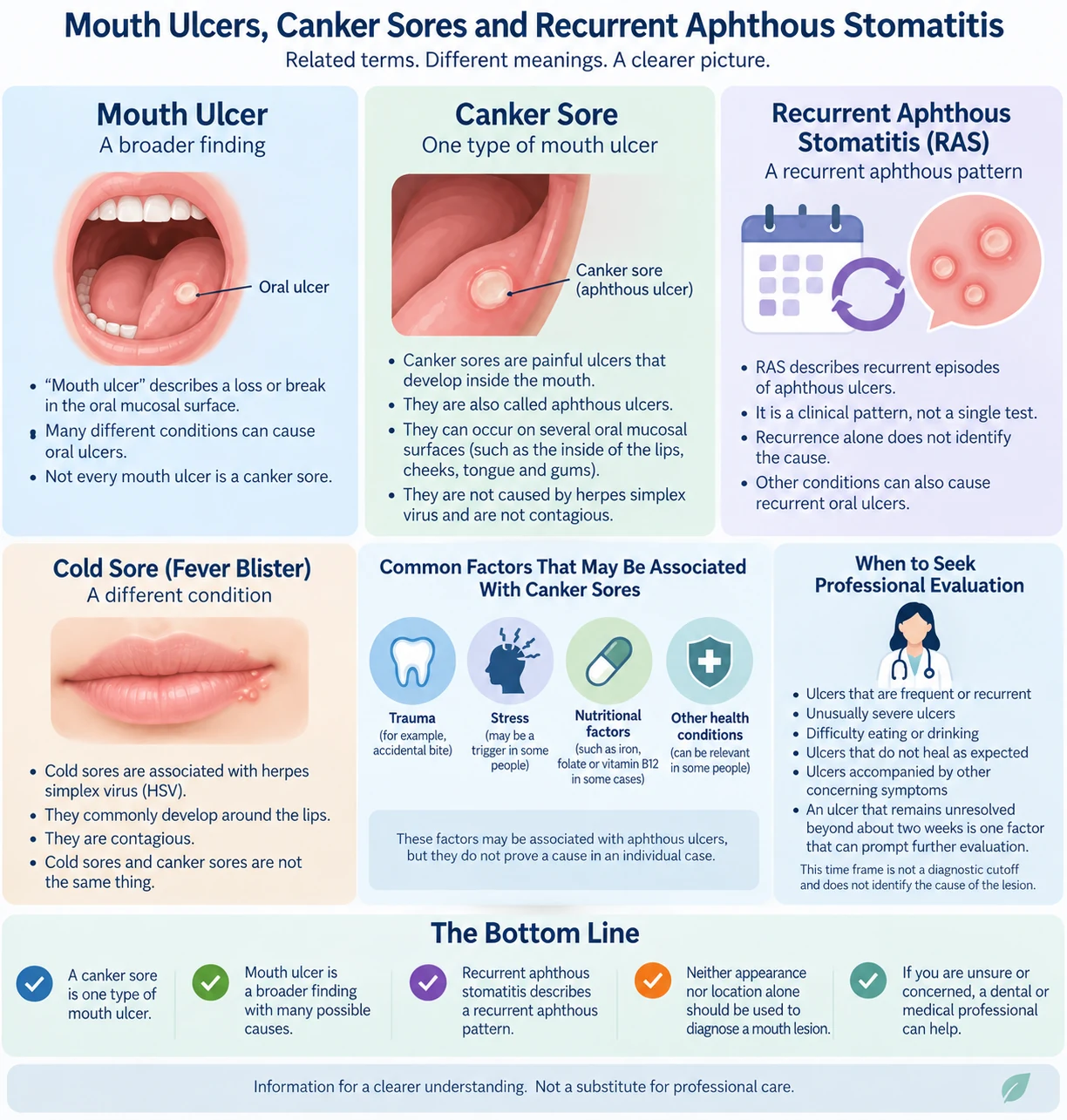
What Is a Canker Sore?
Canker sores are painful ulcers that develop inside the mouth. They are also commonly called aphthous ulcers.
Canker sores form inside the mouth and can occur on several oral mucosal surfaces.
Unlike cold sores, canker sores are not caused by herpes simplex virus and are not contagious.
The term mouth ulcer, however, describes a broader finding. Oral ulcers can occur in different clinical contexts and do not all have the same explanation.
What an Aphthous Ulcer Means
An aphthous ulcer is an ulcerative lesion of the oral mucosa associated with the aphthous spectrum.
When aphthous ulcers occur repeatedly in a characteristic pattern, clinicians may consider recurrent aphthous stomatitis, often abbreviated RAS.
That does not mean every isolated mouth sore represents RAS.
The recurrent pattern, clinical history, characteristics of the ulcers, their location, and the broader health context can all contribute to professional assessment.
Why Not Every Mouth Ulcer Is a Canker Sore
A mouth ulcer describes a loss or break in the oral mucosal surface. Different processes can produce ulceration.
Trauma, infections, inflammatory or immune-mediated conditions, medication-related effects, and other disorders can enter the differential diagnosis depending on the individual situation.
And the appearance of an ulcer by itself does not necessarily explain why it developed.
Canker Sore vs. Cold Sore: What’s the Difference?
Canker sores and cold sores are separate conditions.
Canker sores — aphthous ulcers — develop inside the mouth and are not contagious.
Cold sores, or fever blisters, are associated with herpes simplex virus and commonly develop around the lips. Location can help distinguish typical presentations, but location or appearance alone should not be turned into a universal home diagnostic rule.
Why Canker Sores Are Not Cold Sores
The two can both be painful and are sometimes casually called “mouth sores,” but they do not represent the same biological process.
Cold sores involve herpes simplex virus infection. The cause of canker sores is not understood as a herpes infection, and their underlying biology is more complex.
This distinction also means that information about treatment, recurrence, or transmission of cold sores should not automatically be applied to canker sores.
Why Location or Appearance Alone Should Not Be Used to Diagnose a Mouth Lesion
Location and appearance can provide useful clinical clues.
But oral ulcer diagnosis can also depend on factors such as duration, recurrence pattern, accompanying symptoms, medical history, medications, and other findings.
A person should therefore not assume that every painful lesion inside the mouth is an aphthous ulcer simply because it resembles one.
Why Do Canker Sores Keep Coming Back?
For some people, aphthous ulcers recur.
The clinical term recurrent aphthous stomatitis describes recurrent episodes of aphthous ulceration, but its biology is complex and its presentation is not identical in everyone.
Current evidence does not support reducing recurrent aphthous ulceration to one universal cause.
Why Recurrent Mouth Ulcers Can Have More Than One Explanation
Recurrence is useful information, but it is not a diagnosis by itself.
A clinician evaluating recurrent oral ulcers may need to distinguish idiopathic recurrent aphthous stomatitis from other conditions capable of producing recurrent or aphthous-like ulceration.
The pattern over time matters alongside the rest of the clinical picture.
What Recurrent Aphthous Stomatitis Means
RAS is characterized by recurrent painful aphthous ulcers of the oral mucosa.
Professional assessment may be needed when the pattern is frequent, severe, persistent, unusual, or accompanied by other concerning findings.
What Factors May Be Associated With Canker Sores?
Researchers and clinicians have investigated numerous factors in relation to recurrent aphthous ulcers.
These include local trauma, psychological stress, nutritional deficiencies, and other biological or environmental influences. Current clinical literature describes RAS as involving a complex immune-mediated process in susceptible individuals and discusses several possible precipitating factors.
These observations should not be converted into a simple formula in which one factor explains every person's ulcers.
Local Trauma and Other Possible Triggers
Minor trauma inside the mouth — for example, an accidental bite — is among the factors discussed in relation to oral sores and aphthous episodes.
But trauma can also produce a traumatic ulcer that is not the same thing as recurrent aphthous stomatitis.
This is another reason why a single sore cannot reliably reveal its underlying process from appearance alone.
Stress and Other Contextual Factors
Psychological stress has been reported among factors that may be associated with or precipitate aphthous episodes in some people.
That does not mean stress is a universal cause of canker sores.
An ulcer appearing during a stressful period does not prove that stress caused it, and the absence of obvious stress does not rule out an aphthous process.
Can Vitamin or Mineral Deficiencies Cause Mouth Ulcers?
Nutritional deficiencies can enter the clinical investigation of recurrent oral ulceration in some circumstances.
Iron, folate, and vitamin B12 are among the nutrients that have been discussed in association with recurrent aphthous ulcers.
But an oral ulcer is not a test for nutritional status.
Where Iron, Vitamin B12, Folate, and Other Nutrients May Enter the Clinical Picture
When ulcers are recurrent or the broader history raises concern about nutritional status or an underlying condition, a health professional may consider whether additional evaluation is appropriate.
The relevance of nutritional testing depends on the clinical context rather than on the presence of one ulcer alone.
Why a Mouth Ulcer Does Not Diagnose a Nutrient Deficiency
Vitamin B12, iron, and folate deficiencies have many possible manifestations, and mouth ulcers themselves have many possible explanations.
Likewise, the presence of recurrent ulcers should not be used as a reason to begin supplementation without understanding whether a deficiency actually exists.
Can Recurrent Mouth Ulcers Be Related to Other Health Conditions?
Sometimes recurrent oral ulceration occurs in a broader medical context.
Clinical evaluation may therefore consider whether there are findings outside the mouth or other aspects of the health history that change the differential diagnosis.
Current clinical literature emphasizes distinguishing idiopathic RAS from secondary causes and from traumatic, infectious, autoimmune, and neoplastic causes of oral ulceration.
Why Oral Ulcers Can Appear in Different Clinical Contexts
Conditions involving the gastrointestinal, immune, hematologic, or other systems can sometimes include oral ulceration among their manifestations.
But the fact that a disease can involve mouth ulcers does not mean a person with a mouth ulcer has that disease.
This distinction is especially important online, where long lists of diseases associated with a common symptom can make a relatively nonspecific finding seem diagnostic.
Why Recurrent Ulcers Do Not Diagnose a Systemic Disease
Recurrent ulcers alone cannot diagnose Behçet disease, inflammatory bowel disease, celiac disease, an immune disorder, or another systemic condition.
Those diagnoses depend on their own clinical criteria, history, examination, and, where appropriate, additional investigation.
The mouth may provide one piece of clinical information. It does not provide the entire diagnosis.
How Are Recurrent or Persistent Mouth Ulcers Evaluated?
Evaluation begins with context.
A dental or medical professional may consider how long an ulcer has been present, whether similar ulcers have occurred before, where lesions develop, their clinical characteristics, medications, health history, and whether symptoms occur elsewhere in the body.
Depending on those findings, further testing may or may not be appropriate.
What Medical and Dental History Can Contribute
The history can help distinguish an isolated episode from a recurrent pattern.
Questions about previous episodes, trauma, medications, nutritional or gastrointestinal concerns, systemic symptoms, and other health information may help guide the differential.
Clinical examination adds information about the oral tissues and characteristics of the lesion.
Neither history nor appearance should be reduced to one finding that supposedly reveals the cause.
Why There Is No Single Home Test for the Cause of a Mouth Ulcer
There is no universal home checklist capable of determining why an oral ulcer developed.
Color, shape, discomfort, location, or recurrence may provide clues, but different conditions can overlap in their appearance or presentation.
Professional evaluation brings those clues together rather than treating any one of them as diagnostic.
When Should a Mouth Ulcer Be Professionally Evaluated?
Many common canker sores resolve without complications, but some situations deserve professional assessment.
Frequently recurring sores, unusually severe ulcers, difficulty eating or drinking, ulcers that do not heal as expected, or lesions accompanied by other concerning symptoms are reasons to seek evaluation.
Persistence matters. An oral ulcer that remains unresolved rather than following an expected healing pattern deserves professional attention. In clinical guidance for difficult or undiagnosed oral ulcers, a course beyond about two weeks is one factor that can prompt further evaluation. That time frame is not a diagnostic cutoff and does not identify the cause of the lesion.
The purpose of evaluation is to determine what the lesion actually represents and whether further investigation is appropriate.
The Bottom Line
A canker sore is one type of mouth ulcer, but not every oral ulcer is a canker sore.
Recurrent aphthous stomatitis describes a recurrent aphthous pattern, but recurrence alone does not identify why ulcers are occurring.
Local trauma, stress, nutritional factors, and other health contexts may be relevant in some people, but association does not establish an individual's cause.
And neither appearance nor one symptom should be turned into a home diagnostic test.
Sources & References
- National Institute of Dental and Craniofacial Research — Fever Blisters & Canker Sores
- PubMed PMID 42562675 — Recurrent Aphthous Stomatitis: A Review
- PubMed PMID 25621959 — Oral ulceration: causes and management
- Expert consensus guideline for diagnosis of difficult and complicated oral ulceration
Last updated: September 18, 2026.