The mouth is home to diverse communities of microorganisms. They live on the teeth, tongue, gums, and other oral surfaces, interacting with one another and with the environment around them.
The term oral microbiome is commonly used to describe this microbial ecosystem, although its precise meaning can vary depending on the scientific context. It may encompass the microorganisms themselves as well as their genetic material, interactions, functions, and surrounding ecological conditions.
Interest in the oral microbiome has grown as researchers investigate how these communities are organized, how they vary across different parts of the mouth, and how microbial patterns relate to oral health and disease.
But the subject is easy to oversimplify. The oral microbiome is not simply a collection of “good” bacteria fighting “bad” bacteria, and scientists have not identified one microbial composition that represents a universally ideal or “balanced” mouth.
Understanding those distinctions is an important starting point.
What Does “Oral Microbiome” Actually Mean?
The mouth contains bacteria as well as fungi, viruses, archaea, and other microorganisms. Bacteria are among the most extensively studied members of oral microbial communities, but they are not the whole picture.
Research continues to refine how these communities are described and measured, and terminology is not always used consistently across studies. This matters when comparing findings from different areas of microbiome research.
Microbiome, Microbiota, and Biofilm Are Related — but Not Identical
Microbiota generally refers to the microorganisms present in a particular environment.
Microbiome is often used more broadly to include those microorganisms together with aspects of their genetic material, interactions, functions, and ecological context. Definitions, however, can vary across scientific publications.
A biofilm is different again.
Biofilms are structured microbial communities associated with surfaces and embedded within a surrounding matrix. In the mouth, biofilms can develop on surfaces such as teeth.
These concepts overlap, but they should not be treated as interchangeable.
Why Dental Plaque Is Not the Entire Oral Microbiome
Dental plaque is a familiar example of an oral biofilm.
However, the oral microbiome extends beyond plaque on the teeth. Microbial communities also occupy the tongue, gingival areas, saliva, and other surfaces and spaces within the mouth.
This matters because microorganisms living in different oral locations experience different ecological conditions.
Plaque is therefore part of the oral microbial ecosystem — not a synonym for the entire oral microbiome.
Where Does the Oral Microbiome Live?
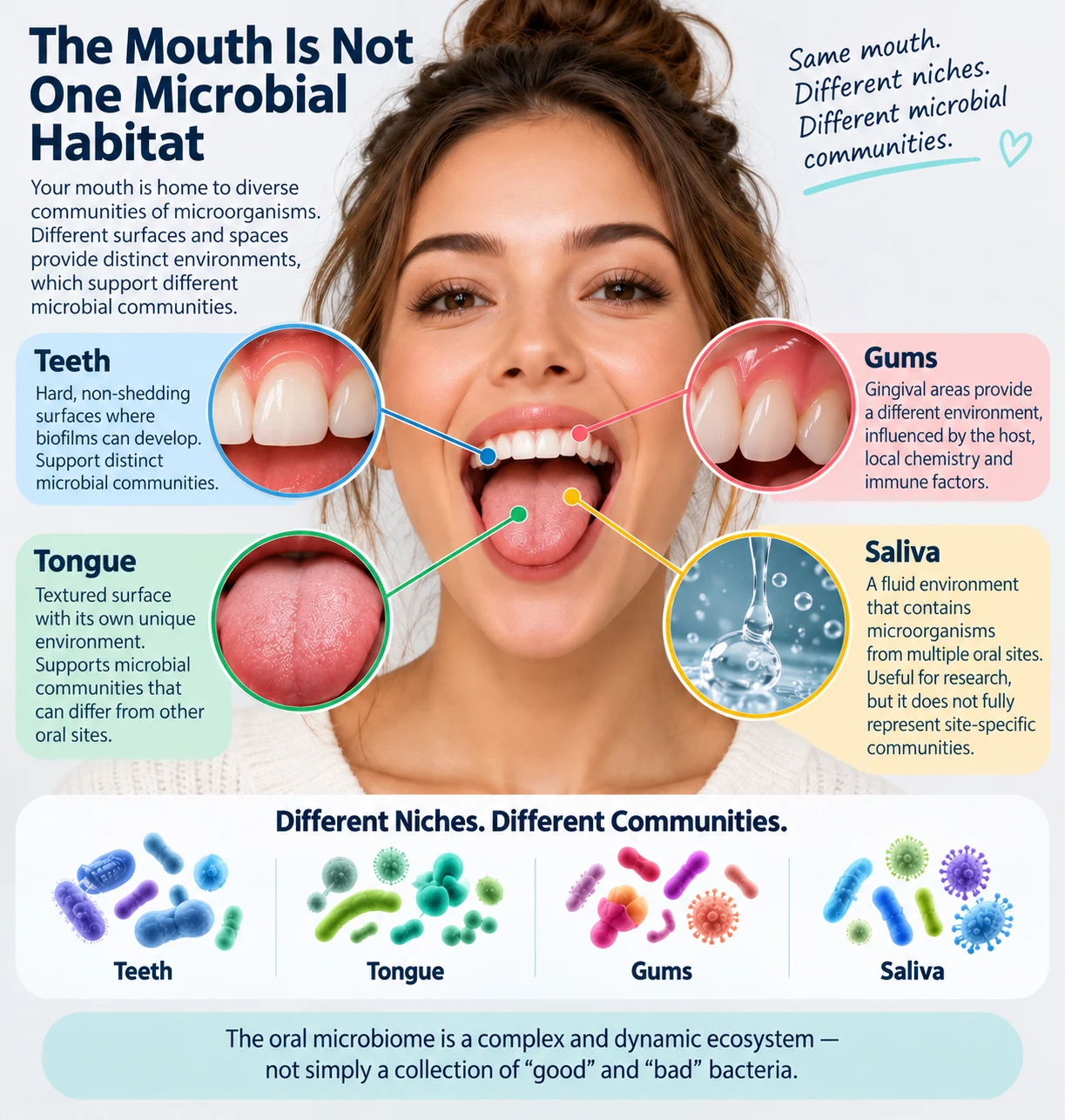
The mouth is not one uniform habitat.
Its surfaces differ in structure, moisture, oxygen exposure, nutrient availability, local chemistry, and other environmental conditions. These differences help create distinct ecological niches for microorganisms. Research comparing oral sites has found substantial site-specific variation in microbial communities.
Teeth, Tongue, Gums, Saliva, and Other Oral Niches
Teeth provide hard, non-shedding surfaces where biofilms can develop.
The tongue has a textured surface that supports its own microbial communities. Areas around the gums provide another environment.
Saliva is commonly used in oral-microbiome research because it is relatively easy to collect and contains microorganisms originating from multiple oral sites. However, it does not provide a complete substitute for site-specific samples such as dental plaque or tongue communities.
These locations are connected, but they are not microbiologically identical.
Why Different Parts of the Mouth Support Different Communities
Microorganisms are influenced by the conditions of the places where they live.
Access to nutrients, oxygen levels, local chemistry, surface characteristics, saliva, and interactions with other organisms can all form part of the ecological environment surrounding oral microbial communities.
For that reason, a saliva sample, a tongue sample, and a dental-plaque sample should not automatically be assumed to represent the same microbial community.
Is the Oral Microbiome Just “Good” and “Bad” Bacteria?
It is tempting to divide oral microorganisms into two teams: beneficial organisms and harmful organisms.
The biology is more complicated.
The significance of a microorganism can depend partly on the larger community and ecological conditions in which it exists. Changes in the surrounding environment can also alter microbial activity, interactions, or relative abundance.
Why That Simple Divide Can Be Misleading
Labeling individual microorganisms as universally “good” or “bad” can obscure the importance of ecological context.
Oral health is related not only to which microorganisms are detected, but also to their interactions with one another, the host, and the environment.
This is why oral-microbiome research often examines microbial communities and their ecological context rather than reducing every change to the presence of a single organism.
Why the Environment Around Microbes Matters
Microbial communities respond to their surroundings.
Variation in oral microbial communities has been studied in relation to factors including age, diet, oral-hygiene practices, saliva, medication exposure, smoking, health status, and characteristics of the sampled oral site.
These relationships should not be interpreted to mean that each factor causes a specific or predictable microbiome change in every person.
Different studies may examine different populations, sampling locations, laboratory methods, and definitions, making direct comparisons difficult.
What Can Influence the Oral Microbiome?
The oral microbiome is dynamic rather than fixed.
Microbial patterns can vary between individuals, between different locations within the same mouth, and under different environmental or host conditions.
Modern sequencing and analytical methods allow researchers to detect differences in microbial composition and diversity that were difficult to characterize using culture methods alone.
Why a Change in the Microbiome Does Not Automatically Mean Harm
Detecting a difference in a microbial community is not the same as demonstrating disease.
Microbial communities naturally vary, and researchers are still working to determine which patterns or changes are clinically meaningful.
This becomes particularly important when words such as “balance” or “healthy microbiome” are used outside research settings.
There is no single universally validated microbiome score that can classify every person's mouth as simply “balanced” or “unbalanced.”
What Does “Dysbiosis” Mean in Oral-Health Research?
Dysbiosis is a term used in microbiome research to describe alterations in microbial communities in relation to disrupted ecological conditions or disease.
However, the term does not have a single universally applied definition or threshold. Its interpretation can vary according to the disease model, microbial measurements, and research context.
It should therefore not be interpreted as a simple diagnosis of having “too many bad bacteria.”
Dysbiosis Is Not a Simple Count of “Bad Bacteria”
Microbial communities contain many interacting organisms.
Changes associated with disease may involve shifts in relative abundance, community structure, microbial activity, environmental conditions, or interactions among microorganisms and the host.
Reducing all of this to a ratio of “good” versus “bad” bacteria creates a misleading impression of what microbiome research can measure and explain.
Association Does Not Automatically Establish Cause
If researchers find different microbial patterns in people with and without a particular oral condition, the finding can demonstrate an association.
It does not automatically establish what caused the difference.
Disease-related environmental changes may affect microbial communities. Microbial changes may participate in disease processes. Multiple factors may also interact.
Determining direction and causality requires evidence beyond observing that two things occur together.
What Is the Oral Microbiome Being Studied For?
Researchers study the oral microbiome to better understand microbial ecology, biofilm development, and differences in microbial communities across oral health and disease states.
Researchers are also investigating how microbiome research might contribute to understanding disease mechanisms and identifying potentially useful biomarkers. These research applications should be distinguished from approaches that have already been clinically validated.
Oral Health and Disease Research
Microbial communities are studied in connection with dental caries, periodontal disease, and other areas of oral-health research.
Researchers also examine how changes in the oral environment and microbial community may occur together during health and disease.
Such studies can contribute to understanding biological mechanisms, but they do not mean that a microbiome result alone can diagnose a dental condition or predict what will happen to an individual.
Appropriate clinical assessment remains necessary for diagnosing oral disease.
What Can the Oral Microbiome Tell Us Today — and What Can’t It Tell Us Yet?
Research has established that the mouth contains diverse microbial communities and that these communities differ across oral habitats and health states.
Modern molecular methods have greatly expanded researchers' ability to characterize this microbial diversity.
What remains much harder is translating that complexity into simple conclusions for an individual person. Recent reviews continue to identify variation in terminology, sampling, methodology, and clinical interpretation across oral-microbiome research.
There is no single universally accepted composition that defines the “perfect” oral microbiome.
A change in microbial composition does not automatically mean disease, and an association between a microbial pattern and a health condition does not by itself prove causation.
Similarly, research involving individual microorganisms, microbial patterns, or interventions should not automatically be translated into claims that a food, mouthwash, probiotic, or dietary supplement can “reset,” “restore,” or “balance” a person's oral microbiome.
For now, the oral microbiome is best understood as a complex and evolving area of research that is improving our understanding of microbial ecology in the mouth while still leaving important questions about clinical interpretation unanswered.
Sources & References
- Guo K, Edwards D. — Interpreting oral microbiome research in clinical dentistry: terminology, limitations and clinical implications (British Dental Journal, 2026)
- Mark Welch JL, et al. — Microbial biogeography and ecology of the mouth and implications for periodontal diseases
- The evolution of plaque hypotheses: The past, present, and future
- Scannapieco FA, Dongari-Bagtzoglou A. — Dysbiosis revisited: a critical assessment of the oral microbiome in gingivitis and periodontitis
- Lamont RJ, Koo H, Hajishengallis G. — The oral microbiota: dynamic communities and host interactions
Published: September 17, 2026 · Last reviewed: September 17, 2026