Plaque and tartar are often mentioned together, but they are not the same thing.
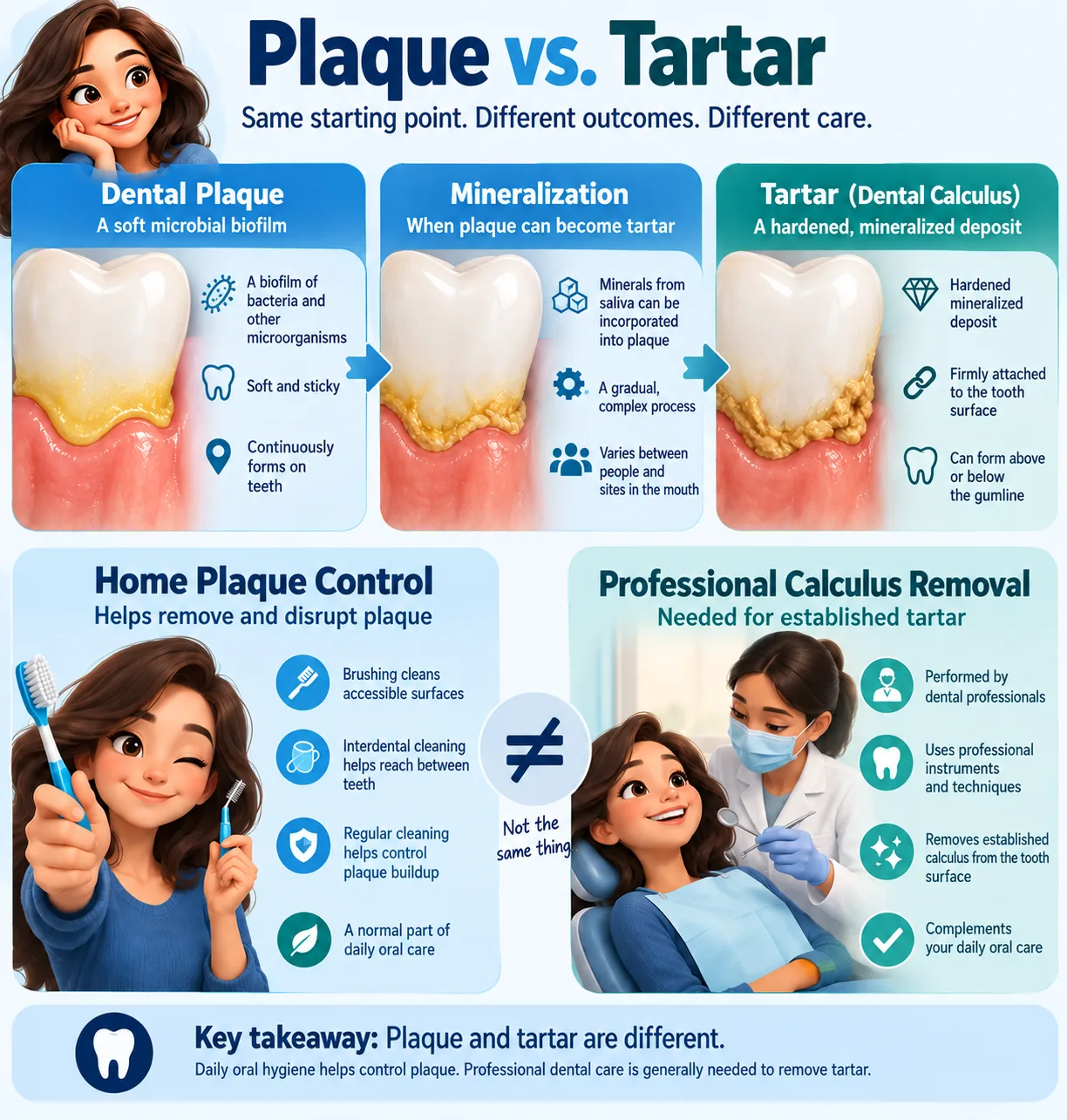
Dental plaque is a soft microbial biofilm that develops on tooth surfaces. Tartar, also called dental calculus, is a mineralized deposit that can develop when plaque remains on the teeth and undergoes mineralization.
That difference matters because plaque and established calculus are not managed in the same way.
Regular brushing and interdental cleaning can help disrupt and remove plaque. Once plaque has mineralized into calculus, routine brushing and interdental cleaning are no longer expected to remove the deposit; professional removal is generally needed.
Understanding how plaque and tartar differ helps explain why daily plaque control and professional calculus removal have different roles in oral care.
What Is Dental Plaque?
Dental plaque is a biofilm that develops on surfaces within the mouth, particularly the teeth.
A biofilm is more than a loose collection of microorganisms. Microorganisms within plaque exist as an organized community embedded in a surrounding matrix that helps the biofilm adhere to a surface.
Plaque can accumulate as microbial communities continue to develop on tooth surfaces between episodes of mechanical cleaning.
Why Plaque Is Considered a Biofilm
Calling plaque a biofilm emphasizes that its microorganisms live within a structured community rather than existing independently.
The biofilm contains microorganisms, microbial products, and a surrounding extracellular matrix. Its composition and activity can vary according to location and environmental conditions.
Plaque is therefore not the same thing as the entire oral microbiome. It is one form of microbial community within the larger oral ecosystem.
What Is Tartar — and Is It the Same as Dental Calculus?
Tartar and dental calculus refer to the same mineralized dental deposit.
“Tartar” is the term commonly used in everyday language, while “calculus” is widely used in dentistry and scientific literature.
Calculus develops when dental plaque undergoes mineralization. Minerals present in oral fluids can become incorporated into the plaque biofilm, creating a harder deposit attached to the tooth surface.
What Changes When Plaque Becomes Mineralized
Mineralization changes the physical characteristics of the deposit.
Soft plaque can be disrupted mechanically through routine oral-hygiene practices. Mineralized calculus is harder and more firmly attached to the tooth surface.
This is why plaque control and calculus removal should not be treated as interchangeable tasks.
Why Tartar Is Different From Soft Plaque
The difference is not simply that tartar is “older plaque.”
Calculus is plaque that has undergone mineralization, changing its structure and physical properties.
That distinction helps explain what happens next.
How Does Plaque Become Tartar?
Calculus formation involves the mineralization of dental plaque.
As plaque remains on a tooth surface, minerals available in the oral environment can precipitate within the biofilm. Mineral crystals can form as the deposit becomes increasingly calcified.
The process is more complex than plaque simply “drying out” or becoming hard because it has been left alone.
The Role of Minerals in Calculus Formation
Calcium and phosphate are among the minerals involved in the formation of dental calculus.
These minerals are present in oral fluids and can become incorporated into plaque during mineralization.
The resulting deposit contains mineralized material as well as microbial components.
Calculus can form above or below the gumline.
Why There Is No Single “Plaque-to-Tartar” Timeline
It is common to see precise timelines describing how quickly plaque becomes tartar.
In reality, calculus formation is not identical in every person or at every site in the mouth.
The rate and extent of mineralization can vary according to local oral conditions, plaque accumulation, mineral availability, saliva, and other individual or site-specific factors.
For that reason, a fixed number of hours should not be interpreted as a universal countdown after which all plaque suddenly becomes tartar.
The practical point is simpler: regular plaque control helps limit the opportunity for persistent plaque deposits to become mineralized.
Plaque vs. Tartar: What’s the Practical Difference?
Plaque and tartar differ in consistency, attachment to the tooth surface, and how they are managed.
Plaque is generally soft and can be disrupted by mechanical cleaning.
Calculus is mineralized and adheres much more firmly.
That physical difference is more useful than relying only on appearance.
Appearance and Texture Are Not the Whole Story
People sometimes try to distinguish plaque and tartar by color alone.
That can be unreliable.
Dental deposits may vary in appearance depending on location, staining, thickness, and other factors. A visual impression alone does not necessarily establish exactly what a deposit is.
The more important biological distinction is whether the deposit remains primarily a soft biofilm or has undergone mineralization.
Why the Difference Matters for Removal
The distinction between plaque and calculus changes what routine home care can reasonably accomplish.
Mechanical plaque control is part of everyday oral hygiene.
Established calculus is different. Because it is mineralized and firmly attached, routine brushing or interdental cleaning should not be expected to remove it in the same way they can disrupt soft plaque.
That is why the question “Can I remove it at home?” depends first on what type of deposit is actually present.
Can You Remove Plaque at Home?
Routine home oral care is designed in part to disrupt and remove dental plaque.
Brushing cleans accessible tooth surfaces, while interdental cleaning helps reach areas between teeth that a toothbrush may not clean effectively.
Because dental biofilm continually develops on tooth surfaces, plaque control is an ongoing process rather than a one-time task.
Brushing and Interdental Cleaning Help Control Plaque
Regular mechanical cleaning interferes with plaque accumulation.
Brushing and interdental cleaning therefore have complementary roles in plaque control.
The goal is not to sterilize the mouth or eliminate its microbiome. Microbial communities are a normal part of the oral environment.
Instead, oral hygiene helps manage biofilm accumulation on tooth surfaces.
Why Plaque Control Does Not Mean a Mouth Can Be Completely Plaque-Free
Plaque control is not the same as permanently eliminating microbial communities from the mouth.
Oral biofilms continually develop, which is why oral hygiene is an ongoing process.
For this reason, phrases such as “remove all bacteria” or “eliminate plaque permanently” do not accurately describe what routine oral hygiene can accomplish.
Can You Remove Tartar at Home?
Established dental calculus is not managed in the same way as soft plaque.
Once a deposit has mineralized and become firmly attached to the tooth surface, ordinary brushing and interdental cleaning are no longer expected to remove it.
Professional dental instruments and techniques are used to remove established calculus.
Why Established Calculus May Require Professional Removal
Calculus may be located in areas that are difficult to see or access at home, including areas around or below the gumline.
Dental professionals can evaluate where deposits are located and use appropriate instruments and techniques to remove them in a clinical setting.
This is different from routine plaque control performed at home.
Why Scraping Tartar Yourself Is Not a Good Substitute for Dental Care
Trying to reproduce professional scaling with home instruments is not equivalent to professional calculus removal and is not recommended as a substitute for dental care.
Professional calculus removal involves more than simply seeing a hardened deposit and scraping it away. The location and nature of the deposit need to be considered as part of appropriate dental care.
Home plaque control and professional calculus removal should therefore be treated as different parts of oral care rather than interchangeable approaches.
Why Do Plaque and Tartar Matter for Gum Health?
Accumulation of dental plaque is associated with gingival inflammation.
Calculus can also provide a surface on which non-mineralized biofilm accumulates.
Calculus is clinically relevant in periodontal care, but its role should not be reduced to a simple one-factor explanation of periodontal disease.
This article focuses on the distinction between plaque and calculus rather than attempting to diagnose or explain periodontal disease in an individual.
When Does Tartar Need Professional Removal?
When mineralized calculus is present, professional dental care provides the appropriate setting for evaluating and removing the deposit.
Routine brushing and interdental cleaning remain important for plaque control, but they do not substitute for professional removal of established calculus.
Understanding that difference makes the relationship between daily oral hygiene and professional dental care clearer.
Sources & References
- National Institute of Dental and Craniofacial Research (NIDCR) — Ask the Expert: Gum Disease
- American Dental Association — Floss/Interdental Cleaners
- Akcalı A, Lang NP. — Dental calculus: the calcified biofilm and its role in disease development
- Jin Y, Yip HK. — Supragingival calculus: formation and control
- Harrel SK, Yoshimura A, Cobb CM. — Re-evaluating the role of subgingival calculus in periodontal disease (2025)
Published: September 17, 2026 · Last reviewed: September 17, 2026