Tooth enamel may look solid and unchanging, but its mineral surface is continually exposed to conditions in the mouth that can favor either mineral loss or mineral gain.
These processes are known as demineralization and remineralization.
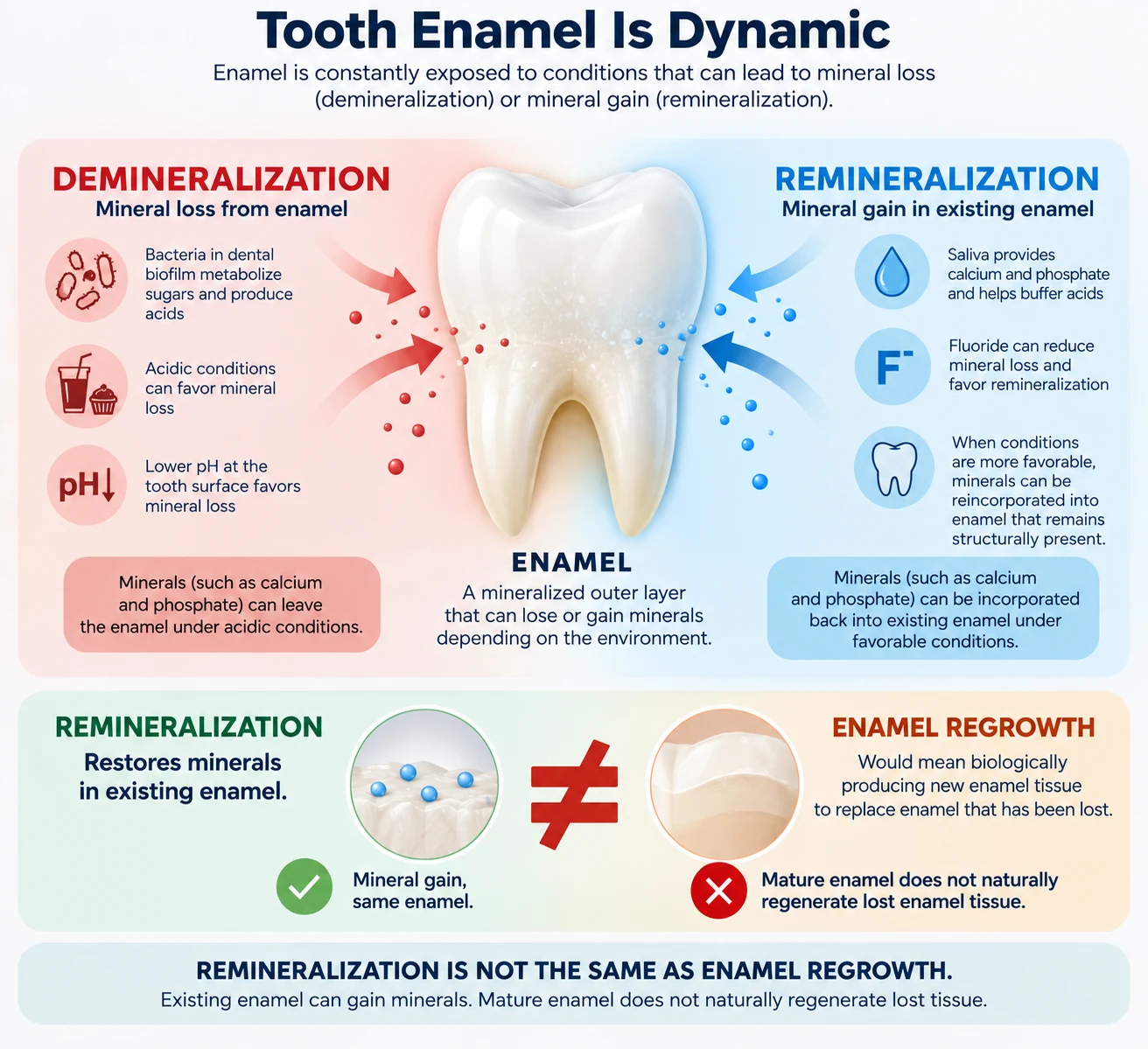
Demineralization occurs when minerals are lost from enamel. Remineralization involves minerals being incorporated back into existing enamel under favorable conditions.
The two processes are closely related, but understanding them requires an important distinction: remineralizing existing enamel is not the same as growing new enamel after tooth structure has been lost.
That distinction helps explain what enamel can — and cannot — do.
What Is Tooth Enamel Demineralization?
Tooth enamel is the highly mineralized outer covering of the visible part of a tooth.
Although enamel is extremely hard, its mineral structure can be affected by changes in the environment around the tooth.
When conditions at the tooth surface favor mineral loss, minerals can leave the enamel. This process is called demineralization.
Acidic conditions can promote this mineral loss, including conditions that develop when microorganisms in dental biofilm metabolize fermentable carbohydrates and produce acids.
But demineralization should not be understood as a single event or as something that automatically means a tooth has developed a cavity.
What Happens When Enamel Loses Minerals
Enamel contains mineral crystals composed largely of calcium and phosphate.
During demineralization, acidic conditions can alter the equilibrium around these crystals and favor the movement of mineral components away from the enamel.
At an early stage, this can occur beneath a surface that is still physically present.
The amount and significance of mineral loss depend on the conditions at the tooth surface and how those conditions change over time.
Why Demineralization Is Not the Same as a Cavity
Demineralization describes a mineral process.
A cavity involves established structural breakdown of the tooth.
Those concepts are related in dental-caries biology, but they are not interchangeable.
Early mineral changes can occur before a surface has become cavitated. A cavitated lesion represents a different structural situation.
For that reason, saying that enamel has undergone some demineralization is not the same as saying that a person has a cavity.
What Is Tooth Enamel Remineralization?
Remineralization is the process through which minerals can be incorporated into previously demineralized areas of existing enamel.
When conditions become more favorable, calcium, phosphate, and other components of the oral environment can participate in mineral deposition within enamel.
This means enamel is not simply undergoing continuous mineral loss.
Demineralization and remineralization can occur at different times as conditions at the tooth surface change.
How Minerals Can Be Reincorporated Into Existing Enamel
Saliva contributes to the mineral environment surrounding the teeth and contains calcium and phosphate.
When oral conditions favor mineral gain rather than loss, these minerals can participate in remineralization of enamel that remains structurally present.
The process involves chemistry at and beneath the enamel surface and should not be reduced to the idea that minerals simply form a new outer layer of tooth.
Why Remineralization Does Not Mean Enamel Regeneration
This distinction is central.
Those are not the same process.
Mature erupted enamel does not retain the enamel-forming cells responsible for producing it during tooth development.
Remineralization therefore should not be interpreted as evidence that lost enamel structure can simply grow back.
Demineralization vs. Remineralization: How Do They Relate?
Demineralization and remineralization are opposing parts of a dynamic mineral process at the tooth surface.
Conditions can shift between favoring mineral loss and favoring mineral gain.
This helps explain why enamel biology cannot be described accurately as a one-way process in which mineral loss begins and then inevitably continues.
Why Enamel Is Exposed to Both Processes
The environment around a tooth changes throughout the day.
Dental biofilm activity, food and drink exposure, saliva, pH, mineral availability, and oral-hygiene practices can all form part of that changing environment.
During periods when conditions favor mineral dissolution, demineralization can occur.
When conditions become more favorable to mineral deposition, remineralization can occur.
Why the Balance Can Change Over Time
The relative amount of mineral loss and mineral gain is influenced by multiple interacting factors.
It is therefore misleading to imagine a fixed switch that places a tooth permanently into either “demineralization mode” or “remineralization mode.”
Researchers instead describe a dynamic relationship in which the conditions surrounding the tooth influence the direction of mineral exchange.
That dynamic relationship is also why a single food, drink, or moment does not by itself describe the long-term mineral state of a person's enamel.
What Role Does Saliva Play in Enamel Remineralization?
Saliva is an important part of the environment surrounding the teeth.
Among its functions, saliva helps buffer acids and provides minerals that can participate in remineralization.
Its role is therefore relevant to understanding why conditions at the enamel surface can change after periods that favor mineral loss.
Calcium, Phosphate, and the Oral Environment
Calcium and phosphate are important components of enamel mineral.
They are also present in saliva and other oral fluids.
Under appropriate conditions, mineral ions available in the oral environment can contribute to mineral deposition in areas of enamel that have undergone demineralization.
This mineral exchange is part of the demineralization–remineralization process.
Why Saliva Is Only Part of the Process
It would be an oversimplification to say that saliva simply “rebuilds teeth.”
Remineralization depends on the chemical and biological environment at the tooth surface, including pH and mineral availability.
Dental biofilm, dietary exposures, fluoride exposure, saliva, and other local conditions can interact with that environment.
Saliva therefore contributes to remineralization without functioning as a mechanism for regenerating missing tooth structure.
What Role Does Fluoride Play?
Fluoride is well established in dental research because of its relationship with enamel mineral dynamics and dental caries.
At the tooth surface, fluoride can influence the balance between demineralization and remineralization.
Its effects should nevertheless be described as part of this mineral process rather than as the creation of new enamel tissue.
Fluoride and the Demineralization–Remineralization Process
When fluoride is available in the oral environment, it can reduce mineral loss under acidic conditions and favor remineralization of demineralized enamel.
These mechanisms help explain why fluoride is used in established approaches to dental-caries prevention.
Why Fluoride Does Not Make Lost Enamel Grow Back
The ability to support remineralization does not mean fluoride can regenerate enamel that has been physically lost.
Fluoride acts within the mineral dynamics of enamel that remains available for remineralization.
Supporting remineralization is not the same as restoring the biological machinery that originally formed enamel.
This is another reason why the words remineralization and regeneration should not be used interchangeably.
Can Tooth Enamel Remineralize?
Yes — existing enamel can undergo remineralization.
That statement, however, needs boundaries.
Remineralization is most relevant when mineral has been lost but enamel structure remains available for mineral deposition.
It does not mean every form of tooth damage can be reversed, nor does it mean a person can determine from appearance alone whether a particular area of enamel is successfully remineralizing.
The biological possibility of remineralization should therefore be distinguished from a prediction about what will happen to an individual tooth.
Can Tooth Enamel Grow Back?
Not in the ordinary biological sense of regrowing tissue that has been lost.
Enamel is produced during tooth development by specialized cells called ameloblasts.
After enamel formation is complete and the tooth erupts, those enamel-forming cells are no longer present on the tooth surface.
Mature enamel does not naturally regenerate lost enamel tissue.
Remineralization and Regeneration Are Not the Same Thing
The confusion often comes from using phrases such as “repair enamel” without defining what “repair” means.
If the phrase refers to increasing mineral content in demineralized enamel that remains structurally present, it may describe remineralization.
If it means biologically replacing missing enamel and recreating lost tooth structure, that is a different claim.
Remineralization should not be used as evidence for the second meaning.
Why Mature Enamel Has Limited Biological Regenerative Capacity
Unlike tissues that retain living cells capable of producing replacement tissue, mature enamel does not contain the cellular machinery that originally formed it.
This makes enamel biologically unusual.
Research continues to investigate materials and technologies intended to mimic, restore, or regenerate aspects of dental tissues, but experimental approaches should not be confused with the natural remineralization of existing enamel.
When Is Remineralization No Longer the Whole Story?
The concept of remineralization is particularly useful when discussing mineral changes in enamel that remains structurally present.
Once there is established structural loss, however, the situation is different.
A cavitated lesion is not simply a patch of enamel waiting to absorb enough minerals to rebuild the missing anatomy.
Clinical assessment is needed to determine the nature and extent of tooth changes and what management is appropriate.
This distinction also protects an important boundary: demineralization is part of dental-caries biology, but demineralization and a cavity are not synonymous.
The broader development, diagnosis, and management of dental caries involve additional questions beyond the mineral process discussed here.
What Can Enamel Remineralization Tell Us — and What Can’t It Tell Us Yet?
Enamel remineralization demonstrates that mineral loss at the tooth surface is not necessarily a one-way chemical process.
Existing enamel can gain minerals when conditions favor mineral deposition.
That does not mean enamel has unlimited regenerative capacity.
It also does not mean that every visible change on a tooth represents demineralization, that every early mineral change will progress to a cavity, or that a person can determine the mineral status of enamel simply by looking at it.
And evidence that a mineral, compound, or intervention participates in remineralization should not automatically be translated into a claim that a particular product can “rebuild enamel” or regenerate lost tooth structure.
The most useful distinction is therefore straightforward:
Keeping those concepts separate makes it easier to understand both the real capacity of enamel to undergo mineral change and the important limits of that capacity.
Sources & References
- National Institute of Dental and Craniofacial Research (NIDCR) — Tooth Decay
- NIDCR — The Tooth Decay Process: How to Reverse It and Avoid a Cavity
- American Dental Association — Caries Risk Assessment and Management
- NIDCR — Fluoride
- PubMed — Review of ameloblast biology and enamel formation (2024)
- PubMed — Review of enamel regeneration strategies and translational challenges (2025)
Published: September 17, 2026 · Last reviewed: September 17, 2026