Feeling Less Physically Strong During Midlife: What Women May Notice and What May Be Related
Feeling less physically strong can become noticeable during midlife. A woman may feel that she is not as strong as she used to be, even when she cannot point to a single reason for the change.
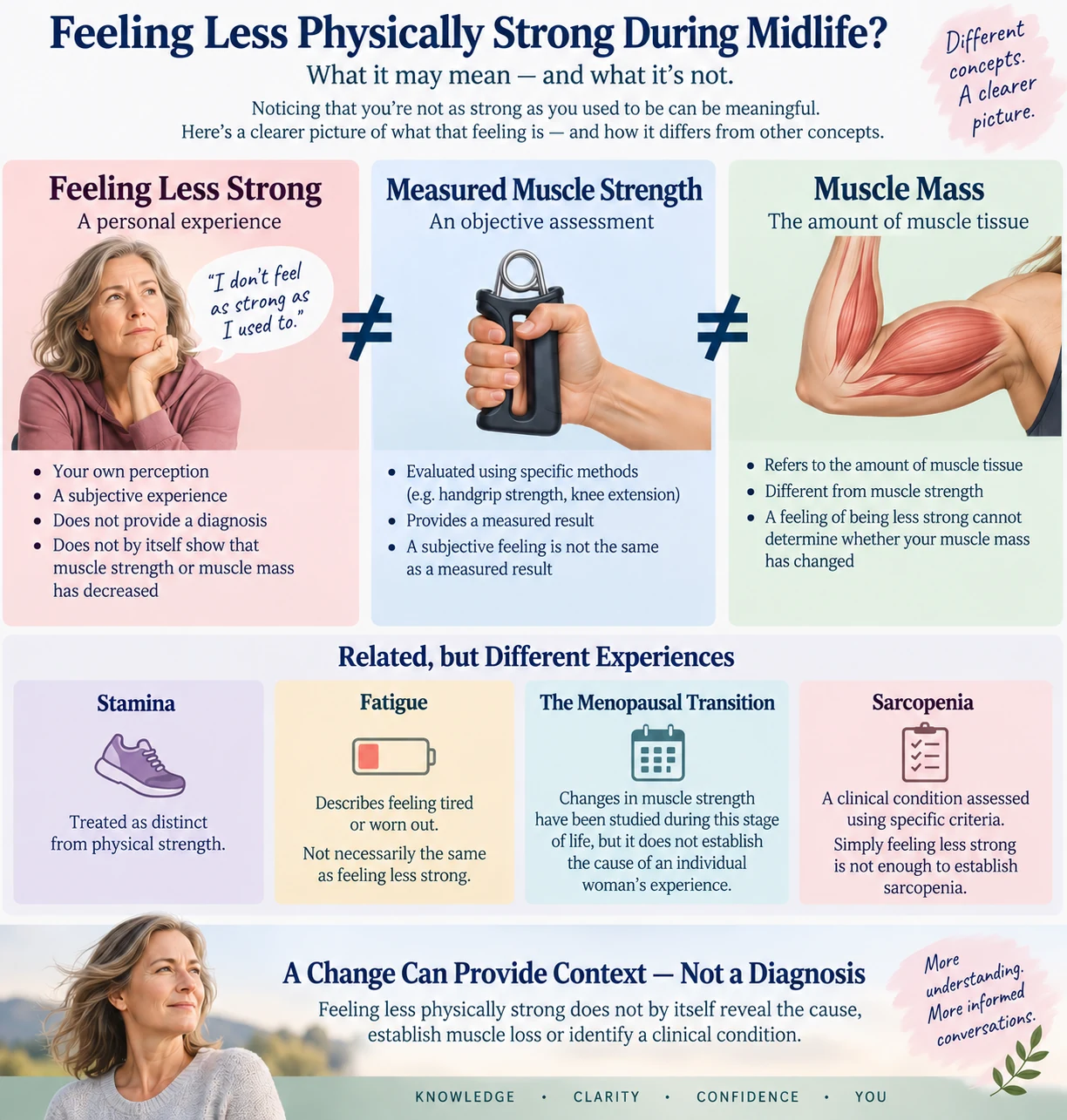
That experience can be meaningful, but it does not provide a diagnosis. Feeling less strong is not the same as demonstrating low muscle strength on an objective measurement, and it does not by itself establish that muscle mass has decreased or that a condition such as sarcopenia is present.
Physical strength can be considered alongside many aspects of health and daily life. The timing of a change may provide useful context, but noticing it during midlife does not establish why it is happening.
What Does Feeling Less Physically Strong Mean?
Feeling less physically strong describes a woman's perception that her physical strength has changed.
She may notice that she does not feel as strong as she remembers feeling before. This is a subjective experience rather than an objective measurement of muscle strength.
The distinction matters because a person's perception of strength and a measured result are not interchangeable. Feeling less strong can be useful information to describe, but the experience alone cannot determine whether muscle strength is objectively low or why a change has occurred.
A Change in Physical Strength May Be Noticed During Midlife
A woman may notice during midlife that she does not feel as physically strong as she once did.
The timing provides context, but it does not establish a cause. A change noticed during midlife should not automatically be attributed to age, the menopausal transition or any other single circumstance.
Why Midlife Does Not Point to a Single Explanation
Physical strength can be influenced by different circumstances, and more than one circumstance may be relevant at the same time.
For this reason, noticing a change during midlife cannot identify its explanation on its own. The fact that two changes occur during the same period does not mean that one necessarily caused the other.
Understanding when a woman began to feel less strong may provide useful context, but timing alone cannot determine why the change occurred.
How the Menopausal Transition May Be Related to Physical Strength
Objective measures of muscle strength have been studied across the menopausal transition. Longitudinal research has reported small changes in specific measures of muscle strength as women moved from perimenopause to postmenopause.
These findings show that physical strength is a relevant area of research during this stage of life. They do not establish that the menopausal transition caused a particular woman's change in strength.
The timing of the menopausal transition should therefore not be used as a shortcut to conclude that declining estrogen or another reproductive hormone explains why an individual woman feels less strong.
Feeling Less Strong and Measured Muscle Strength Are Not the Same Thing
A woman can describe feeling less physically strong without having undergone any objective measurement of muscle strength.
In research and clinical settings, muscle strength can be evaluated using specific methods. Handgrip strength and measures involving knee extension are examples that have been used in research.
These measurements provide information that a subjective impression alone cannot provide. A woman's perception that she feels less strong remains a description of her experience rather than an objective measurement.
The important distinction is that perceived strength and measured muscle strength provide different kinds of information. One should not automatically be substituted for the other.
Physical Strength and Muscle Mass Are Not the Same Thing
Muscle strength and muscle mass are related concepts, but they are not interchangeable.
Muscle strength concerns the ability of muscles to produce force. Muscle mass refers to the amount of muscle tissue.
A woman who feels less strong cannot determine from that experience alone whether her muscle mass has changed. Likewise, a change in muscle mass should not automatically be inferred from a change in perceived or measured strength.
Keeping these concepts separate helps avoid turning a general physical experience into a conclusion that the available information does not support.
Physical Strength, Stamina and Fatigue Describe Different Experiences
Physical strength, stamina and fatigue can sometimes be discussed together, but they describe different experiences.
Feeling less physically strong is not necessarily the same as becoming tired or worn out. Fatigue and lack of energy describe experiences that should not automatically be interpreted as a loss of physical strength.
Stamina is also treated as distinct from physical strength in symptom measures used in research involving women during the menopausal transition.
These experiences may coexist, but one does not automatically establish the presence or cause of another. Separating them helps describe more precisely what a woman has actually noticed.
What Does “Sarcopenia” Mean?
Sarcopenia is a skeletal muscle disorder assessed using specific clinical criteria. Under the EWGSOP2 framework, low muscle strength is used to identify probable sarcopenia, while additional evidence of low muscle quantity or quality is used to confirm it. Physical performance is considered separately when determining severity.
Simply feeling less strong is therefore not enough to establish sarcopenia.
Even when low muscle strength is found on objective assessment, that finding alone does not confirm sarcopenia under this framework.
For a woman who has noticed that she feels less strong during midlife, the term should therefore not be used as an automatic explanation for the experience.
Why Feeling Less Strong Cannot Tell You the Cause
Feeling less strong describes an experience. It does not identify the reason for that experience.
Different circumstances may be relevant to physical strength, and their importance can differ from one woman to another. Several circumstances may also overlap.
For that reason, neither the feeling itself nor its timing during midlife can determine an individual cause.
Different Circumstances May Be Relevant to Physical Strength
Changes in physical strength can occur in different contexts.
Considering those contexts may help provide a fuller picture of what a woman has noticed, but the presence of a particular circumstance does not prove that it caused the change.
Physical Activity May Provide Relevant Context
Physical activity may provide relevant context when considering physical strength.
Research examining women across the menopausal transition has also considered physical activity in relation to measures of strength and physical performance. These relationships do not establish why an individual woman feels less strong.
A change in physical strength should therefore not automatically be attributed to being more or less physically active, and general observations about physical activity are not a substitute for an individual assessment.
Individual Health Circumstances May Also Be Relevant
A woman's broader health circumstances may provide additional context when she notices a change in physical strength.
That broader context may be relevant when considering the change, but feeling less strong cannot distinguish among possible explanations on its own.
The presence of another health circumstance also does not automatically mean that it is responsible for the change.
When Is It Worth Discussing a Change in Physical Strength With a Healthcare Professional?
A woman who notices a change in physical strength may choose to discuss what she has noticed with a healthcare professional, particularly when she is concerned about the change or wants help understanding its context.
The purpose of an individual evaluation is not to assume that midlife or the menopausal transition explains the change. A healthcare professional can consider the broader context and determine whether further evaluation is appropriate.
Feeling less physically strong during midlife can be a useful change to notice and describe. It does not, on its own, reveal the cause, establish a loss of muscle mass or identify a clinical condition.