Hot Flashes During Midlife: What Women May Notice and What May Be Related
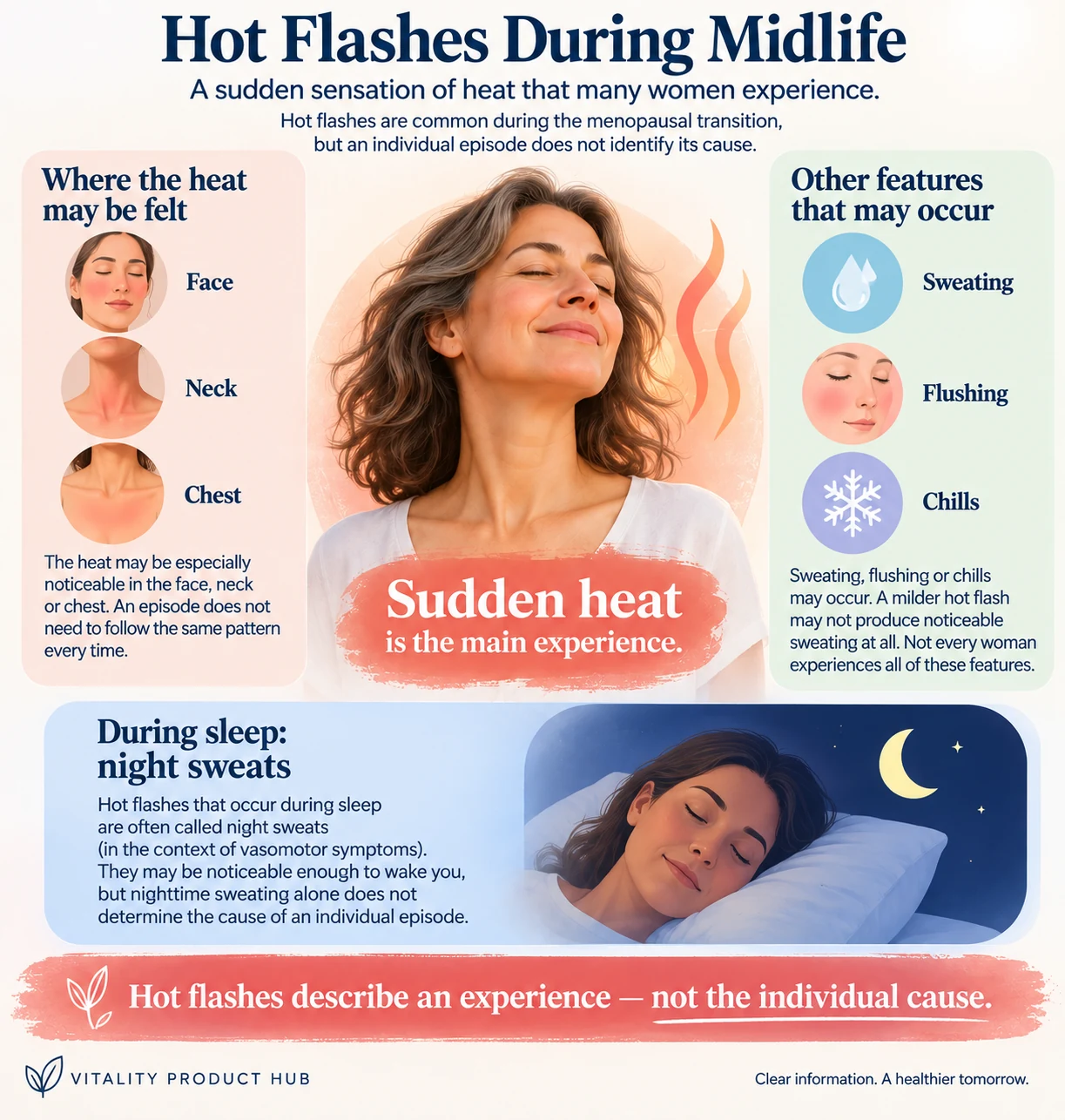
During midlife, some women begin to notice sudden episodes of heat. The sensation may be especially noticeable in the face, neck or chest and may sometimes be accompanied by sweating, flushing, chills or other sensations.
These episodes are commonly called hot flashes.
Because hot flashes are common during the menopausal transition, experiencing them during midlife can naturally raise questions about perimenopause and menopause. But noticing an episode of sudden heat does not identify why that individual episode occurred.
Hot flashes describe episodes of sudden heat; the experience itself does not identify the individual cause.
Understanding what a hot flash may feel like and the different ways it can appear can provide useful context without turning the experience into a diagnosis.
What Does a Hot Flash Feel Like?
A hot flash is often described as a sudden sensation of heat that may be particularly noticeable in the upper body.
Some women notice warmth in the face, neck or chest. The skin may become flushed, and sweating may occur. Some women may also experience chills as the sensation of heat passes.
Not every hot flash feels the same, and not every woman experiences all of these features.
An episode may be mild for one woman and more noticeable for another. Even in the same woman, individual episodes may not always feel identical.
For this reason, the presence or absence of one particular feature does not provide the individual explanation for the episode.
Hot Flashes Can Become More Noticeable During Midlife
Hot flashes may occur during midlife, including during the menopausal transition.
A woman may notice sudden episodes of heat, and the episodes may vary in how often or how strongly they are felt.
Because hot flashes are widely associated with the menopausal transition, it can be tempting to interpret a new episode of heat as proof that perimenopause has begun.
The timing alone cannot provide that conclusion.
Hot flashes are common during the menopausal transition, but experiencing one during midlife does not by itself establish that perimenopause or menopause caused the episode.
Midlife provides relevant context. It does not identify the cause of an individual episode.
Why Midlife Does Not Identify the Cause of an Episode
A symptom occurring during midlife and a symptom being caused by midlife are not the same thing.
The menopausal transition can be an important part of the context when hot flashes occur. At the same time, the woman's age or life stage alone cannot establish why a particular episode of heat or sweating happened.
Medication use and some health conditions may also be relevant when episodes of heat or sweating occur.
Their presence does not establish the explanation either.
This distinction allows the experience to be described accurately without assuming that its timing provides the diagnosis.
How the Menopausal Transition May Be Related to Hot Flashes
Hot flashes are common during the menopausal transition and are often discussed as one of its characteristic experiences.
Changes in hormone levels are thought to play a role in hot flashes during the menopausal transition.
That relationship, however, does not mean that every episode of heat or sweating during midlife has the same explanation.
A woman cannot determine the cause of an individual episode simply because it occurred during a stage of life when hot flashes are common.
The menopausal transition can therefore provide meaningful context without providing an individual diagnosis.
Hot Flashes Can Feel Different From One Woman to Another
There is no single hot-flash experience that every woman follows.
The location and intensity of the heat can differ. Sweating or flushing may occur in some episodes, while other episodes may feel less intense.
Some women may notice additional sensations during or around an episode.
These differences can help describe the experience, but they should not be used as a checklist for determining its cause.
Heat May Be Felt in the Face, Neck or Chest
The sensation of heat may be especially noticeable in the face, neck or chest.
For some women, the feeling may seem to spread across part of the upper body.
These locations are commonly described with hot flashes, but an individual episode does not need to follow an identical pattern every time.
Where the heat is felt can help a woman describe the episode without determining why it occurred.
Sweating or Flushing May Occur
Sweating may accompany the sensation of heat, and the skin may sometimes appear flushed.
The amount of sweating can vary. A milder hot flash may not produce noticeable sweating at all.
For this reason, sweating is not required for every episode to feel like a hot flash, and sweating by itself does not identify the cause of an episode.
Flushing provides another descriptive feature rather than an individual diagnosis.
Chills May Follow the Feeling of Heat
Some women notice chills or a feeling of cold as a hot flash passes.
This does not mean that every hot flash follows a fixed sequence from heat to sweating to chills.
An episode may include some of these sensations and not others.
The presence of chills can therefore help describe what a woman experienced without determining the cause.
Some Women May Notice a Rapid Heartbeat or Feelings of Unease
Some women report a rapid heartbeat or feelings of unease around a hot flash.
These experiences can occur alongside the episode, but their presence does not establish how the symptoms are related in an individual woman.
A rapid heartbeat during an episode should not automatically be interpreted as proof that the hot flash caused an individual woman's palpitations.
Likewise, feelings of unease or anxiety occurring around the same time do not establish that anxiety caused the hot flash or that the hot flash caused the anxiety.
The experiences can occur together without allowing their individual relationship to be determined from timing alone.
Hot Flashes Can Vary in Intensity, Frequency and Duration
Hot flashes do not occur with the same intensity, frequency or duration in every woman.
Some episodes may be mild, while others may feel more disruptive. Some women experience them more frequently than others, and the pattern can change over time.
Individual episodes are usually brief, although their duration can vary.
There is no single number of episodes, level of intensity or duration that every woman must experience.
These characteristics can help describe a woman's pattern, but they should not be used as a home test for determining why the episodes are occurring.
What Are Night Sweats?
Hot flashes can also occur during sleep.
When hot flashes occur during sleep, they are often called night sweats.
A woman may notice heat and sweating during the night, and an episode may sometimes interrupt sleep.
The relationship between hot flashes and night sweats does not mean that every episode of nighttime sweating has the same explanation.
Nighttime sweating alone does not determine the cause of an individual episode.
Hot Flashes During Sleep Are Often Called Night Sweats
In the context of vasomotor symptoms, hot flashes that occur during sleep are often called night sweats.
The heat may be accompanied by sweating and may be noticeable enough to wake a woman.
This describes how a hot flash can appear at night. It does not mean that nighttime sweating by itself establishes that an individual woman experienced a menopausal hot flash.
The circumstances surrounding the episode still matter.
Night Sweats May Disrupt Sleep
A night sweat may interrupt sleep or contribute to nighttime awakening.
That relationship does not mean that every sleep problem during midlife is caused by night sweats.
A woman may experience both sleep disruption and episodes of nighttime heat or sweating, but the presence of one does not establish the individual explanation for the other.
W27 describes the heat and sweating episode. It does not diagnose the cause of nighttime awakening or sleep disturbance.
What Does “Vasomotor Symptoms” Mean?
Hot flashes and night sweats are commonly grouped clinically under the term vasomotor symptoms, sometimes abbreviated as VMS.
The term provides a clinical way to describe these related experiences.
It does not mean that a woman needs to use clinical terminology to describe what she notices, and it does not identify why an individual episode occurred.
For W27, the woman's experience remains the starting point: sudden heat, with or without accompanying sweating or other sensations.
Why Heat or Sweating Alone Cannot Tell You the Cause
A woman can accurately recognize that she suddenly felt hot or began sweating without being able to determine why.
Sudden heat during midlife does not by itself establish perimenopause.
Sweating does not establish the cause of an episode.
Nighttime sweating does not by itself establish that a menopausal hot flash occurred.
And the presence of flushing, chills, a rapid heartbeat or feelings of unease does not turn the episode into a diagnosis.
Different circumstances may be relevant to episodes of heat or sweating, and their relevance depends on the individual situation.
Recognizing what happened and determining why it happened are two different things.
Different Circumstances May Be Relevant to Episodes of Heat or Sweating
The menopausal transition can provide important context for hot flashes during midlife.
It is not the only information that may matter when a woman experiences episodes of heat or sweating.
Medication use, broader health circumstances and other information about the episode may also provide relevant context.
Considering these circumstances does not mean selecting one of them as the cause.
It means avoiding the assumption that a symptom can explain itself.
Medications and Individual Health Circumstances May Provide Context
Medication use and some health conditions may also be relevant when episodes of heat or sweating occur.
The presence of a medication or health condition does not prove that it caused the episode.
Likewise, matching an experience to a list of possible explanations cannot determine the cause for an individual woman.
Medication history, other symptoms, the pattern of the episodes and broader health history may provide useful context when appropriate.
The goal is to understand the situation more completely rather than diagnose the cause from the sensation of heat or sweating alone.
When Is It Worth Discussing Hot Flashes With a Healthcare Professional?
Hot flashes that interfere with daily activities or sleep may be worth discussing with a healthcare professional.
Describing the episodes can provide useful context: when they occur, how often they happen, how long they seem to last, whether sweating or flushing occurs, whether they happen during sleep and whether other sensations appear around the same time.
Medication use and relevant health history may also provide useful context.
A healthcare professional can consider the pattern together with the woman's individual circumstances and decide whether further evaluation is appropriate.
W27 does not diagnose perimenopause, menopause or another condition, determine the cause of an individual episode of heat or sweating, or decide which test or treatment a woman needs.
Hot flashes describe episodes of sudden heat; the experience itself does not identify the individual cause.
Midlife provides context — it does not provide the diagnosis.