Period Changes During Midlife: What Women May Notice and What May Be Related
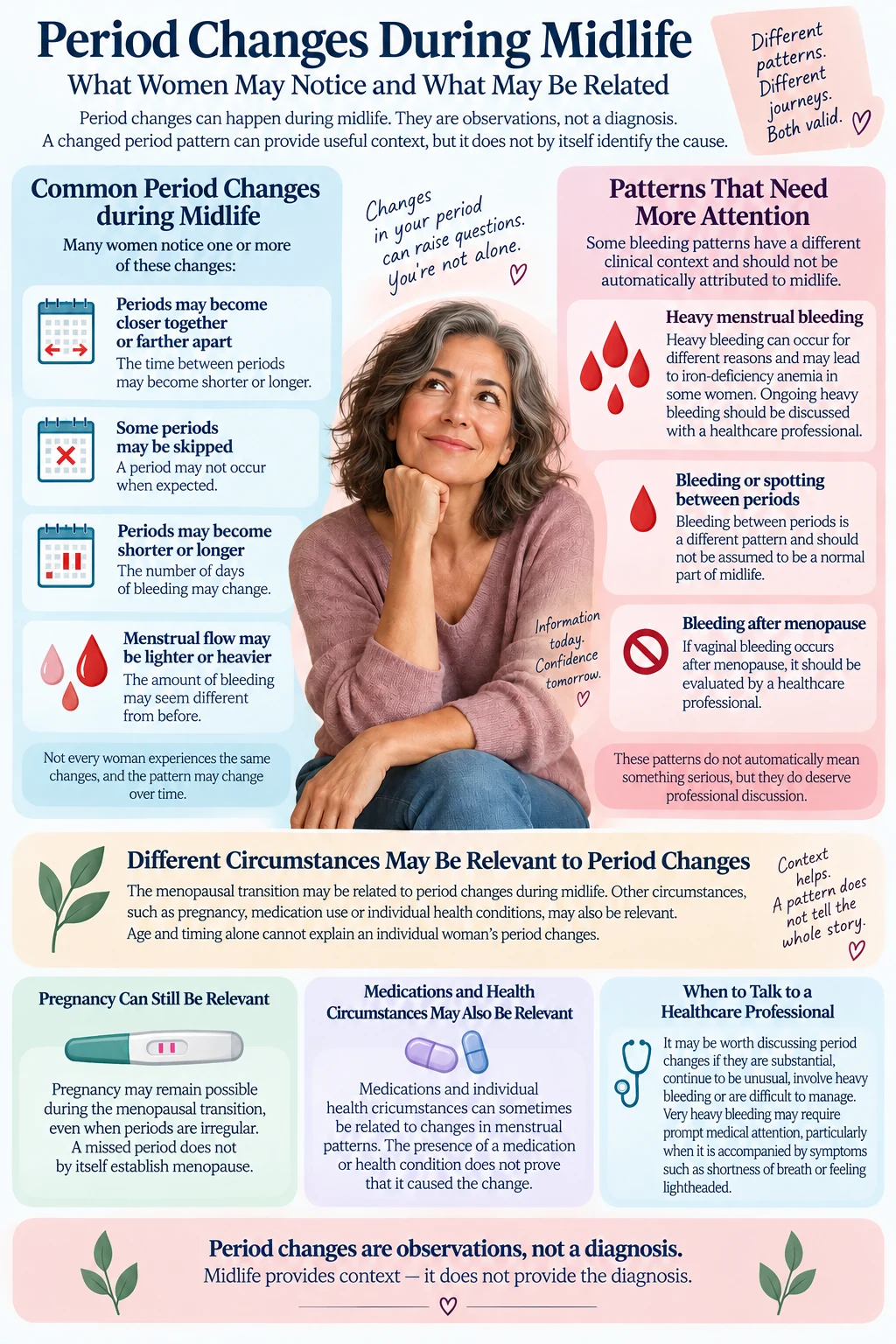
During midlife, some women begin to notice that their periods no longer follow the pattern that once felt familiar. A period may arrive sooner or later than expected, the time between periods may change, some periods may be skipped, or menstrual flow may seem lighter or heavier than before.
These changes can naturally raise questions about perimenopause and the approach of menopause. At the same time, noticing that a period pattern has changed does not identify why the change occurred.
Period changes are observations, not a diagnosis. Changes in menstrual timing, frequency, duration or flow during midlife do not by themselves establish that perimenopause, menopause or any particular condition caused them.
The pattern a woman notices can provide useful context. It cannot provide the individual explanation on its own.
What Do Period Changes Mean?
Period changes can refer to differences in a menstrual pattern that was previously familiar to a woman.
The number of days between periods may change. Periods may become closer together or farther apart. A period may occasionally be skipped. The number of days of bleeding may also change, and menstrual flow may become lighter or heavier.
Not every woman experiences the same changes, and the pattern may not remain the same over time.
For this reason, “my periods have changed” can describe several different observations rather than one specific menstrual pattern.
These observations can help characterize what is happening without establishing why it is happening.
Period Changes Can Become More Noticeable During Midlife
A woman may become more aware of changes in her menstrual pattern during midlife while she is still having periods.
A cycle that once seemed relatively predictable may begin to vary. The time between periods may become shorter or longer, bleeding may last for a different number of days, or the amount of menstrual flow may seem different.
Because changes like these can occur during the menopausal transition, it is understandable for a woman to wonder whether perimenopause may be involved.
But the timing of a change during midlife does not establish its individual cause.
Midlife provides important context. It does not turn a change in menstrual pattern into a diagnosis.
Why Midlife Does Not Point to a Single Explanation
Age and timing alone cannot explain an individual woman's period changes.
The menopausal transition may be relevant, particularly when menstrual patterns begin to vary during midlife. Other circumstances may also be relevant when menstrual bleeding or the timing of periods changes.
Pregnancy may still be relevant for some women who are going through the menopausal transition. Medications and individual health circumstances may also provide important context.
More than one circumstance can sometimes be present at the same time.
This is why a changed period pattern should not automatically be treated as identifying the individual explanation or menopausal stage.
The observation is real. The explanation requires more context.
How the Menopausal Transition May Be Related to Period Changes
Changes in menstrual patterns can occur during the menopausal transition.
During this transition, periods may become less predictable. The intervals between them may change, some periods may be skipped, and menstrual flow or duration may differ from what a woman previously experienced.
These patterns are among the reasons period changes are often discussed in relation to perimenopause.
That relationship does not mean that every menstrual change during midlife has the same explanation.
It also does not allow a woman to determine her individual menopausal stage or the cause of a particular bleeding pattern from the change alone.
The menopausal transition can therefore be an important part of the context without providing the individual diagnosis.
Period Changes Can Follow Different Patterns
There is no single pattern that every woman's periods follow during midlife.
Some women may notice changes in how often periods occur. Others may first notice skipped periods, a difference in how long bleeding lasts, or a change in menstrual flow.
A woman's pattern may also change over time.
Recognizing these differences can help describe what she is experiencing without assuming that one pattern identifies the cause.
Periods May Become Closer Together or Farther Apart
The amount of time between periods can change during the menopausal transition.
Some periods may occur closer together than they did previously, while at other times the interval between periods may become longer.
Not every woman experiences these changes in the same order or follows the same progression.
The spacing between periods can therefore provide useful descriptive information, but it does not establish the individual cause of the change.
Some Periods May Be Skipped
Some women notice that a period does not occur when expected.
Skipped periods can occur during the menopausal transition, particularly as menstrual patterns become less predictable.
However, a missed or skipped period does not by itself establish menopause.
Pregnancy can remain possible during the menopausal transition, and other individual circumstances may also be relevant when a period is missed.
A skipped period is therefore an observation that needs context rather than proof of a particular reproductive stage.
Periods May Become Shorter or Longer
The duration of menstrual bleeding can also change.
A period may last fewer days than it once did or continue for longer than the pattern a woman previously considered usual for herself.
Changes in duration can occur alongside changes in cycle spacing or menstrual flow.
The number of days of bleeding can help describe the pattern, but duration alone cannot identify why that pattern changed.
Menstrual Flow May Become Lighter or Heavier
A woman may notice that the amount of menstrual flow seems different from before.
Some periods may be lighter, while others may seem heavier.
Changes in flow can occur during the menopausal transition, but a heavier period should not automatically be interpreted as something that can be dismissed simply because a woman is in midlife.
There is also an important distinction between noticing that a period seems heavier than a woman's previous pattern and experiencing heavy bleeding that may require clinical attention.
The amount of bleeding is therefore part of the context rather than a way to determine the cause at home.
What Does “Irregular Periods” Mean?
Women often use the phrase “irregular periods” when a menstrual pattern no longer feels predictable.
The term may describe periods that arrive at varying intervals, periods that are sometimes skipped, or other changes from a previously familiar pattern.
“Irregular” is useful as a description, but it is not a diagnosis.
It does not establish that perimenopause is the cause, determine a woman's menopausal stage or identify a particular health condition.
A more complete description — such as whether periods are closer together, farther apart, skipped, shorter, longer, lighter or heavier — can provide more useful context than the word “irregular” alone.
Why a Changed Period Pattern Cannot Tell You the Cause
A woman can accurately notice that her periods have changed without being able to determine why.
A period arriving earlier or later does not establish perimenopause.
A skipped period does not establish menopause.
A heavier period does not establish that hormonal changes are responsible.
And an irregular pattern does not identify a particular condition.
Different circumstances can produce changes in menstrual timing or bleeding patterns, and the relevance of those circumstances depends on the individual situation.
For that reason, recognizing the pattern and determining its cause are two different things.
The pattern can be described carefully without turning it into a diagnosis.
Different Circumstances May Be Relevant to Period Changes
Menstrual changes do not occur in isolation from the rest of a woman's health and circumstances.
The menopausal transition may provide important context, but pregnancy, medication use and individual health circumstances may also be relevant.
Considering these factors does not mean choosing one of them as the cause.
It means recognizing that a changed period pattern may need to be understood alongside other information.
Pregnancy Can Still Be Relevant During the Menopausal Transition
The menopausal transition does not mean that pregnancy immediately becomes impossible.
Pregnancy may remain possible during the menopausal transition even when periods have become irregular.
For that reason, a missed period during midlife should not automatically be interpreted as evidence that menopause has occurred.
Whether pregnancy is relevant depends on the individual woman's circumstances.
The purpose of mentioning pregnancy here is not to determine the explanation for a missed period. It is to prevent a changed menstrual pattern from being interpreted as proof of menopause.
Medications and Individual Health Circumstances May Provide Context
Medication use and different health circumstances can sometimes be relevant when menstrual patterns change.
The presence of a medication or health condition does not prove that it caused a change in bleeding.
Likewise, a woman cannot identify the explanation for a changed period simply by matching her experience to a list of possible causes.
Medication history, other symptoms, pregnancy possibility and broader health history may provide useful context when appropriate.
The goal is to describe the situation more completely rather than diagnose the cause from the menstrual pattern alone.
Some Bleeding Patterns Change the Clinical Context
Not every change involving menstrual bleeding carries the same clinical context.
A period that arrives at a different interval is not the same observation as very heavy bleeding. Bleeding or spotting between periods is also different from simply noticing that the length of a menstrual cycle has changed.
These distinctions matter because some bleeding patterns may deserve professional discussion rather than being automatically attributed to midlife or perimenopause.
The fact that menstrual patterns can change during the menopausal transition should not be used to dismiss a bleeding pattern that is new, unusual or concerning for an individual woman.
Heavy Bleeding Is Not the Same as Simply Noticing a Heavier Period
A woman may notice that a period seems heavier than what was previously usual for her.
That observation is not necessarily the same as clinically significant heavy menstrual bleeding.
Heavy menstrual bleeding can occur for different reasons. Ongoing heavy menstrual bleeding can contribute to iron-deficiency anemia in some women.
A woman does not need to determine the cause of heavy bleeding herself before discussing it with a healthcare professional.
Likewise, heavy bleeding should not automatically be dismissed as an expected consequence of perimenopause.
The distinction is important: heavier than before describes a change a woman has noticed; heavy bleeding that is substantial or difficult to manage may change the clinical context.
Bleeding or Spotting Between Periods Is a Different Pattern
Bleeding or spotting between menstrual periods is not the same as simply having periods that occur closer together or farther apart.
It represents a different bleeding pattern.
Although menstrual patterns can become less predictable during the menopausal transition, bleeding between periods should not automatically be labeled a normal consequence of perimenopause.
A woman who notices bleeding or spotting between periods can describe when it occurs and discuss the pattern with a healthcare professional when appropriate.
The presence of spotting does not establish its cause.
Bleeding After Menopause Is a Different Clinical Context
Bleeding after menopause should not be treated as simply another irregular period.
Menopause is generally recognized after 12 consecutive months without a menstrual period when there is no other explanation for the absence of periods.
If vaginal bleeding occurs after that point, it belongs to a different clinical context from the changing menstrual patterns discussed earlier in this article.
If vaginal bleeding occurs after menopause, it should be evaluated by a healthcare professional rather than assumed to mean that a period has simply returned.
This article does not determine why postmenopausal bleeding occurred or which evaluation an individual woman needs.
The important distinction is that period changes during the menopausal transition and bleeding after menopause are not interchangeable situations.
When Is It Worth Discussing Period Changes With a Healthcare Professional?
A period pattern that has changed substantially, continues to be unusual for a woman, or involves bleeding that is difficult to manage may be worth discussing with a healthcare professional.
It is also important not to automatically attribute heavy bleeding, bleeding or spotting between periods, or bleeding after menopause to midlife or the menopausal transition.
When discussing period changes, it can be useful to describe what has changed: how often periods occur, whether some have been skipped, how long bleeding lasts, whether flow has become lighter or heavier, and whether bleeding occurs between periods.
Pregnancy possibility, medication use, other symptoms and relevant health history may also provide useful context.
Very heavy bleeding may require prompt medical attention, particularly when it is accompanied by symptoms such as shortness of breath or feeling lightheaded.
A healthcare professional can consider the menstrual pattern together with the woman's individual circumstances and decide whether further evaluation is appropriate.
W26 does not diagnose perimenopause, menopause or a gynecologic condition, determine the individual cause of bleeding, or decide which test or treatment a woman needs.
Period changes are observations, not a diagnosis.
Midlife provides context — it does not provide the diagnosis.