Diabetes can affect urination in different ways.
High blood glucose can increase the amount of urine the body produces. Diabetes-related nerve damage can also affect how the bladder senses fullness, stores urine and empties.
These mechanisms are different. Frequent urination does not necessarily mean the bladder itself is malfunctioning, and symptoms such as retention, leakage or urgency can have causes other than diabetes.
Understanding those differences starts with normal bladder function.
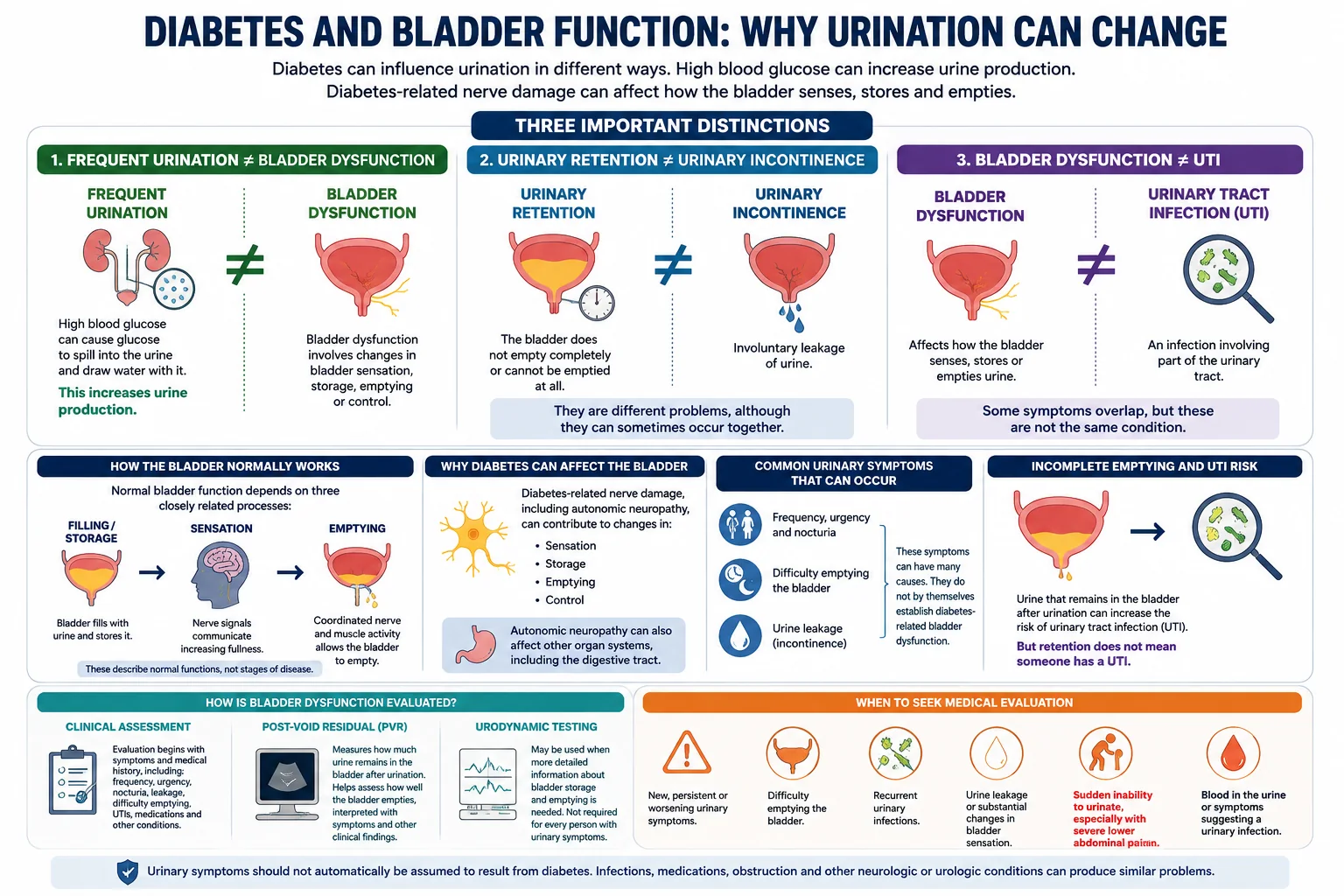
How Does the Bladder Normally Work?
The bladder stores urine produced by the kidneys and empties it during urination.
As the bladder fills, nerve signals communicate increasing fullness. When it is time to urinate, coordinated nerve and muscle activity allows the bladder to empty.
In simple terms, normal bladder function depends on three closely related processes:
These describe normal functions, not stages of disease.
Why Can Diabetes Affect Bladder Function?
Bladder control depends partly on nerves that regulate sensation, storage and emptying.
Diabetes-related nerve damage, including autonomic neuropathy, can contribute to changes in these functions. Some people may have reduced awareness of bladder fullness, while others may experience urgency, leakage or difficulty emptying.
These symptoms do not establish diabetic autonomic neuropathy on their own. Lower urinary tract symptoms can have multiple causes.
Autonomic neuropathy can also affect other organ systems, including the digestive tract. For a closer look at how diabetes can affect stomach emptying, see our guide to diabetes and gastroparesis.
Is Frequent Urination the Same as Bladder Dysfunction?
No. Frequent urination can occur simply because the body is producing more urine.
When blood glucose is high enough, glucose can spill into the urine and draw additional water with it. This process, called osmotic diuresis, can increase urine production.
Bladder dysfunction is different. It involves changes in bladder sensation, storage, emptying or control.
The two can occur together, but one does not automatically establish the other.
What Urinary Symptoms Can Occur With Diabetes?
Frequency, Urgency and Nocturia
Urinary frequency means urinating more often than usual. Urgency is a sudden or difficult-to-defer need to urinate.
Nocturia means waking during the night to urinate.
These symptoms can occur for different reasons and do not by themselves identify diabetes-related bladder dysfunction.
Difficulty Emptying the Bladder
Changes in bladder sensation or contraction can make emptying more difficult.
A person may notice a weak urinary stream, a feeling that the bladder has not emptied completely or reduced awareness that the bladder is full.
More significant emptying difficulty can result in urinary retention.
Urine Leakage
Urinary incontinence means involuntary leakage of urine.
Diabetes-related nerve dysfunction may contribute in some people, but urinary incontinence has many possible causes and should not automatically be attributed to diabetes.
Urinary Retention and Incontinence Are Not the Same
Urinary retention means the bladder does not empty completely or, in acute cases, cannot be emptied at all.
Urinary incontinence means involuntary leakage of urine.
They describe different problems, although they can sometimes coexist.
Is Bladder Dysfunction the Same as a Urinary Tract Infection?
No.
Bladder dysfunction concerns how the bladder senses, stores or empties urine. A urinary tract infection (UTI) is an infection involving part of the urinary tract.
Some symptoms, such as frequency and urgency, can overlap.
Incomplete bladder emptying can also increase the risk of urinary infection because urine remains in the bladder after urination.
Having retention does not mean someone has a UTI, and having a UTI does not establish diabetes-related bladder dysfunction.
How Is Bladder Dysfunction Evaluated?
Evaluation begins with the pattern of symptoms and a person's medical history.
A healthcare professional may ask about frequency, urgency, nighttime urination, leakage, difficulty emptying, urinary infections, medications and other conditions that could affect urinary function.
Post-Void Residual
A post-void residual (PVR) measures how much urine remains in the bladder after urination.
It can help assess whether the bladder is emptying adequately, but the result is interpreted together with symptoms and other clinical findings.
Urodynamic Testing
Urodynamic testing may be used when clinicians need more detailed information about bladder storage and emptying.
It is not required for every person with urinary symptoms. Whether it is useful depends on the clinical situation.
When Should Bladder Symptoms Be Evaluated?
New, persistent or worsening urinary symptoms should be discussed with a healthcare professional, particularly when there is difficulty emptying the bladder, recurrent urinary infections, leakage or substantial changes in bladder sensation.
Urinary symptoms should not automatically be assumed to result from diabetes because infections, medications, obstruction and other neurologic or urologic conditions can produce similar problems.
The Bigger Picture: Diabetes and Bladder Function
Diabetes can influence urination through more than one pathway.
High blood glucose can increase urine production, while diabetes-related nerve damage can affect bladder sensation, storage and emptying.
URINARY RETENTION ≠ URINARY INCONTINENCE
BLADDER DYSFUNCTION ≠ UTI
These conditions and symptoms can overlap, but they describe different processes.
Related urinary symptoms can arise through different mechanisms.
Sources & Medical References
- American Diabetes Association — Standards of Care in Diabetes—2026: Retinopathy, Neuropathy, and Foot Care
- NIDDK — Autonomic Neuropathy
- NIDDK — Diagnosis of Urinary Retention
- European Association of Urology — Neuro-Urology Guideline
- AUA/SUFU — Neurogenic Lower Urinary Tract Dysfunction Guideline
Published: September 2, 2026 · Last reviewed: September 2, 2026