Diabetes can affect brain function in more than one way.
Blood glucose changes may temporarily affect how clearly a person thinks, especially when glucose falls too low. Over the longer term, diabetes is also associated with changes in cognitive function and with a higher risk of cognitive impairment and dementia.
These are different clinical situations.
Feeling confused during a glucose problem is not the same as having long-term cognitive decline. Occasional forgetfulness is not the same as mild cognitive impairment. And mild cognitive impairment is not the same as dementia.
Memory is part of this story, but it is only one part of cognition.
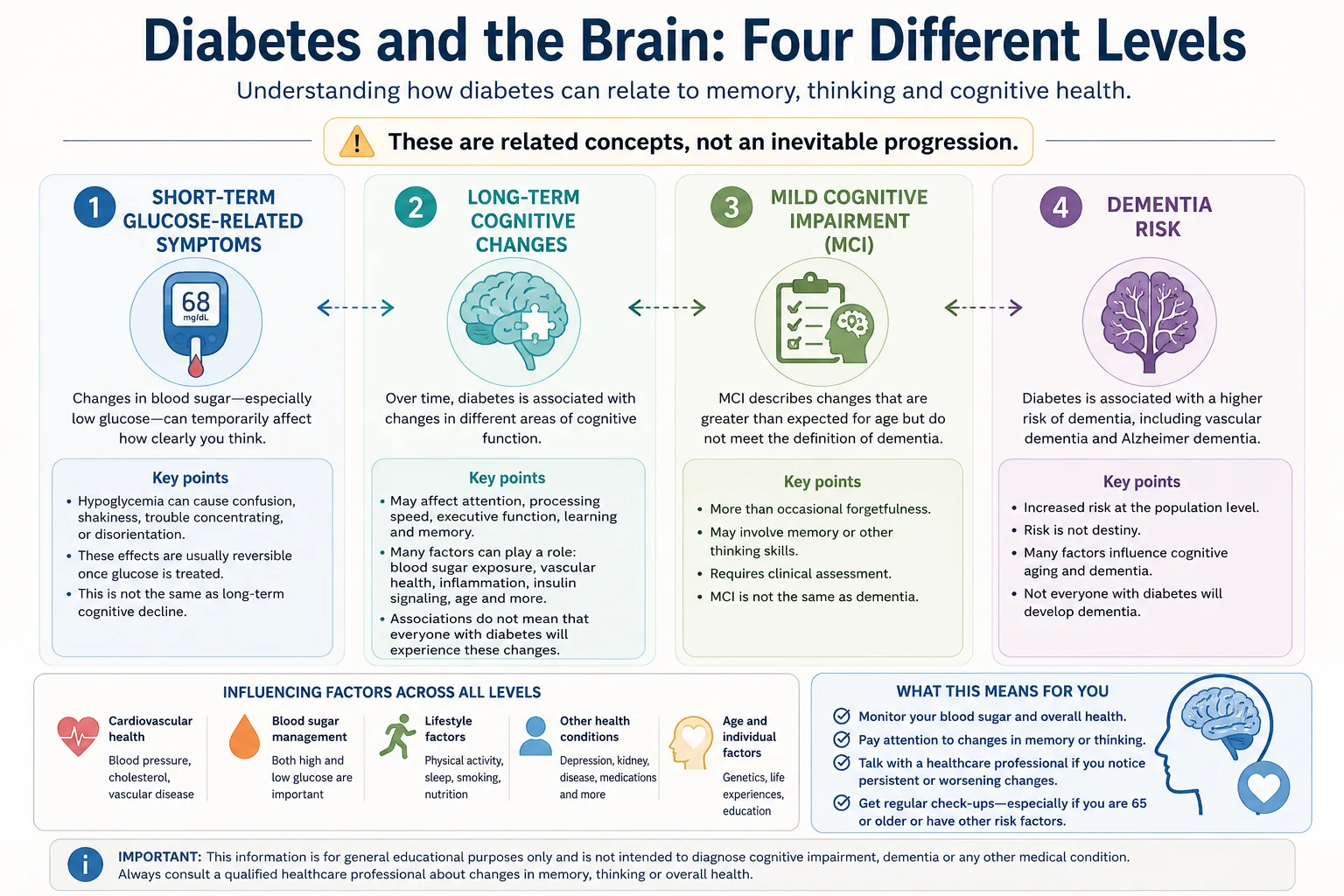
Can Diabetes Affect Memory and Thinking?
Diabetes is associated with changes in cognitive function, particularly over the long term.
Cognition includes memory, attention, concentration, reasoning, planning, decision-making and the speed at which information is processed.
That means a person can have difficulty in one cognitive area without having the same degree of difficulty in another.
Current diabetes guidance recognizes cognitive capacity as important because these abilities are also involved in daily diabetes self-management.
Memory Is Only One Part of Cognitive Function
Memory often gets the most attention because it is easy to notice when someone forgets a name, appointment or task.
But other cognitive abilities matter just as much.
Executive function, for example, helps with planning, organizing and adapting when circumstances change.
Processing speed refers to how efficiently information can be understood and acted on.
This is why the phrase “diabetes causes memory loss” is too simple to describe what researchers and clinicians are actually studying.
Can Blood Sugar Changes Affect How You Think?
Blood glucose that falls too low can interfere with normal brain function.
The relationship between high glucose and cognition is more often discussed in terms of longer-term glycemic exposure and cognitive outcomes rather than as a specific short-term “brain fog” diagnosis.
What Can Happen When Blood Sugar Is Too Low?
Hypoglycemia means blood glucose has fallen below the desired range.
The American Diabetes Association considers glucose below 70 mg/dL (3.9 mmol/L) clinically important in people with diabetes.
Symptoms may include shakiness, sweating, hunger and irritability, but neurological symptoms such as confusion can also occur.
When glucose falls substantially, a person may have difficulty concentrating, thinking clearly or responding normally.
More severe hypoglycemia can be dangerous and requires appropriate treatment.
These effects are acute. They should not be confused with long-term cognitive impairment.
What About High Blood Sugar?
Long-term hyperglycemia is associated with diabetes complications and has also been linked with cognitive outcomes.
But the relationship is more complex than a simple rule such as:
Duration of diabetes, vascular health, glucose extremes, age, medications and other medical conditions can all influence cognitive health.
Temporary Symptoms Are Not the Same as Cognitive Decline
A sudden episode of confusion during hypoglycemia is a different clinical situation from gradually worsening memory, attention or planning ability over months or years.
The symptoms may overlap. The underlying mechanism and clinical meaning may not.
What Does “Brain Fog” Mean in Diabetes?
“Brain fog” is an informal term people use when they feel mentally slower or less clear than usual.
It may describe difficulty concentrating, forgetfulness or mental fatigue.
But brain fog is a description, not a diagnosis.
Sleep problems, stress, medications, illness, glucose disturbances and many other factors can affect mental sharpness.
The phrase can describe how someone feels, but it does not reveal the cause.
Can Diabetes Be Associated With Long-Term Cognitive Changes?
Yes. Long-term diabetes has been associated with cognitive decline, although the pattern and degree of change vary between individuals.
Research has examined several cognitive domains, including attention, executive function, processing speed, learning and memory.
Diabetes does not determine a person's cognitive future, and cognitive aging cannot be explained by blood glucose alone.
Why Can Long-Term Cognitive Changes Happen?
There is no single established mechanism that explains every association between diabetes and cognition.
Researchers continue to study several interacting factors, including:
- metabolic changes
- vascular disease
- insulin-related signaling
- inflammation
- cardiovascular risk factors
- aging and other medical conditions
These mechanisms should be understood as interacting possibilities rather than one proven pathway that applies to everyone.
The relationship is more complicated than:
What Role Do Blood Vessels Play in Brain Health?
The brain depends on a continuous supply of blood, oxygen and nutrients.
Diabetes frequently occurs alongside cardiovascular risk factors and vascular disease, so cerebrovascular health is one part of the cognition story.
The Brain Depends on a Continuous Blood Supply
Disease affecting blood vessels in or leading to the brain can influence brain function.
That makes vascular health relevant when considering the higher rates of cognitive impairment and dementia observed in people with diabetes.
But vascular disease is only one possible contributor. Metabolic, glycemic and other biological factors may also matter.
What Is Mild Cognitive Impairment?
Mild cognitive impairment (MCI) is a clinical concept describing cognitive changes that are greater than expected from normal variation or aging but do not meet the definition of dementia.
It may involve memory or other cognitive abilities.
MCI cannot be diagnosed from occasional forgetfulness or from a symptom checklist online.
MCI Is More Than Occasional Forgetfulness
Forgetting a name temporarily or misplacing something does not by itself establish cognitive impairment.
Clinical evaluation considers the pattern and severity of cognitive changes, whether other abilities are involved and how everyday functioning has changed.
MCI Is Not the Same as Dementia
Some people with MCI later develop dementia, while others remain stable or follow a different course.
The outcome depends on the underlying cause and individual circumstances.
Does Diabetes Increase the Risk of Dementia?
Research has associated diabetes with a higher risk of cognitive decline and dementia.
Current ADA guidance reports higher incidences of all-cause dementia, Alzheimer dementia and vascular dementia among people with diabetes compared with people without diabetes.
That is a population-level association.
It does not mean that a person with diabetes will inevitably develop dementia.
Vascular Dementia and Cerebrovascular Disease
Vascular dementia is associated with disease or injury affecting blood vessels and blood supply in the brain.
Because diabetes is closely connected with cardiovascular and cerebrovascular risk, vascular pathways are particularly relevant.
Again, however, vascular disease does not explain the entire relationship between diabetes and dementia.
What About Alzheimer's Disease?
Diabetes is also associated with a higher observed risk of Alzheimer dementia.
That association should not be rewritten as:
Researchers continue to investigate how vascular, metabolic and neurodegenerative processes may interact.
Risk Is Not the Same as Destiny
Risk describes what happens across groups of people. It does not predict exactly what will happen to one person.
Age, genetics, cardiovascular health, lifestyle, other medical conditions and many additional factors can influence cognitive health.
Can Cognitive Changes Make Diabetes Harder to Manage?
The relationship can work in both directions.
Diabetes is associated with cognitive changes, but cognitive difficulties can also make diabetes self-management more complicated.
Memory, Planning and Daily Diabetes Tasks
Depending on the treatment plan, diabetes care may require:
- remembering medications
- monitoring glucose
- interpreting glucose information
- planning meals
- using insulin safely
- recognizing and responding to hypoglycemia
- keeping medical appointments
These tasks rely on memory, attention, planning and judgment.
When those abilities decline, diabetes care may become harder to manage safely.
Why Support May Become Important
When cognitive impairment is identified, treatment plans may need to be simplified.
Current ADA guidance emphasizes matching diabetes care to a person's cognitive and functional abilities and reducing hypoglycemia risk.
Support from family members, caregivers or healthcare professionals may become helpful when complex self-management becomes difficult.
The goal is not to remove independence unnecessarily. It is to make diabetes care safer and more manageable.
What Can Support Brain Health When You Have Diabetes?
There is no single food, supplement or glucose number that guarantees protection against cognitive decline.
Brain health is part of overall health.
Diabetes Management Is Part of the Bigger Picture
Appropriate diabetes care may include attention to:
- blood glucose
- blood pressure
- cholesterol and other blood lipids
- physical activity
- smoking
- sleep
- cardiovascular health
- other medical conditions
These factors should be managed in the context of the individual.
Importantly, intensive glucose lowering should not be pursued solely in an attempt to improve cognitive function.
Current ADA guidance specifically advises against intensive glycemic management for that purpose in people with type 2 diabetes.
There Is No Single “Brain-Protecting” Number
An A1C target that is appropriate for one person may not be appropriate for another.
Age, medications, diabetes type, hypoglycemia risk, other health conditions and cognitive or functional status can influence treatment goals.
Brain health is therefore not protected by chasing one universal glucose target.
When Should Memory or Thinking Changes Be Evaluated?
Occasional forgetfulness is common.
Persistent, progressive or functionally important cognitive changes deserve more attention.
A healthcare professional can consider the timing and pattern of symptoms, medications, medical history and other possible causes before deciding whether cognitive assessment or further evaluation is appropriate.
Persistent or Worsening Changes Deserve Attention
Changes are especially important when they begin to interfere with tasks that were previously manageable.
For someone with diabetes, examples may include increasing difficulty:
- remembering medications
- calculating insulin doses
- monitoring glucose
- planning meals
- recognizing or responding to hypoglycemia
A decline in diabetes self-management can be an important reason to consider cognitive evaluation.
Sudden Confusion Is Different
Sudden confusion is not the same pattern as gradual cognitive decline.
Hypoglycemia is one possible cause in someone with diabetes, but it is not the only one.
Cognitive Assessment Can Look Beyond Memory
Cognitive assessment may examine several abilities, including memory, attention, executive function and reasoning.
Current ADA guidance recommends monitoring cognitive capacity throughout the lifespan in people with diabetes and considering formal assessment when cognitive ability changes or becomes insufficient for safe self-management.
For adults aged 65 and older, the ADA recommends screening for early detection of MCI or dementia at the initial visit, annually and as appropriate.
The Bigger Picture: Glucose, Blood Vessels and the Brain
Diabetes and brain health cannot be reduced to one symptom or one mechanism.
Blood glucose disturbances can sometimes affect mental function in the short term.
Long-term diabetes is associated with changes in cognitive function.
Vascular health may contribute to that relationship, alongside metabolic and other biological factors.
Mild cognitive impairment describes a different clinical situation from occasional forgetfulness.
And dementia represents another level again.
↓
are not the same as
long-term cognitive changes
↓
which are not automatically
mild cognitive impairment
↓
and MCI is not automatically
dementia
Memory matters, but it is only one part of cognition.
Blood glucose matters, but it is only one part of brain health.
And increased risk does not determine what will happen to an individual.
Understanding those distinctions gives a clearer picture of what clinicians and researchers mean when they discuss diabetes, the brain and cognitive health.
Sources & Medical References
- American Diabetes Association — Older Adults: Standards of Care in Diabetes—2026
- American Diabetes Association — Comprehensive Medical Evaluation and Assessment of Comorbidities—2026
- American Diabetes Association — Glycemic Goals, Hypoglycemia, and Hyperglycemic Crises—2026
- American Diabetes Association — Facilitating Positive Health Behaviors and Well-being—2026
Published: September 1, 2026 · Last reviewed: September 1, 2026