When people hear that diabetes can affect circulation, they may imagine blood simply moving more slowly through the body. The relationship is more complex.
Over time, diabetes can contribute to changes in blood vessel health. These changes may affect how vessels function and, in some situations, how effectively blood reaches different tissues.
A useful way to understand the connection is:
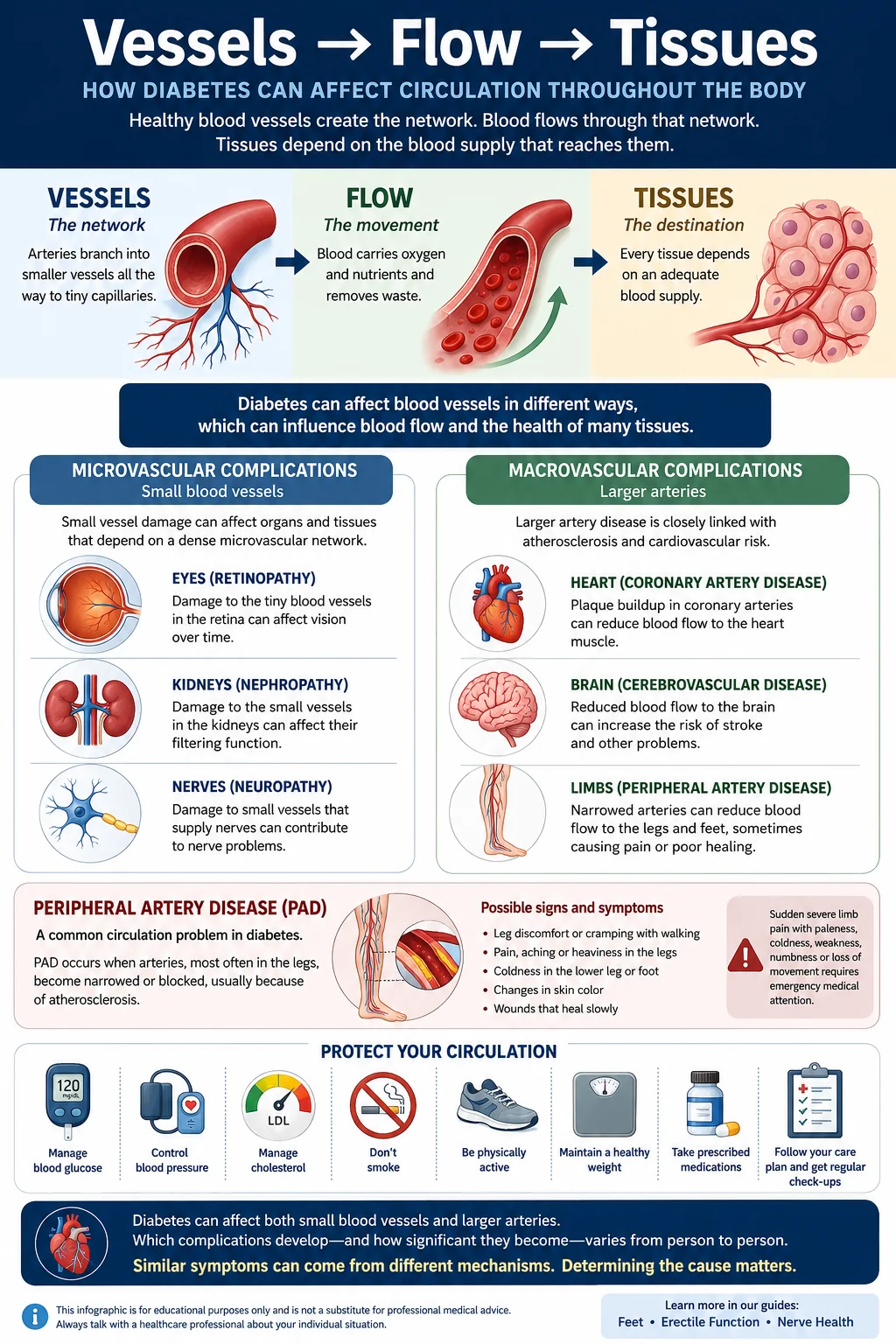
Blood vessels provide the network. Blood flows through that network, carrying oxygen and nutrients to tissues throughout the body.
Diabetes can affect different parts of this system, but that does not mean everyone with diabetes will develop circulation problems. Individual risk depends on many factors, including blood glucose management, blood pressure, cholesterol levels, smoking, age and overall cardiovascular health.
It is also worth clarifying one common expression from the start: “poor circulation” is a broad everyday term, not a specific medical diagnosis.
How Does Diabetes Affect Circulation?
Circulation depends on a vast network of blood vessels that reaches virtually every tissue in the body.
Arteries carry blood away from the heart and branch into progressively smaller vessels. At the smallest level, tiny blood vessels help deliver oxygen and nutrients to tissues and support the exchange of substances between the blood and surrounding cells.
For this system to work well, blood vessels need to do more than simply stay open. Their walls respond to changing conditions, helping regulate how much blood reaches different tissues.
Over time, diabetes can contribute to vascular changes that interfere with some of these normal functions.
Blood Vessels Do More Than Carry Blood
A blood vessel is not just a passive tube. Its wall contains several layers, and the inner lining — called the endothelium — plays an important role in vascular function.
The endothelium helps regulate how blood vessels relax and constrict and participates in processes that influence blood flow and vascular health.
Why Blood Flow Matters to Tissues
Every tissue requires an adequate blood supply. Blood carries oxygen and nutrients while also helping transport metabolic waste products away from tissues.
When vascular disease interferes with blood flow, the consequences depend partly on which vessels — and therefore which tissues — are affected.
How Can High Blood Sugar Affect Blood Vessels?
Persistently elevated blood glucose is associated with biological changes that can contribute to blood vessel damage over time. The process, however, should not be reduced to the idea that “sugar clogs the arteries.”
Vascular health in diabetes involves multiple interacting factors. Blood glucose matters, but blood pressure, cholesterol, smoking and other metabolic and cardiovascular factors can also influence risk.
Vascular Changes Usually Develop Over Time
A single elevated glucose reading does not mean circulation has suddenly been damaged. The vascular complications associated with diabetes generally develop within a much broader context that can include glucose exposure over time, duration of diabetes and other individual cardiovascular risk factors.
The Role of the Endothelium
The endothelium helps blood vessels adjust their diameter and maintain normal vascular function. One of the signaling molecules involved in vessel relaxation is nitric oxide.
Metabolic changes associated with diabetes can interfere with normal endothelial function as part of a much larger biological picture that includes inflammatory and oxidative processes.
The important idea does not require a lesson in biochemistry: blood vessels are living, responsive tissues. How well they function matters for blood flow.
Does Diabetes Cause Poor Circulation?
Diabetes can increase the risk of vascular conditions that reduce blood flow, but the phrase “poor circulation” does not identify what is actually happening.
“Poor Circulation” Can Mean Different Things
Cold feet, leg discomfort, numbness or changes in skin appearance can have several explanations. None of these symptoms, by itself, confirms peripheral artery disease or another circulation disorder.
This distinction is especially important in diabetes because nerve problems and vascular problems can coexist while involving different mechanisms.
Small Blood Vessels and Large Arteries: What's the Difference?
One useful way to understand vascular complications associated with diabetes is to distinguish problems involving small blood vessels from those involving larger arteries. These are commonly described as microvascular and macrovascular complications.
Microvascular Complications
Diabetes is strongly associated with microvascular complications such as retinopathy, kidney disease and neuropathy. Although these conditions affect very different tissues, they illustrate why the effects of diabetes are not limited to one organ or one part of the body.
Larger Arteries and Cardiovascular Disease
Problems involving larger arteries are closely connected with cardiovascular disease and atherosclerosis.
Atherosclerosis is a disease process in which plaque accumulates within artery walls. As disease progresses, affected arteries can become narrowed and blood flow may be reduced.
- heart
- brain
- limbs
Diabetes is an important cardiovascular risk factor, but it does not act alone. Blood pressure, cholesterol, smoking, age and other factors also influence cardiovascular risk.
Small- and Large-Vessel Problems Can Coexist
The small-vessel and large-artery categories are useful for understanding different complications, but they are not mutually exclusive.
What Is Peripheral Artery Disease and Why Does Diabetes Matter?
One vascular condition particularly relevant to diabetes is peripheral artery disease, or PAD.
PAD occurs when arteries supplying areas outside the heart and brain — most commonly the lower extremities — become narrowed or blocked, usually as a result of atherosclerosis.
PAD Affects Blood Flow Through the Arteries
Because PAD commonly affects arteries carrying blood to the legs, symptoms may become noticeable during physical activity, when working muscles need more oxygen. Some people experience leg discomfort while walking. Others may have few or no obvious symptoms.
Diabetes Is an Important PAD Risk Factor
People with diabetes have an increased risk of developing PAD.
- smoking
- high blood pressure
- abnormal cholesterol levels
- increasing age
- other cardiovascular risk factors
PAD and Neuropathy Are Not the Same Thing
PAD primarily involves arteries and blood flow.
Diabetic neuropathy primarily involves nerve damage and nerve function.
They are different problems, although both can affect the lower extremities and can occur in the same person.
What Are Possible Signs of Reduced Blood Flow?
Problems that reduce arterial blood flow can produce different signs and symptoms depending on their location and severity. Possible findings may include leg discomfort during activity, changes in skin color or temperature, or wounds that do not heal normally.
Symptoms Don't Identify the Mechanism
Cold feet, leg discomfort or numbness can have several explanations. None of them, by itself, confirms PAD or another circulation disorder.
Persistent, new or concerning changes deserve appropriate medical evaluation rather than self-diagnosis from a symptom checklist.
Why Do Circulation Problems Often Affect the Legs and Feet?
The legs and feet are common locations for problems involving peripheral arterial blood flow to become clinically important.
Blood Flow and Sensation Are Different Problems
Blood vessels influence blood flow.
Nerves influence sensation.
Diabetes can affect both systems. Reduced sensation can make an injury harder to notice, while impaired arterial blood flow can affect the tissue's ability to receive an adequate blood supply.
Can Circulation Affect Erectile Function?
Erectile function also depends partly on blood vessels responding appropriately and increasing blood flow to erectile tissue. But erectile dysfunction is not simply a circulation problem.
Neurological, vascular, hormonal, medication-related and psychological factors can all play a role.
Can Diabetes Affect Blood Vessels in the Eyes and Brain?
Every organ depends on an adequate blood supply, including the eyes and brain. Diabetes-related vascular complications can therefore involve tissues far removed from the areas people usually associate with “circulation.”
The Eyes Depend on Small Blood Vessels
The retina is the light-sensitive tissue at the back of the eye and contains an extensive network of small blood vessels. Diabetes can damage retinal blood vessels over time, which is one reason regular eye examinations are an important part of diabetes care.
Because diabetes can affect the retina and other parts of the eye in different ways, see our guide to how diabetes affects the eyes and vision, including blurred vision, diabetic retinopathy, macular edema, cataracts and glaucoma.
The Brain Depends on a Continuous Blood Supply
Like every organ, the brain depends on a continuous supply of blood. Conditions affecting larger arteries and cardiovascular health can therefore also have implications for cerebrovascular health.
Symptoms involving memory or cognition should not automatically be attributed to diabetes or circulation.
For a closer look at the cognitive side of diabetes, see our guide to how diabetes may affect memory, thinking and cognitive health.
Can You Protect Your Circulation If You Have Diabetes?
Protecting vascular health involves more than focusing on a single blood glucose measurement. Diabetes management matters, but overall cardiovascular risk matters too.
Blood Glucose Is Only One Part of Vascular Health
- blood glucose
- blood pressure
- cholesterol and other blood lipids
- smoking
- physical activity
- body weight and metabolic health
- prescribed medications
- existing cardiovascular or kidney disease
Appropriate goals and treatments differ from person to person. There is no single food, supplement, exercise or trick that addresses every possible cause of impaired blood flow.
Diabetes can also affect the kidneys in ways that are not fully explained by circulation alone. For a closer look at kidney filtering, albumin in the urine, UACR and eGFR, see our guide to how diabetes may affect kidney health.
Diabetes is also closely connected with liver health in ways that go beyond circulation alone. For a closer look at liver fat, MASLD, MASH and fibrosis risk, see our guide to how type 2 diabetes may affect the liver.
Why Individualized Medical Care Matters
A healthcare professional can assess vascular and cardiovascular risk in the context of a person's age, diabetes history, medications, symptoms and other medical conditions.
When Should Circulation Symptoms Be Evaluated?
New, persistent or worsening symptoms involving the legs, feet or other areas should not automatically be attributed to diabetes.
Don't Assume Every Symptom Is “Poor Circulation”
Symptoms can point to a problem, but they do not identify the underlying mechanism on their own. Identifying the cause matters because different problems require different approaches.
The Bigger Picture: Vessels, Flow and Tissues
Circulation becomes easier to understand when we move beyond the vague idea of “poor circulation” and look at the system behind it:
Blood vessels create the network. Blood flows through that network. Tissues depend on the blood supply that reaches them.
Problems in the feet may involve nerves, blood flow or both. Erectile function depends partly on an appropriate vascular response. The retina depends on small blood vessels. The brain depends on a continuous blood supply.
The inner ear also depends on a healthy blood supply. For a closer look at the relationship between diabetes and hearing, see our guide to diabetes and hearing loss.
The vascular network connects them.
Sources & Medical References
This article was developed using current diabetes and cardiovascular guidance from established medical sources.
- American Diabetes Association — Standards of Care in Diabetes—2026: Cardiovascular Disease and Risk Management
- American Diabetes Association — Standards of Care in Diabetes—2026: Retinopathy, Neuropathy, and Foot Care
- American Diabetes Association — Standards of Care in Diabetes—2026: Comprehensive Medical Evaluation and Assessment of Comorbidities
- American Heart Association — About Peripheral Artery Disease (PAD)
Published: August 30, 2026 · Last reviewed: August 30, 2026