Hearing loss is more common among people with diabetes. But that does not mean diabetes is the cause of every hearing change.
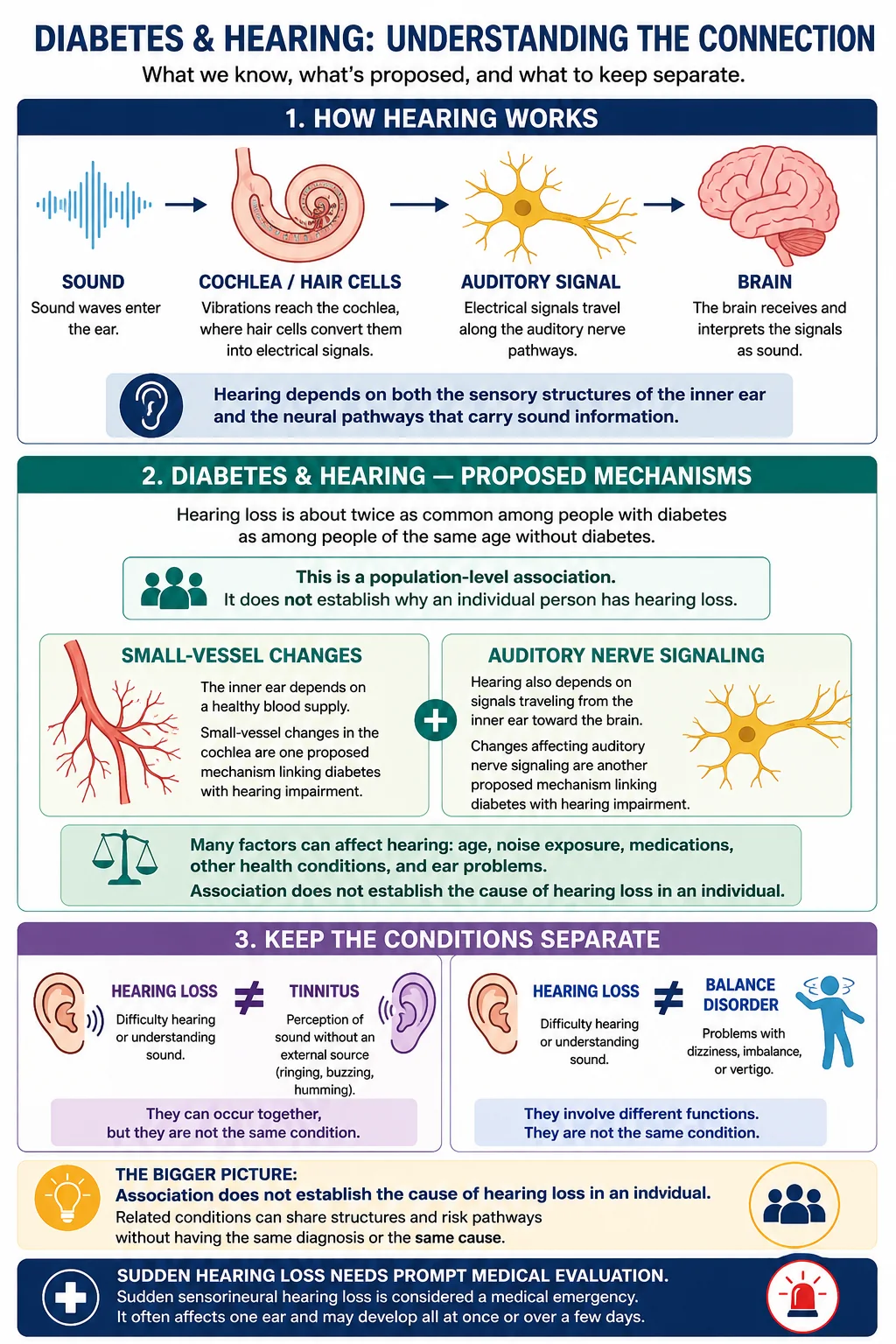
Hearing depends on delicate structures in the inner ear, a steady blood supply and nerve pathways that carry sound information to the brain. Changes involving small blood vessels and auditory nerve signaling are among the mechanisms proposed to help explain the connection between diabetes and hearing loss.
Age, noise exposure, medications and other health conditions can affect hearing too.
Understanding the connection starts with how hearing normally works.
How Does Normal Hearing Work?
Sound travels through the outer ear, crosses the middle ear and reaches the inner ear.
Inside the inner ear is the cochlea, the sensory structure responsible for hearing. Specialized hair cells within the cochlea help convert mechanical sound vibrations into electrical signals.
Hair cells are sensory cells — they are not the auditory nerve itself.
Those signals are then carried through auditory nerve pathways toward the brain, where sound information is processed.
Hearing therefore depends on both the sensory structures of the inner ear and the neural pathways that carry auditory information.
What Is the Connection Between Diabetes and Hearing Loss?
Hearing loss is about twice as common among people with diabetes as among people of the same age without diabetes.
That finding describes a population-level association. It does not establish why an individual person has hearing loss.
Diabetes may be one contributor to hearing risk, while age, noise exposure, medications and other medical or ear conditions may also play a role.
A person with diabetes and hearing loss should not automatically assume that one caused the other.
How Might Diabetes Affect Hearing?
Small Blood Vessels in the Inner Ear
The inner ear depends on a healthy blood supply.
Small-vessel changes in the cochlea are one proposed mechanism linking diabetes with hearing impairment.
For a broader look at how diabetes can affect blood vessels and blood flow, see our guide to diabetes and circulation.
This proposed mechanism cannot establish the cause of hearing loss in an individual person.
Nerves and Auditory Signaling
Hearing also depends on signals traveling from the inner ear toward the brain.
Changes affecting auditory nerve signaling are another proposed mechanism linking diabetes with hearing impairment.
These vascular and neural mechanisms may both contribute, and neither means that hearing loss should simply be treated as another name for peripheral neuropathy.
What Can Hearing Loss Feel Like?
Hearing changes can develop gradually and may be easy to overlook.
Someone may have more difficulty following conversations, particularly when there is background noise. They may ask people to repeat themselves, turn up the television or phone volume, or feel that other people are mumbling.
Sometimes friends or family notice the change first.
Persistent difficulty hearing or understanding speech is a reason to consider a professional hearing assessment.
Is Hearing Loss the Same as Tinnitus?
No.
Tinnitus is the perception of sound without a corresponding external sound source. It is often described as ringing, buzzing or humming.
Tinnitus and hearing loss can occur together, but they are not the same condition.
One does not automatically establish the other.
Is Hearing Loss the Same as a Balance Disorder?
No.
Structures involved in hearing and balance share the inner ear, but they perform different functions. The cochlea is involved in hearing, while other inner-ear structures form part of the vestibular system, which contributes to balance.
Hearing symptoms and balance symptoms may occur together, but they should not be treated as interchangeable problems.
What Else Can Affect Hearing?
Diabetes is only one factor associated with hearing changes.
Age-related changes and repeated or intense noise exposure are common contributors to hearing loss. Some medications can also affect hearing, as can other ear and medical conditions.
That is why the presence of diabetes alone cannot determine the cause of a hearing problem.
How Is Hearing Loss Evaluated?
Evaluation usually begins with the person's symptoms and hearing history.
A healthcare professional may ask when the change began, whether it developed gradually or suddenly, whether one or both ears seem affected, and about noise exposure, medications and other symptoms.
An ear examination may also help identify problems involving the outer or middle ear.
Hearing Tests and Audiometry
An audiologist is a healthcare professional trained to evaluate hearing and related auditory problems.
Hearing tests, including audiometry, can measure hearing sensitivity and help characterize hearing loss.
A hearing test can identify hearing impairment. It cannot, by itself, establish that diabetes caused it.
When Should Hearing Changes Be Evaluated?
Gradual or persistent hearing difficulty should be discussed with a healthcare professional, particularly when it begins to interfere with conversation or everyday communication.
The Bigger Picture: Diabetes and Hearing
Normal hearing depends on a sequence of sensory and neural events:
Diabetes is associated with a greater likelihood of hearing loss, and small-vessel and neural changes are among the mechanisms proposed to help explain that relationship.
But an association observed across populations cannot determine the cause of hearing loss in one person.
HEARING LOSS ≠ TINNITUS
HEARING LOSS ≠ BALANCE DISORDER
Related auditory conditions can share structures and risk pathways without having the same diagnosis or the same cause.
Sources & Medical References
- American Diabetes Association — Standards of Care in Diabetes—2026: Comprehensive Medical Evaluation and Assessment of Comorbidities
- CDC — Diabetes and Hearing Loss
- NIDCD — How Do We Hear?
- NIDCD — Tinnitus
- NIDCD — Sudden Deafness
- AAO-HNSF — Clinical Practice Guideline: Sudden Hearing Loss
Published: September 2, 2026 · Last reviewed: September 2, 2026