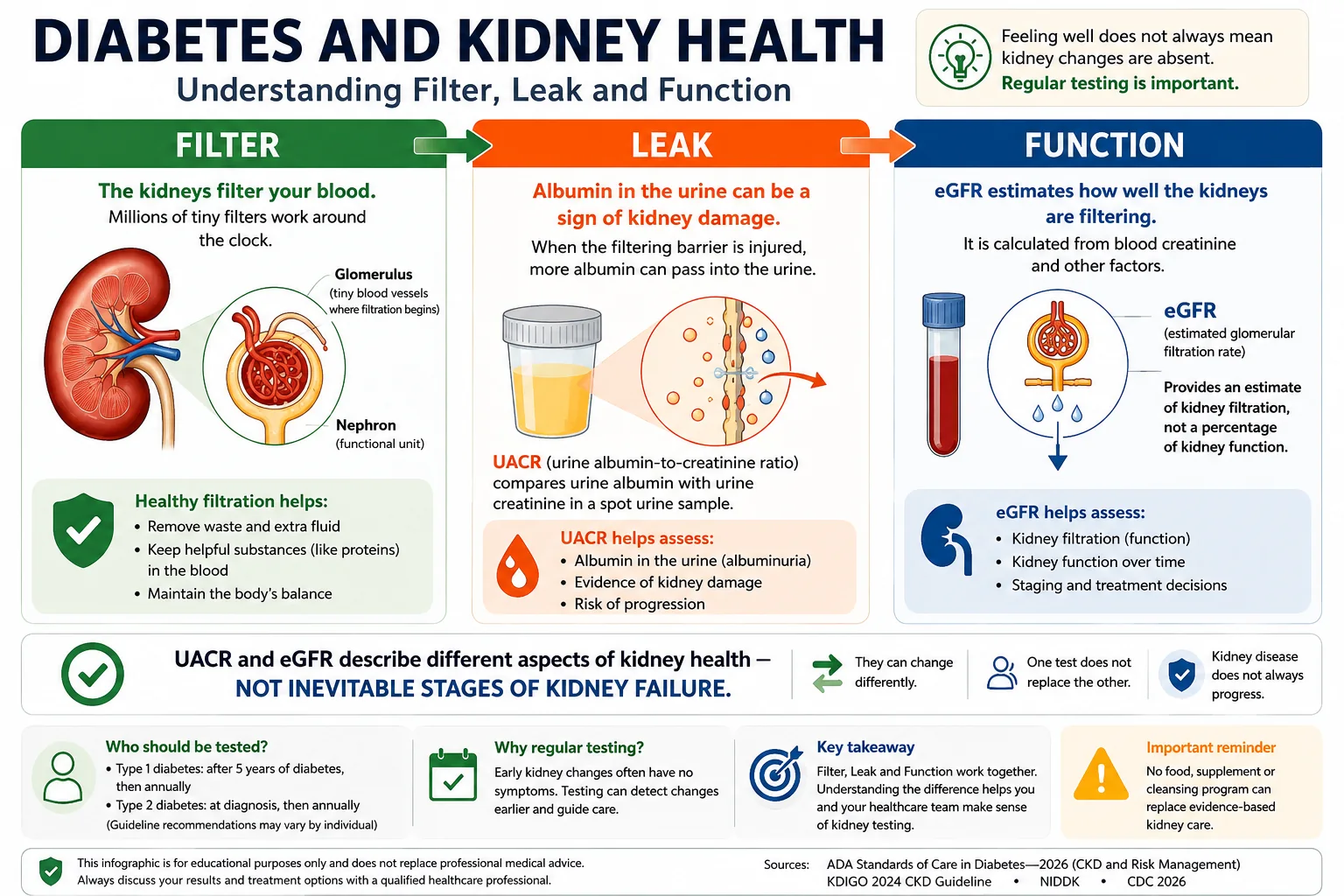
Your kidneys filter your blood continuously, removing waste and helping your body maintain the right balance of water and other substances.
Diabetes can affect this filtering system over time. But diabetic kidney disease often develops quietly, which means a person may feel well even while changes are occurring.
That is why kidney health in diabetes is not judged only by symptoms.
Two measurements are especially important:
- UACR, which helps assess albumin in the urine
- eGFR, which helps estimate kidney filtration
The kidneys contain microscopic filtering structures. Albumin in the urine can provide evidence of kidney damage, while eGFR helps estimate how well the kidneys are filtering.
These measures describe different aspects of kidney health. They are not an inevitable sequence toward kidney failure.
What Do Your Kidneys Actually Do?
The kidneys do much more than produce urine.
They remove waste and excess water from the blood and help regulate the body's internal balance.
For understanding diabetic kidney disease, one function matters especially: filtration.
Kidneys Filter the Blood
Blood continuously passes through the kidneys.
The kidneys filter waste and excess fluid while keeping substances the body needs.
When kidney function becomes impaired, this filtering process may become less effective.
Nephrons and Glomeruli: The Tiny Filtering Units
Each kidney contains many microscopic functional units called nephrons.
Within each nephron is a cluster of tiny blood vessels called a glomerulus. The glomeruli are central to blood filtration.
How Can Diabetes Affect the Kidneys?
Diabetes can affect kidney structure and function over time.
Persistently elevated blood glucose is one important factor, but kidney disease in diabetes is influenced by more than glucose alone.
High Blood Glucose and Kidney Filtration
Over time, diabetes can damage structures involved in filtration and contribute to chronic kidney disease.
The pattern is not identical in everyone.
Some people develop albuminuria. Others may have a decline in eGFR without significant albuminuria. These changes do not always occur in a fixed order.
Blood Pressure and Kidney Health Are Closely Connected
Blood pressure is also closely linked with kidney health.
High blood pressure can contribute to kidney damage, while kidney disease can make blood pressure harder to manage.
What Is Diabetic Kidney Disease?
Diabetic kidney disease (DKD) refers to chronic kidney disease attributed to diabetes in the appropriate clinical context.
It is one of the major long-term complications associated with diabetes.
But not every person with diabetes and CKD necessarily has kidney disease caused only by diabetes. Other kidney conditions can occur too.
Diabetic Kidney Disease and Chronic Kidney Disease
Chronic kidney disease (CKD) is a broader clinical category.
CKD is defined by abnormalities of kidney structure or function that persist for more than 3 months and have implications for health.
That means a single abnormal result does not automatically establish CKD.
Clinicians look at persistence over time, laboratory findings, medical history and the overall pattern.
What Does “Diabetic Nephropathy” Mean?
You may also see the term diabetic nephropathy.
It is an older and still-used term for kidney disease caused by diabetes. In current clinical discussion, diabetic kidney disease is often used more broadly.
Why Can Kidney Disease Be Silent at First?
Early CKD may cause few or no noticeable symptoms.
A person can feel well and still have changes in urine albumin or kidney filtration.
This is not a reason to assume hidden disease. It is a reason that appropriate screening matters.
Symptoms Usually Do Not Tell the Whole Story
Symptoms may become more noticeable as kidney disease advances, but waiting for symptoms is not an effective way to detect early CKD.
For people with diabetes, blood and urine testing can identify changes before symptoms become obvious.
What Does Albumin in the Urine Tell You?
Now we come to the LEAK part of the framework.
Here, “leak” is simply an educational way to think about albumin appearing in the urine. Clinically, the important term is albuminuria.
Albumin Usually Belongs in the Blood
Albumin is a protein normally found in the blood.
Healthy kidney filtration keeps most albumin from passing into the urine.
When more albumin than expected appears in the urine, it can be a marker of kidney damage.
What Is Albuminuria?
Albuminuria means that albumin is present in the urine above expected levels.
Persistent albuminuria can be an important marker of CKD.
But one abnormal result should not automatically be interpreted as permanent kidney damage. Urinary albumin can vary, which is one reason repeat testing may be needed.
What Is UACR?
UACR stands for urine albumin-to-creatinine ratio.
It compares urine albumin with urine creatinine in a spot urine sample.
This makes the result more useful than albumin concentration alone because it helps account for differences in how concentrated the urine is.
It does not tell us the same thing as eGFR.
What Does eGFR Tell You About Kidney Function?
Now we reach the FUNCTION part of the framework.
eGFR stands for estimated glomerular filtration rate.
It provides an estimate of how well the kidneys are filtering blood.
eGFR Estimates Kidney Filtration
As kidney filtration declines, eGFR may decline.
But eGFR is not a percentage of kidney function.
It is an estimated filtration rate and must be interpreted in context.
eGFR Is Estimated, Not Directly Measured
In routine care, eGFR is commonly calculated from serum creatinine using a validated equation.
That is different from the urine creatinine used in UACR.
One Result Does Not Always Tell the Whole Story
Kidney function can change temporarily for reasons unrelated to chronic kidney disease.
That is why CKD is not diagnosed from one unexpected result alone.
Clinicians look at trends over time and consider eGFR together with other information.
Why Are UACR and eGFR Used Together?
UACR and eGFR provide different information.
| Test | What it helps assess |
|---|---|
| UACR | Albumin in the urine / evidence of kidney damage |
| eGFR | Estimated kidney filtration / kidney function |
One does not replace the other.
Albumin and Filtration Can Change Differently
Kidney disease does not always follow a simple sequence.
Some people with diabetes can have reduced eGFR without albuminuria, while others may have albuminuria with relatively preserved filtration.
That is why clinicians use both measures.
not Stage 1 → Stage 2 → Stage 3
These are different aspects of kidney health, not inevitable steps toward kidney failure.
Who Should Be Screened for Kidney Disease With Diabetes?
Because early CKD may cause no symptoms, kidney assessment is an important part of diabetes care.
Current ADA guidance recommends annual assessment with UACR and eGFR in specific groups.
Screening in Type 1 Diabetes
For people with type 1 diabetes, annual kidney assessment is generally recommended once diabetes has been present for 5 years or more.
Screening in Type 2 Diabetes
For people with type 2 diabetes, annual assessment is recommended regardless of treatment.
This matters because CKD may already be present when type 2 diabetes is diagnosed.
Why Regular Testing Matters Even Without Symptoms
The purpose of screening is not to assume that kidney disease will develop.
It is to detect changes that may otherwise go unnoticed.
A urine test can assess albumin, while a blood test provides information used to estimate filtration.
Does Kidney Disease Always Progress?
CKD progression varies widely.
Some people may have relatively stable kidney function for long periods, while others experience faster decline.
A CKD diagnosis does not mean that kidney failure is inevitable.
Kidney Function Can Change at Different Rates
Clinicians often look at trends, not isolated results.
Changes in eGFR over time provide information about filtration, while changes in UACR provide information about albuminuria.
For people who already have CKD, monitoring may be more frequent than routine annual screening.
Risk Factors Can Influence Progression
- blood glucose
- blood pressure
- cardiovascular health
- smoking
- other kidney conditions
- medications and other health factors
Can Kidney Damage From Diabetes Be Reversed?
This question needs careful wording.
Some kidney markers can improve with treatment. Albuminuria may decrease, and kidney function may stabilize.
That is not the same as proving that established structural CKD has been fully reversed.
Slowing Progression Is Different From “Reversing” CKD
For established CKD, an important goal is often to slow progression and preserve kidney function.
That is different from promising that chronic kidney damage can simply be undone.
Claims that a food, supplement, cleanse or home remedy can “reverse diabetic kidney damage” should therefore be treated cautiously.
What Helps Protect Kidney Health in Diabetes?
Kidney protection is part of broader diabetes care.
Management may include glucose control, blood pressure management, cardiovascular risk reduction, appropriate medication and regular monitoring.
Glucose and Blood Pressure Management Matter
Current diabetes guidance emphasizes optimizing both glucose and blood pressure management to reduce the risk or slow the progression of CKD.
Goals should be individualized rather than treated as one universal target for everyone.
Kidney-Protective Treatments May Be Used
Modern diabetes care includes medications that can provide kidney and cardiovascular benefits for appropriately selected people.
For many people with type 2 diabetes and CKD, SGLT2 inhibitors are one important treatment option, depending on kidney function and other clinical factors.
Other therapies may also be appropriate in certain situations.
This article is not a medication-selection guide. Treatment decisions should be made with a healthcare professional.
Be Careful With “Kidney Detox” Claims
Healthy kidneys already perform filtration and waste-removal functions continuously.
Commercial “kidney detox” or “kidney cleanse” claims should not be confused with evidence-based management of CKD.
People with kidney disease may also have specific dietary or medication considerations, so “natural” does not automatically mean safe.
When Should Kidney Results Be Discussed With a Healthcare Professional?
Kidney test results need context.
An abnormal UACR or eGFR result does not explain, by itself, what caused the change or what treatment is needed.
Abnormal Results Need Context
- whether the abnormality persists
- how quickly values are changing
- medications
- other health conditions
- whether another cause of kidney disease is possible
Sudden Changes Are Different From Chronic Kidney Disease
Acute kidney injury (AKI) and chronic kidney disease (CKD) are different clinical situations.
CKD involves abnormalities that persist over time.
A sudden change in kidney function may require evaluation for an acute cause rather than being assumed to represent ordinary progression of diabetic kidney disease.
When a Kidney Specialist May Be Needed
Some people may benefit from evaluation by a nephrologist, a physician who specializes in kidney disease.
Referral may be appropriate when kidney function continues to decline, albuminuria continues to rise, kidney function becomes substantially reduced, or the cause of kidney disease is uncertain.
These are clinical decisions, not thresholds for self-diagnosis.
The Bigger Picture: Filter, Leak and Function
Nephrons and glomeruli filter blood.
LEAK
Albumin in the urine can provide evidence of kidney damage; UACR helps assess that albumin.
FUNCTION
eGFR estimates kidney filtration.
UACR and eGFR complement each other because they describe different aspects of kidney health.
They are not stages and they are not an inevitable sequence toward kidney failure.
A single abnormal result does not automatically establish the whole diagnosis.
Feeling well does not necessarily mean that early kidney changes are absent.
And diabetic kidney disease does not inevitably progress to kidney failure.
For people with diabetes, regular kidney assessment allows changes to be detected and interpreted in context rather than waiting for symptoms.
Sources & Medical References
- American Diabetes Association — Standards of Care in Diabetes—2026: Chronic Kidney Disease and Risk Management
- KDIGO 2024 Clinical Practice Guideline for the Evaluation and Management of Chronic Kidney Disease
- NIDDK — Diabetic Kidney Disease
- NIDDK — Quick Reference on UACR and GFR
- CDC — Chronic Kidney Disease Data & Research
Published: September 1, 2026 · Last reviewed: September 1, 2026