Diabetes and Skin Problems: Common Changes, Conditions, and Warning Signs
Skin changes can happen for many reasons. Having diabetes does not mean that every rash, dry patch, blister, or area of discoloration is caused by diabetes.
Still, some skin problems occur more often in people with diabetes, while certain conditions are particularly associated with diabetes or insulin resistance. In some people, a skin change may even be an early clue that blood sugar regulation deserves attention.
A skin change alone cannot diagnose diabetes or identify a specific skin disorder. What it can do is provide useful information about when a closer look may be worthwhile.
How Can Diabetes Affect Your Skin?
Skin contains many small blood vessels and nerves, both of which can be affected by diabetes. High blood glucose over time may also contribute to dryness and increase susceptibility to some infections.
That does not create one universal “diabetes rash.” Diabetes is associated with several different skin conditions, and they do not all develop for the same reason.
High blood sugar and changes in the skin
When blood glucose is high, increased urination can contribute to fluid loss and dry skin. Diabetes can also affect small blood vessels, which matters because the skin depends on an adequate blood supply.
People with diabetes are also more prone to some bacterial and fungal skin infections, particularly when blood glucose is high.
These are related pathways, not one explanation for every skin symptom.
Blood vessels, nerves, and the skin barrier
Changes in blood supply can contribute to certain skin problems. Reduced sensation may make an injury harder to notice, while very dry skin can crack and weaken the skin's protective barrier.
The role of circulation and nerve function becomes especially important when a wound involves the feet. Those risks deserve separate attention rather than being treated as ordinary skin irritation.
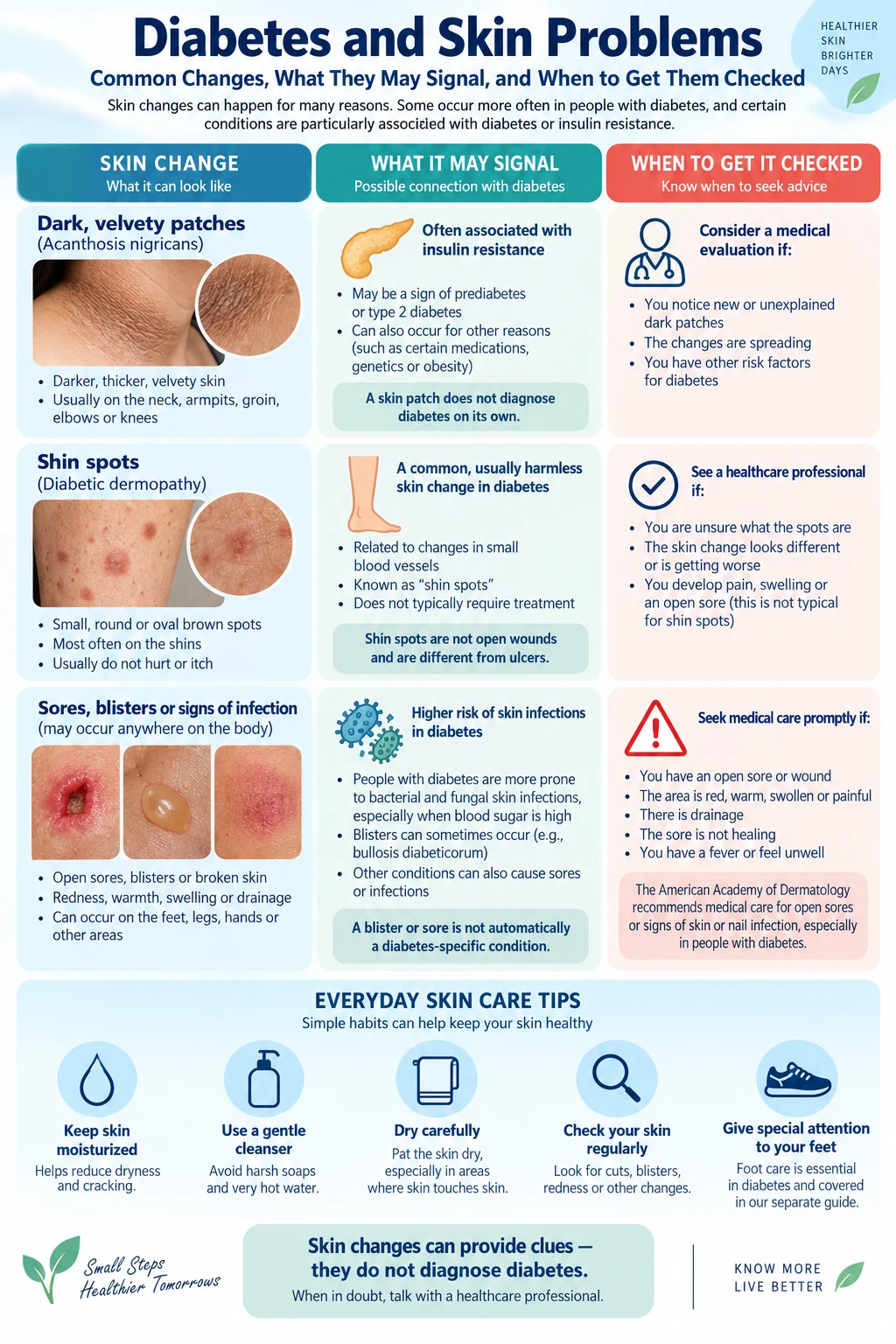
Acanthosis Nigricans: Dark, Velvety Skin Patches
Acanthosis nigricans causes areas of skin to become darker, thicker, and often velvety in texture.
It commonly develops in body folds and creases, especially around the neck, armpits, and groin. Patches can also occur on areas such as the hands, elbows, or knees.
Acanthosis nigricans is associated with insulin resistance and can be a sign of prediabetes or type 2 diabetes. It is not, however, a diagnosis of diabetes by itself.
Where these patches commonly appear
The characteristic texture is important. A patch may look darker than the surrounding skin and feel thicker or velvety.
Because the discoloration may resemble a surface stain, someone may initially try to scrub it away. The change is occurring in the skin itself rather than simply sitting on its surface.
The connection with insulin resistance
Insulin resistance occurs when cells do not respond to insulin as effectively as they should.
Because acanthosis nigricans is strongly associated with insulin resistance, its appearance can give a clinician a reason to consider whether metabolic evaluation is appropriate.
The relationship should not be reversed, though: a dark skin patch does not establish that a person has diabetes. Other explanations are possible, and appearance alone cannot make the diagnosis.
Diabetic Dermopathy: Shin Spots
Diabetic dermopathy, commonly called shin spots, usually appears as small round or oval reddish-brown or brown areas, most often on the shins.
The spots typically do not hurt, itch, or break open. Diabetic dermopathy is considered harmless and usually does not require treatment.
What diabetic dermopathy can look like
Shin spots can become flat and brown and may be mistaken for age-related changes in the skin.
Other conditions can also produce spots or discoloration on the legs, so appearance alone is not enough for self-diagnosis.
Shin spots are not open wounds
This distinction is especially important in diabetes.
Typical diabetic dermopathy does not form an open ulcer. A cut, sore, draining area, blister, or wound that is not healing should not simply be dismissed as a shin spot.
Open wounds—particularly on the feet—belong to a different clinical problem with different risks.
Less Common Diabetes-Related Skin Conditions
Several diabetes-associated skin disorders are considerably less common than dry skin or itching.
Knowing that they exist can be useful. Trying to identify one from a photograph or written description is much less reliable.
Necrobiosis lipoidica
Necrobiosis lipoidica is a rare condition that may begin with small raised areas and develop into larger yellowish, reddish, or brown patches.
Affected areas can become firm or shiny and may itch or hurt. In some cases, the skin can crack or break open.
Its cause is not clear, so an unexplained lesion should be evaluated rather than assumed to be necrobiosis lipoidica simply because someone has diabetes.
Diabetic blisters (bullosis diabeticorum)
Bullosis diabeticorum refers to uncommon blisters that can develop spontaneously in people with diabetes.
They are seen particularly on the feet and lower legs and can also occur on the hands or arms. They may resemble burn blisters but are typically painless.
The cause is not known. And because many conditions and injuries can produce blisters, a blister in someone with diabetes is not automatically a diabetic blister.
Eruptive xanthomatosis
Eruptive xanthomatosis causes crops of small bumps that can become yellowish and may be tender or itchy.
It is associated with very high triglyceride levels and can appear in the setting of poorly controlled diabetes. That lipid connection matters: the condition should not be presented simply as something that diabetes directly causes in every case.
Sudden unexplained bumps of this kind warrant medical evaluation rather than diagnosis from appearance alone.
Why Are Dry and Itchy Skin More Common With Diabetes?
Dry and itchy skin is common among people who do not have diabetes, too.
In diabetes, high blood glucose can contribute to fluid loss and dryness. Circulatory changes may also contribute to dry, itchy skin in some people.
Dryness can become more than a comfort issue when the skin cracks, because cracks weaken the barrier that normally helps protect underlying tissue.
High blood sugar, fluid loss, and dry skin
When blood glucose is high, the body may produce more urine as it removes excess glucose. The associated fluid loss can contribute to dryness.
But dry skin has many other explanations—including weather, bathing habits, aging, medications, and dermatologic conditions. It is therefore a nonspecific finding, not evidence of diabetes on its own.
When itching may have another cause
Itching has an even broader range of possible explanations.
Dryness, fungal infections, allergic reactions, dermatologic disorders, medications, and other medical conditions can all be involved.
Persistent, severe, widespread, or otherwise unexplained itching deserves evaluation instead of automatically being attributed to diabetes.
Skin Infections and Diabetes
People with diabetes are more prone to some bacterial and fungal skin infections, particularly when blood glucose levels are high.
These infections are not one condition and should not be grouped together as a single “diabetic skin disease.”
Bacterial skin infections
Bacterial infections may cause swelling, discoloration or redness, warmth, tenderness, pain, drainage, or other changes.
An infection can become more serious in a person with diabetes. Signs suggesting a skin or nail infection deserve prompt medical attention rather than being treated as ordinary dry or irritated skin.
Fungal skin infections
Fungal infections often favor warm, moist areas and can cause itchy or scaly rashes. Athlete's foot, ringworm, and infections involving skin folds are examples.
Anyone can develop a fungal infection, but these infections occur more readily in people with diabetes.
When Should a Skin Change Be Checked?
Not every new spot or patch is an emergency. Persistent, unexplained, painful, rapidly changing, or otherwise concerning skin changes are good reasons to talk with a health professional.
That distinction matters particularly on the feet, where reduced sensation and reduced blood flow can make an injury harder to notice and a sore harder to heal. Learn more in our guide to diabetes and foot problems .
New skin reactions can also occur in connection with diabetes medicines, insulin injections, continuous glucose monitors, or insulin pumps. A clinician or dermatologist can help determine whether a reaction is related to a medication, adhesive, device, injection site, or something unrelated.
Everyday Skin Care With Diabetes
Simple skin care can help maintain the skin barrier and reduce dryness and cracking.
Dermatologists recommend measures such as moisturizing regularly, using a gentle cleanser, bathing or showering in warm rather than hot water, and carefully drying areas where skin touches skin.
Regularly noticing changes in the skin is useful as well. Cuts, scratches, blisters, sores, swelling, or signs of infection deserve attention rather than being ignored because they seem small.
Feet require additional precautions in diabetes, which is why foot care is better treated as its own subject rather than compressed into general skin care.
The Bigger Picture: Skin Changes Are Not All the Same
There is no single appearance that represents “diabetic skin.”
A dark, velvety patch is not the same condition as a shin spot. A shin spot is not an ulcer. Dry skin is not an infection. And a blister in someone with diabetes is not automatically bullosis diabeticorum.
Some skin findings are associated with insulin resistance. Some occur more often in people with diabetes. Others are uncommon diabetes-associated disorders. And many everyday skin problems are not specific to diabetes at all.
That is why the most useful question is not simply “Does diabetes cause skin problems?”
It is: “What kind of skin change is this, and does it need professional evaluation?”
Skin can provide clues. Those clues still need context.
Sources
- Centers for Disease Control and Prevention — Diabetes and Your Skin
- American Diabetes Association — Diabetes and Skin Complications
- American Academy of Dermatology — Diabetes: 10 Warning Signs That Can Appear on Your Skin
- American Academy of Dermatology — Diabetes and Your Skin
- National Institute of Diabetes and Digestive and Kidney Diseases — Diabetes & Foot Problems