The liver plays a central role in metabolism. It helps manage glucose, stores energy and processes fats.
That also makes liver health closely connected with type 2 diabetes.
One of the most common liver conditions in this setting is metabolic dysfunction-associated steatotic liver disease (MASLD), the current name for what was previously called nonalcoholic fatty liver disease (NAFLD).
MASLD involves excess fat in the liver in a metabolic setting. Some people also develop inflammation and liver-cell injury, called MASH, while fibrosis refers to liver scarring.
These are related changes, but they are not inevitable steps that everyone with type 2 diabetes or MASLD will experience.
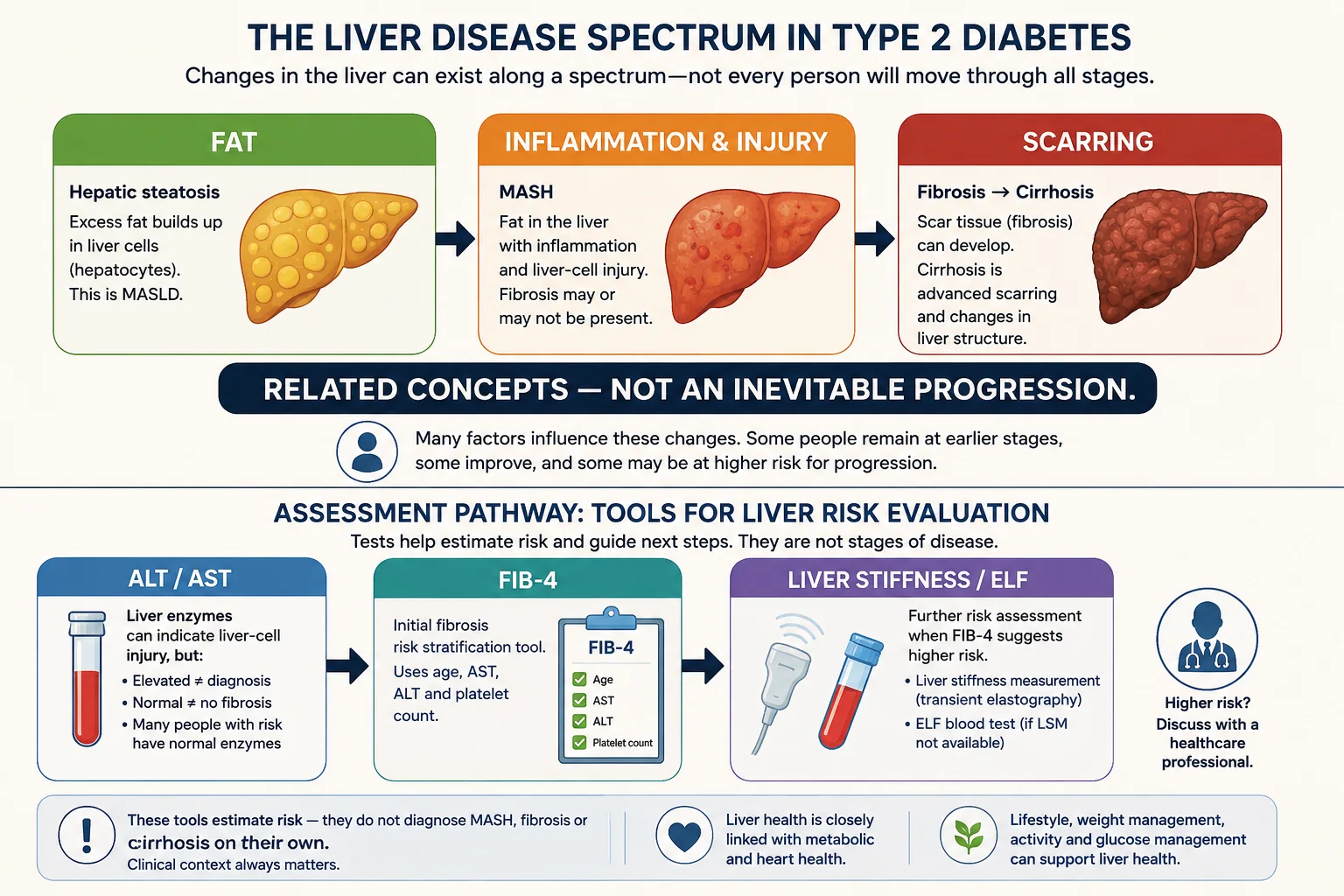
What Does the Liver Do in Metabolic Health?
The liver helps regulate the way the body stores, releases and processes energy.
The Liver Helps Manage Glucose
The liver can store glucose as glycogen and make glucose available again when the body needs it.
Its main functional cells, called hepatocytes, perform many of these metabolic tasks.
Insulin helps regulate this system.
The Liver Also Processes Fat
The liver normally processes fatty acids and triglycerides.
When the balance between fat entering, being produced, used and exported by the liver changes, excess fat can accumulate inside hepatocytes.
This is called hepatic steatosis.
Steatosis does not mean that the liver is failing, and it does not by itself mean that advanced liver disease will develop.
How Are Type 2 Diabetes and Liver Health Connected?
Type 2 diabetes and MASLD share several metabolic pathways. One of the most important is insulin resistance.
Insulin Resistance Connects the Two
With insulin resistance, cells do not respond to insulin as effectively as they normally would.
In the liver, altered insulin signaling can affect glucose and fat metabolism. Other metabolic factors, including excess adiposity, can also contribute to fat accumulation in the liver.
MASLD is therefore very common among people with type 2 diabetes, and diabetes is an important risk factor for MASH and worse liver outcomes.
The Relationship Is Not One-Way
The relationship is more complicated than “diabetes causes fatty liver.”
Type 2 diabetes and MASLD share metabolic risk factors, and each is associated with increased risk of the other. Cardiovascular risk also overlaps with these conditions.
What Is Fatty Liver Disease, or MASLD?
MASLD stands for metabolic dysfunction-associated steatotic liver disease.
It describes steatotic liver disease occurring in the presence of cardiometabolic risk, within the appropriate clinical context. Type 2 diabetes is one of those cardiometabolic risk factors.
What Does Fat Accumulation in the Liver Mean?
Excess fat within hepatocytes is called hepatic steatosis.
This is different from liver inflammation, fibrosis or liver failure.
Keeping those concepts separate matters because the presence of liver fat alone does not tell us how much liver injury or scarring is present.
MASLD Is the Current Name
Readers may still encounter fatty liver, NAFLD and NASH in older articles or medical records.
Current terminology uses MASLD — metabolic dysfunction-associated steatotic liver disease — and MASH — metabolic dysfunction-associated steatohepatitis.
MASLD replaced NAFLD, while MASH replaced NASH. The newer terminology emphasizes the metabolic context of the disease.
What Is MASH?
MASLD and MASH are related, but they are not interchangeable.
MASLD and MASH Are Not the Same Thing
MASH involves liver fat together with inflammation and hepatocyte injury. Fibrosis may or may not also be present.
MASH is not diagnosed from an ALT, AST or FIB-4 result alone.
Not Everyone With MASLD Develops MASH
Having MASLD does not mean that MASH will inevitably develop.
Likewise, MASH does not mean that cirrhosis is inevitable.
What matters clinically is identifying people whose liver disease carries greater risk, particularly when significant fibrosis may be present.
What Do Fibrosis and Cirrhosis Mean?
Fibrosis means scar tissue has developed in the liver in response to injury.
It is different from steatosis itself.
Fibrosis Means Liver Scarring
Fibrosis can vary in severity. More advanced fibrosis is associated with greater risk of liver-related complications.
But fibrosis cannot be assumed simply because someone has type 2 diabetes or liver fat.
Cirrhosis Is Advanced Scarring
Cirrhosis represents advanced fibrosis accompanied by substantial changes in normal liver structure.
It is a serious condition, but it is not the automatic endpoint of MASLD.
related concepts, not an inevitable progression
Can MASLD Be Present Without Symptoms?
Yes.
MASLD and MASH can exist for years without obvious symptoms. That makes symptoms alone a poor way to identify liver disease.
A person may feel well while liver changes are present, while nonspecific symptoms such as fatigue cannot establish a diagnosis.
For people at increased metabolic risk, clinical assessment and appropriate testing provide much more useful information than symptoms alone.
What Do ALT and AST Tell You?
ALT, or alanine aminotransferase, and AST, or aspartate aminotransferase, are enzymes commonly measured in blood tests.
They can provide information about liver-cell injury, but they do not describe the entire condition of the liver.
Liver Enzymes Have Limits
Elevated ALT or AST can occur for different reasons and does not by itself diagnose MASLD or MASH.
The reverse is also important: normal liver enzymes do not guarantee that significant fibrosis is absent.
That is why fibrosis risk assessment uses more than liver enzymes alone.
What Is FIB-4?
FIB-4, or the Fibrosis-4 Index, is a noninvasive tool used for initial fibrosis risk stratification.
It helps estimate the likelihood of advanced fibrosis and identify people who may need further assessment.
What Information Is Used in FIB-4?
FIB-4 uses four pieces of clinical information:
- age
- AST
- ALT
- platelet count
FIB-4 Is a Risk Tool, Not a Diagnosis
A FIB-4 result does not by itself diagnose MASLD, MASH or cirrhosis.
Its interpretation also depends on factors such as age and clinical context. For that reason, an isolated score should not be treated as a self-diagnosis.
What Happens When FIB-4 Suggests Higher Risk?
When FIB-4 indicates that further assessment is appropriate, another noninvasive test may be used.
Liver Stiffness Measurement
Transient elastography can be used to measure liver stiffness.
Greater stiffness can be associated with fibrosis, but the result still requires clinical interpretation.
What Is the ELF Test?
The Enhanced Liver Fibrosis (ELF) test is a blood-based test used for further fibrosis risk assessment.
Current guidance uses liver stiffness measurement with transient elastography as an important next step after a higher-risk FIB-4 result, with ELF as an alternative when liver stiffness measurement is unavailable.
These are second-step assessment tools, not stages of liver disease.
Who Should Be Assessed for Liver Fibrosis With Type 2 Diabetes?
Current diabetes guidance recommends fibrosis risk screening in adults with type 2 diabetes or prediabetes, particularly when obesity, other cardiometabolic risk factors or established cardiovascular disease are present.
Importantly, this recommendation applies even when liver enzymes are normal.
Screening Is About Risk, Not Assuming Disease
Screening does not mean that every person with type 2 diabetes has MASH or advanced fibrosis.
Its purpose is to identify people at lower risk and those who may benefit from additional evaluation.
Can MASLD Improve?
MASLD is not necessarily static.
For people with overweight or obesity, gradual weight loss can reduce liver fat. Sustained metabolic improvement may also improve inflammation and fibrosis in some people, and physical activity can provide benefits even without weight loss.
But improvement in liver fat or another marker does not guarantee complete reversal of established fibrosis.
What Helps Protect Liver Health in Type 2 Diabetes?
Liver health is closely tied to broader metabolic health.
Depending on the individual, management may involve nutrition, physical activity, weight management, glucose management and appropriate medical treatment.
Treatment choices depend on factors such as weight, glycemic needs, fibrosis risk and other health conditions. They should not be selected from a liver test or risk score alone.
Be Careful With “Liver Detox” Claims
“Liver detox” or “cleanse” products are not substitutes for evidence-based evaluation and treatment.
Some dietary or herbal supplements can themselves cause liver injury, so people with liver disease should discuss supplement use with an appropriate healthcare professional.
When Should Liver Findings Be Discussed With a Healthcare Professional?
An abnormal liver test or fibrosis risk score needs context.
Age, medical history, medications, metabolic risk factors, alcohol exposure, previous results and other possible causes of liver disease can all affect interpretation.
Higher Fibrosis Risk May Need Further Evaluation
Current guidance recommends gastroenterology or hepatology evaluation when noninvasive assessment indicates a higher risk of significant liver fibrosis.
Other Causes of Liver Disease Still Matter
Having type 2 diabetes does not prove that every abnormal liver result is caused by MASLD.
Other liver diseases, medications and clinical conditions may need to be considered. Persistent abnormalities deserve appropriate clinical evaluation rather than being attributed automatically to diabetes.
The Bigger Picture: Fat, Inflammation and Scarring
Hepatic steatosis means excess fat has accumulated in the liver. In the appropriate metabolic setting, this is part of MASLD.
INFLAMMATION AND INJURY
MASH involves steatosis together with inflammation and liver-cell injury.
SCARRING
Fibrosis means scar tissue has developed. Cirrhosis represents advanced fibrosis.
These changes are related, but they are not an inevitable progression for every person with MASLD or type 2 diabetes.
The assessment tools are separate from the disease itself.
ALT and AST provide biochemical information. FIB-4 helps with initial fibrosis risk stratification. Liver stiffness measurement or ELF can provide further risk assessment when appropriate.
For people with type 2 diabetes, the purpose of this evaluation is not to predict that advanced liver disease will occur. It is to recognize clinically important risk earlier and determine when further evaluation may be useful.
Sources & Medical References
- American Diabetes Association — Standards of Care in Diabetes—2026: Comprehensive Medical Evaluation and Assessment of Comorbidities
- EASL–EASD–EASO Clinical Practice Guidelines on MASLD — 2024
- NIDDK — Fatty Liver / MASLD Treatment Information
- CDC — Type 2 Diabetes and Your Liver
Published: September 1, 2026 · Last reviewed: September 1, 2026