Tooth sensitivity can make an ordinary sip of cold water, a hot drink, something sweet or acidic, or even a breath of cool air feel unexpectedly uncomfortable.
But “sensitive teeth” describes a symptom — not a single diagnosis.
Different dental conditions can produce sensitivity, and the trigger alone does not reveal what is causing it. Exposed dentin is one important explanation, but tooth decay, cracks, worn restorations, and other dental problems can produce similar symptoms.
That distinction is especially important when discussing dentin hypersensitivity, a more specific clinical condition that should not be used as a synonym for every sensitive tooth.
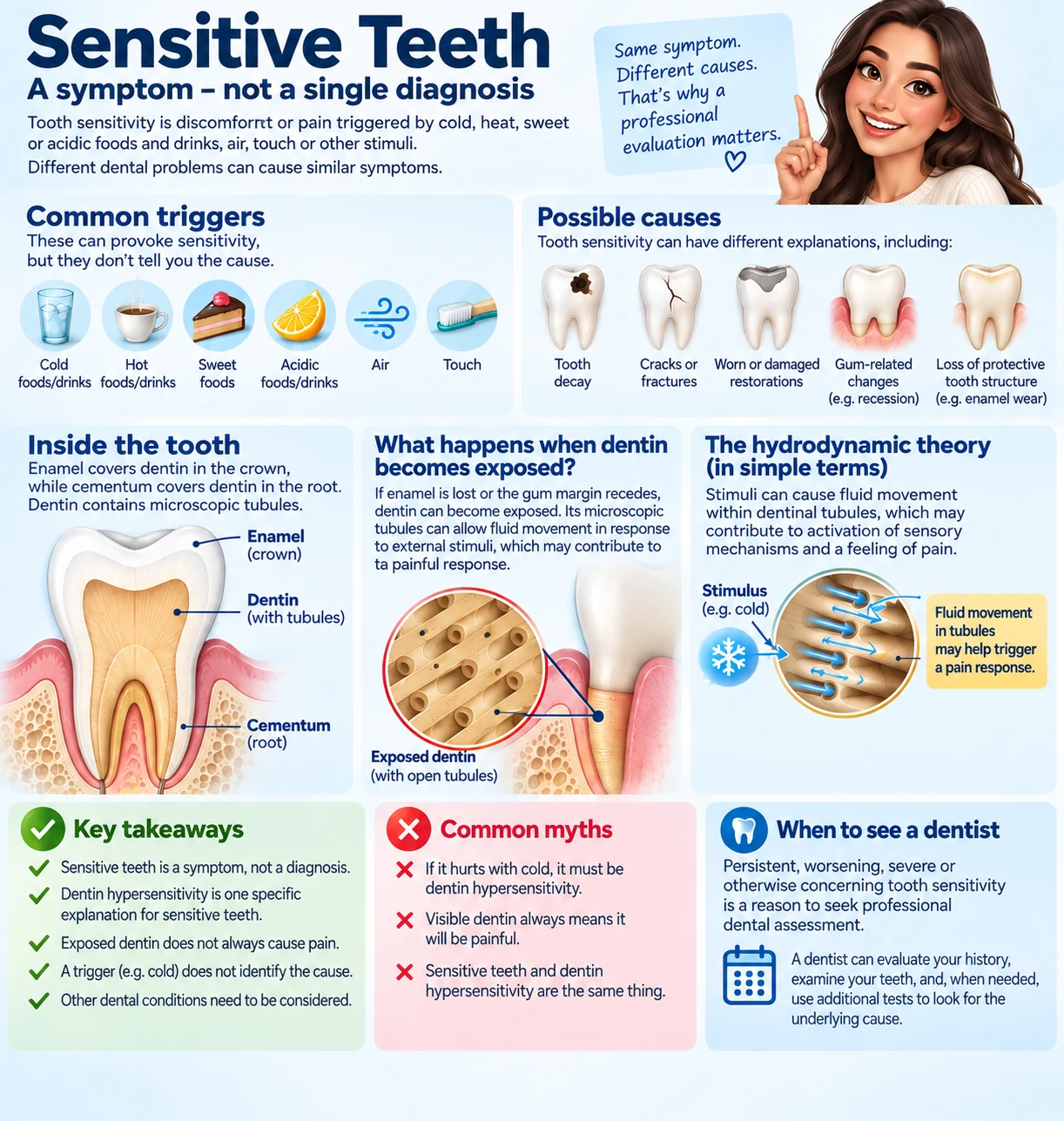
What Does “Sensitive Teeth” Actually Mean?
People generally use the term sensitive teeth to describe discomfort or pain triggered by cold, heat, sweet or acidic foods and drinks, air, touch, or other stimuli.
The experience may feel brief and sharp in some situations, but the presence of a particular sensation does not establish its cause.
Tooth Sensitivity Is a Symptom, Not a Single Diagnosis
Tooth sensitivity can occur for different reasons.
Possible explanations include tooth decay, fractured teeth, worn restorations, gum-related changes, loss of protective tooth structure, and exposed tooth roots.
These possibilities do not mean that a person experiencing sensitivity has any particular one of them.
Why Different Dental Problems Can Feel Similar
Different dental problems can overlap in the way they are experienced.
A tooth affected by exposed dentin may respond to cold. A tooth with decay or a crack may also be sensitive.
For that reason, describing the trigger is useful information, but it is not enough to identify the diagnosis.
Why Can Teeth Become Sensitive?
There is no single explanation for all tooth sensitivity.
One important pathway involves dentin, the mineralized tissue beneath enamel in the crown of the tooth and beneath cementum around the root.
Unlike enamel, dentin contains large numbers of microscopic tubules.
When dentin becomes exposed to the oral environment, these tubules become relevant to understanding one important form of sensitivity.
Exposed Dentin Is One Possible Explanation
In the tooth crown, enamel covers the underlying dentin, while cementum covers dentin along the root.
If those protective coverings are lost or if the gum margin recedes and exposes part of the root, dentin may become exposed.
That exposure can create conditions in which external stimuli interact with dentinal tubules and contribute to a painful response.
Enamel Wear and Gum Recession Can Change What Is Exposed
Changes that reduce the protective covering over dentin can alter which tooth tissues are exposed to the oral environment.
Loss of the protective enamel covering can leave underlying dentin exposed. Gingival recession can expose root surfaces that were previously covered by gum tissue.
These changes are relevant when considering dentin hypersensitivity because exposed dentin is central to the condition.
They do not, however, mean that every area of exposed dentin will necessarily be painful.
Cavities, Cracks, and Other Dental Problems Can Also Cause Sensitivity
Sensitivity should not automatically be attributed to exposed dentin.
Tooth decay, fractured teeth, worn or damaged restorations, and other dental conditions can produce similar complaints.
That is why other possible dental causes need to be considered when evaluating sensitivity.
Our separate guide to tooth decay and dental caries explains how early noncavitated decay differs from a cavity. Here, the important point is simply that decay belongs among the possible explanations for tooth sensitivity rather than being assumed from the symptom alone.
Why Can Cold, Hot, Sweet, or Acidic Foods Trigger Tooth Sensitivity?
Temperature changes and certain foods or drinks are common situations in which people notice sensitive teeth.
In dentin hypersensitivity specifically, thermal, evaporative, tactile, osmotic, and chemical stimuli have been described as possible triggers.
But a trigger answers a different question from a diagnosis.
A Trigger Does Not Tell You the Cause
If a tooth hurts when exposed to cold, that tells us something about what provoked the sensation.
It does not, by itself, tell us why the tooth responded that way.
The same principle applies to hot, sweet, or acidic stimuli.
A pattern of triggers can be clinically useful information, but it needs to be interpreted alongside dental history, examination, and other findings.
Why Air or Touch Can Sometimes Trigger Sensitivity Too
Dentin hypersensitivity is not limited to food and drinks.
Air directed across exposed dentin or physical contact with the area may also provoke a response.
This broader range of triggers is one reason the condition is described in relation to several categories of stimuli rather than simply as “cold-sensitive teeth.”
What Is Dentin Hypersensitivity?
Dentin hypersensitivity is more specific than the everyday phrase sensitive teeth.
Clinical literature describes dentin hypersensitivity as a characteristic pain response arising from exposed dentin following particular stimuli, after other dental conditions that could explain the pain have been considered or excluded.
Why Dentin Hypersensitivity Is More Specific Than “Sensitive Teeth”
Someone can report tooth sensitivity without necessarily having dentin hypersensitivity.
Dentin hypersensitivity involves a particular clinical context: exposed dentin, a stimulus-related pain response, and consideration of other dental conditions that could better explain the symptoms.
Why Other Dental Causes Need to Be Considered
This diagnostic boundary exists because several dental problems can produce similar complaints.
Clinical evaluation may therefore consider dental history, examination, responses to controlled stimuli and, when indicated, radiographic information or other findings while looking for alternative explanations.
That is why diagnosing dentin hypersensitivity is not simply a matter of asking whether cold water hurts.
How Can Exposed Dentin Produce a Painful Response?
Dentin is not structured like enamel.
It contains microscopic channels called dentinal tubules, extending through the dentin toward the inner part of the tooth.
When dentin is exposed and tubules are open to the oral environment, external stimuli can interact with this system.
What Are Dentinal Tubules?
Dentinal tubules are microscopic channels within dentin.
Their presence helps distinguish dentin structurally from enamel and is central to current explanations of dentin hypersensitivity.
But saying that dentin contains tubules does not mean that a cold stimulus simply “travels down a tube and touches the nerve.”
The proposed mechanism is more complex.
What Does the Hydrodynamic Theory Propose?
The hydrodynamic theory has long been the predominant explanation for dentin-hypersensitivity pain.
It proposes that stimuli acting on exposed dentin can produce fluid movement within dentinal tubules, contributing to activation of sensory mechanisms associated with pain.
Current research also examines additional cellular and neural mechanisms, so the hydrodynamic model should not be treated as a complete explanation of every biological step.
Does Exposed Dentin Always Cause Tooth Sensitivity?
No.
Dentin exposure is relevant to dentin hypersensitivity, but exposure and pain are not identical concepts.
Characteristics of dentinal tubules — including whether they are open and patent — can be relevant to sensitivity. Simply identifying exposed dentin does not establish that a particular site is producing a hypersensitivity response.
Why Dentin Exposure and Pain Are Not the Same Thing
This distinction prevents another common oversimplification:
Dentin lies outside the dental pulp. Its microscopic tubules and their relationship with fluid movement and sensory structures help explain why exposed dentin can participate in sensitivity without a nerve literally being uncovered at the tooth surface.
Therefore, dentin exposure may help create the conditions for dentin hypersensitivity, but dentin exposure alone does not diagnose it.
Can You Tell What Is Causing Tooth Sensitivity at Home?
A person can notice useful details about a symptom — which tooth seems affected, what triggers the sensation, when it began, and whether it changes.
Those observations do not reliably establish the underlying diagnosis.
Different dental conditions can overlap in symptoms, and dentin hypersensitivity itself requires consideration of alternative explanations.
Why the Trigger Alone Cannot Identify the Cause
Cold, heat, sweetness, acidity, air, or touch may provide clues about when sensitivity occurs.
None of these stimuli functions as a stand-alone diagnostic test.
A response to cold, for example, cannot by itself distinguish dentin hypersensitivity from every other dental condition capable of producing temperature sensitivity.
Why Appearance, Location, or Pain Duration Are Not Enough for a Diagnosis
The appearance and location of a tooth may provide clinically relevant information, as can the character and duration of pain.
But these findings need interpretation in context.
A visible change does not necessarily reveal its biological cause, and a particular pain pattern cannot safely be converted into a diagnosis without considering other dental explanations.
That boundary is especially important because “sensitive teeth” is a symptom category much broader than dentin hypersensitivity.
When Does Tooth Sensitivity Need Professional Dental Assessment?
Because sensitivity has multiple possible causes, professional dental assessment can help distinguish dentin hypersensitivity from tooth decay, cracks, restoration-related problems, and other dental conditions.
Persistent, worsening, severe, or otherwise concerning tooth sensitivity is a reason to seek professional dental assessment.
Assessment may involve dental history and clinical examination and, depending on the situation, additional diagnostic information.
Sources & References
- American Dental Association (MouthHealthy) — Sensitive Teeth
- PubMed PMID 32762733 — Clinical review of dentin hypersensitivity
- PubMed PMID 42004794 — Contemporary review of dentin hypersensitivity
- PubMed PMID 42642981 — Consensus work on dentin hypersensitivity definition and diagnostic criteria
- PubMed PMID 40216070 — Review of cellular and neural mechanisms in dentin hypersensitivity
- PubMed PMID 1508879 — Dentinal tubules and hypersensitive dentin
Last updated: September 17, 2026.