Tooth decay is often pictured as a hole in a tooth. But a visible cavity is only one possible point in a broader process.
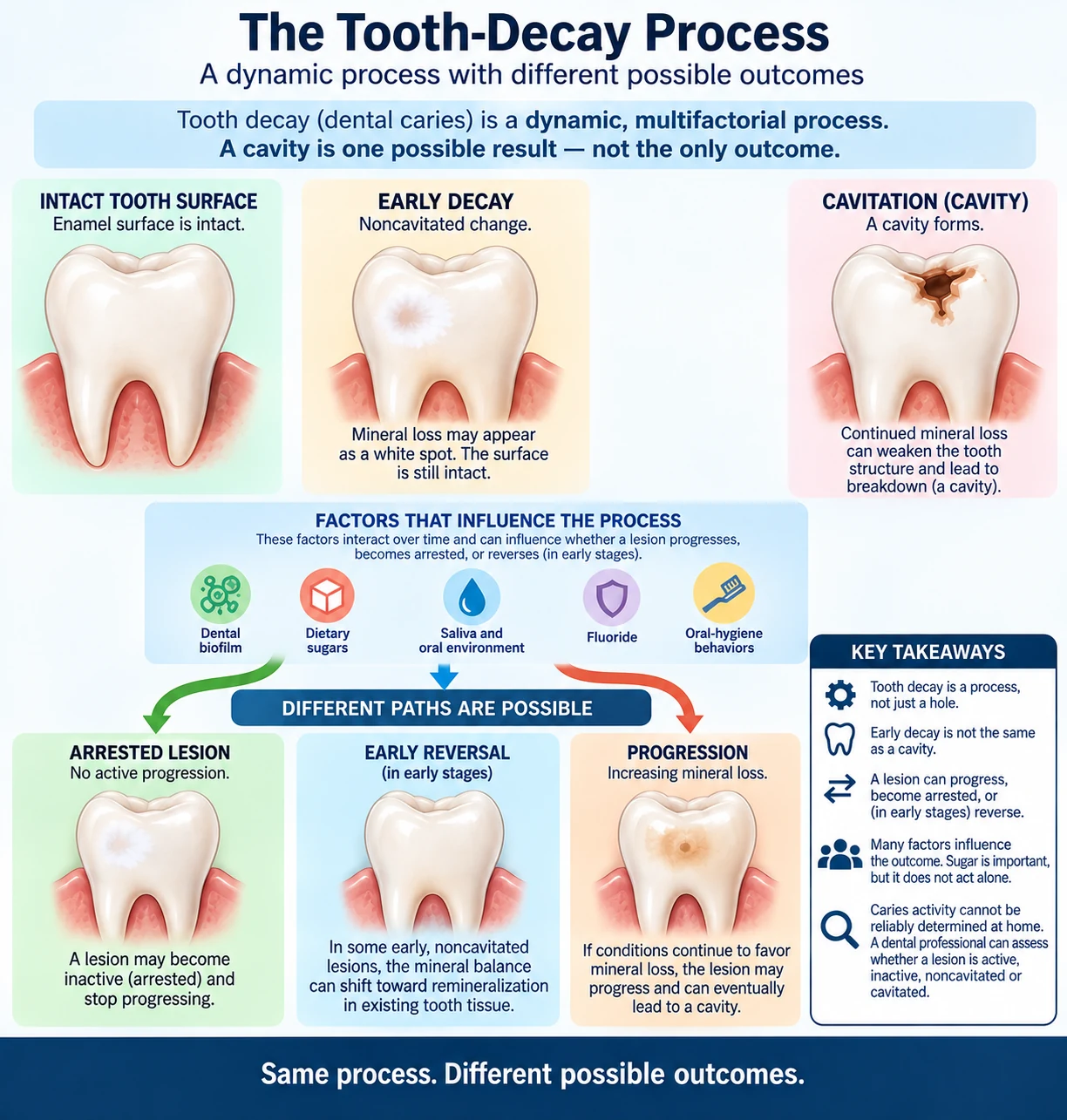
Dental caries — another term commonly used for tooth decay — is a dynamic, multifactorial disease process involving dental biofilm, dietary sugars, the oral environment, and the balance between factors that favor mineral loss and those that help protect tooth structure. The process can begin before a cavity is present, and its course is not identical in every tooth or every person.
Understanding that distinction helps make sense of several questions: What exactly is tooth decay? When does early decay become a cavity? Does every early lesion progress? And what does it really mean when early tooth decay is described as reversible?
What Is Tooth Decay?
Dental caries is not simply a hole that suddenly appears in a tooth. The term can refer to the disease process itself as well as to the noncavitated or cavitated lesions that can result from that process.
Modern definitions describe dental caries as biofilm-mediated, sugar-driven, multifactorial, and dynamic. This means that the process involves microbial activity within dental biofilm, exposure to fermentable carbohydrates, and multiple protective and disease-promoting factors interacting over time.
Why Dental Caries Is More Than Just a “Hole in a Tooth”
A cavity represents structural breakdown, but caries can exist before that breakdown occurs.
Early changes may involve mineral loss while the tooth surface remains intact. If the process continues and mineral loss exceeds what can be restored, tooth structure can eventually weaken and break down, producing a cavity.
So the absence of a visible hole does not, by itself, establish that no caries process is occurring.
Why Tooth Decay Is Considered a Dynamic, Multifactorial Process
Caries develops through interactions rather than through one isolated cause.
Bacteria within dental biofilm can metabolize dietary carbohydrates and produce acids. At the same time, factors including salivary conditions, fluoride exposure, dietary patterns, oral hygiene, and characteristics of the local tooth environment can influence whether mineral balance shifts toward loss, stability, or gain.
Because these influences can change, caries is not necessarily a one-way process from healthy tooth to cavity.
How Does Tooth Decay Develop?
The caries process involves repeated interactions among dental biofilm, fermentable carbohydrates, acid production, and tooth mineral.
When bacteria in dental biofilm metabolize carbohydrates, acidic by-products can lower the pH around the tooth surface. Under conditions that favor net mineral loss, early changes can begin in dental hard tissue.
This is where tooth decay intersects with — but does not replace — the broader concepts of enamel demineralization and remineralization.
The Role of Dental Biofilm, Sugars, and Acid Production
Dental biofilm contains microbial communities attached to oral surfaces. When microorganisms within that biofilm ferment dietary carbohydrates, they produce acids that can contribute to mineral loss from dental hard tissues.
Sugars play an important role in the caries process, but they are not the whole explanation.
The caries process is influenced by the interaction between biofilm metabolism, carbohydrate exposure and multiple protective and disease-promoting factors over time.
Why Early Mineral Loss Does Not Automatically Mean a Cavity
Mineral loss can occur before there is physical cavitation.
The NIDCR describes early decay as a stage in which mineral loss may be visible as a white spot while the enamel surface has not yet broken down into a cavity.
The mineral processes themselves are explored separately in our guide to tooth enamel demineralization and remineralization.
What Is a Cavity?
A cavity involves structural loss or breakdown of tooth tissue.
Within the caries process, cavitation can occur when continued mineral loss and structural weakening reach the point at which the tooth surface breaks down.
A cavity therefore tells us something different from the broader term tooth decay.
How a Cavity Relates to the Tooth-Decay Process
One way to understand the relationship is to think of dental caries as a process that can produce lesions of different severities.
Some caries lesions are noncavitated: changes are present, but the surface has not formed a cavity. Others are cavitated and involve structural breakdown.
The ADA explicitly recognizes both noncavitated and cavitated caries lesions within the caries continuum.
Why Tooth Decay and a Cavity Are Not Perfect Synonyms
In everyday conversation, tooth decay and cavity are often used interchangeably. Clinically, however, they do not describe exactly the same thing.
Dental caries can refer to the disease process and the lesions resulting from it, including lesions that have not cavitated. A cavity describes structural loss or breakdown.
That is why a person can have an early caries lesion without yet having a cavity.
What Factors Can Influence Tooth Decay?
No single factor fully explains whether caries develops or progresses.
The process reflects an interaction between disease-promoting and protective influences that can vary among people, among teeth, and over time.
Why Sugar Is Important — but Not the Whole Story
Dietary carbohydrates provide substrates that microorganisms in dental biofilm can ferment, producing acidic by-products. For that reason, sugar exposure is an important part of the caries process.
But eating sugar is not, by itself, a complete explanation for why a particular lesion develops.
The biological environment also includes the biofilm itself, salivary conditions, fluoride exposure, preventive behaviors and other factors affecting the balance between mineral loss and protection.
Biofilm, Saliva, Fluoride, and the Oral Environment
Dental biofilm provides the microbial environment in which carbohydrate fermentation and acid production can occur.
Saliva contributes to the oral environment, while fluoride can influence the balance between demineralization and remineralization. Oral-hygiene practices can also affect biofilm accumulation and the conditions surrounding tooth surfaces.
These factors interact. None should be interpreted as a stand-alone guarantee that caries will or will not develop.
Does Tooth Decay Always Progress?
No. Dental caries is dynamic, and a lesion does not necessarily follow an inevitable path toward increasing destruction.
Depending on conditions over time, the caries process may progress, become arrested, or — in some early stages — reverse.
This is one reason modern caries assessment involves more than simply asking whether a lesion exists.
Why an Early Lesion Does Not Have One Inevitable Outcome
An early lesion represents a point in a changing biological process, not a guaranteed forecast of a future cavity.
If conditions continue to favor net mineral loss, a lesion may progress. If the balance changes, progression may slow or stop, and early changes may in some circumstances undergo mineral gain.
The presence of an early lesion therefore does not tell us, by itself, exactly what will happen next.
What “Active” and “Inactive” Caries Lesions Mean
Lesion activity concerns whether the caries process at that site appears to be currently progressing or has become arrested.
An active lesion shows characteristics consistent with ongoing caries activity, whereas an inactive or arrested lesion does not show the same evidence of current activity.
Importantly, activity is a clinical assessment. Current consensus recommendations emphasize that no single clinical feature is enough to determine lesion activity; multiple characteristics must be considered, and monitoring over time can be important.
Can Early Tooth Decay Be Reversed?
In some early stages, tooth decay can be stopped or reversed before cavitation occurs.
The word reversed, however, needs careful interpretation.
It does not mean that tooth structure that has already been physically lost grows back.
It refers to changes in an early, noncavitated process in which the mineral balance can shift away from continued net loss and toward mineral gain or arrest. The NIDCR specifically distinguishes this early stage from the later breakdown that produces a cavity.
What “Reversal” Means Before Cavitation
Before structural breakdown has occurred, mineral changes in existing enamel may still respond to a more favorable oral environment.
This is why early caries and established cavitation should not be treated as interchangeable concepts.
Why Reversal Does Not Mean Regrowing Lost Tooth Structure
Once tooth structure has physically broken down, describing the situation as simple remineralization becomes misleading.
Remineralization involves mineral gain within structurally present dental tissue. It is not the biological regeneration of tooth structure that has already been lost.
That distinction is covered in greater detail in our enamel demineralization and remineralization guide.
Can You Tell Whether Tooth Decay Is Active at Home?
Not reliably from a single visible characteristic or symptom.
Caries lesions can differ in appearance, texture, location and severity. Although dental professionals use clinical characteristics when assessing lesion activity, current consensus guidance emphasizes that no single characteristic determines whether a lesion is active.
Why Appearance or Symptoms Alone Cannot Establish Lesion Activity
Color alone is not enough to establish activity. Neither is the presence or absence of pain.
Early tooth decay often produces no symptoms, while more advanced disease may be associated with sensitivity or pain. But symptoms do not provide a complete assessment of lesion depth, activity or progression.
Professional assessment may involve clinical examination and, when appropriate, additional diagnostic information such as dental radiographs.
When Does Tooth Decay Need Professional Dental Assessment?
Because early caries may have no symptoms and lesion activity cannot be established reliably from appearance alone, dental assessment can help determine whether a suspicious change represents caries and whether a lesion appears active, inactive, noncavitated or cavitated.
Pain, increasing sensitivity, a visible hole, swelling, or other concerning dental changes are reasons to seek professional evaluation.
Sources & References
- American Dental Association — Caries Risk Assessment and Management
- American Dental Association — Nutrition and Oral Health
- National Institute of Dental and Craniofacial Research (NIDCR) — Tooth Decay
- NIDCR — The Tooth Decay Process: How to Reverse It and Avoid a Cavity
- PubMed — ORCA/EFCD consensus on caries lesion activity and progression (2024)
- PubMed — ORCA/EFCD consensus on caries detection and assessment (2024)
Published: September 17, 2026 · Last reviewed: September 17, 2026