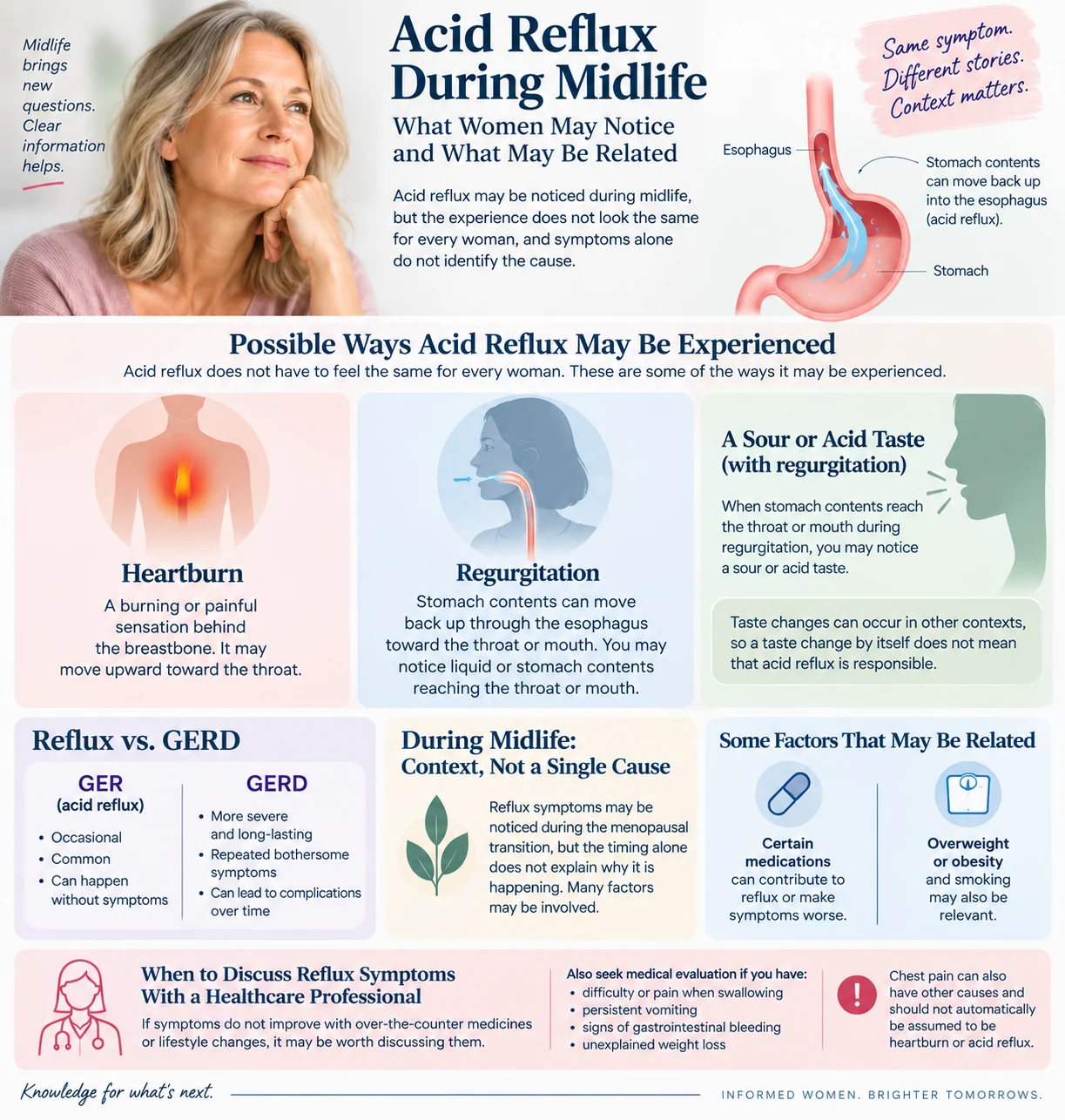
Acid reflux may be noticed during midlife, but the experience does not look exactly the same for every woman. Some women may notice heartburn, while others may experience regurgitation or a sour or acid taste when stomach contents reach the throat or mouth.
These symptoms can occur during the years around the menopausal transition, but their timing alone does not explain why reflux is happening. Acid reflux can occur in different circumstances, and experiencing it during midlife does not by itself establish that a woman has gastroesophageal reflux disease, or GERD.
Understanding the different ways reflux may be experienced can help a woman describe what she has noticed without assuming a cause or diagnosis from the symptoms alone.
What Does Acid Reflux Mean?
Acid reflux, also called gastroesophageal reflux or GER, occurs when stomach contents move back up into the esophagus.
This can sometimes lead to symptoms such as heartburn or regurgitation. However, not everyone experiences reflux in exactly the same way, and the presence of a particular symptom does not identify why the reflux is occurring.
Occasional acid reflux is not the same thing as automatically having GERD.
Acid Reflux May Be Noticed During Midlife
A woman may first notice reflux symptoms, or changes in an existing pattern of reflux, during midlife.
The experience may involve heartburn, regurgitation or more than one reflux-related symptom. Symptoms may also differ in how often they occur or how bothersome they feel.
Noticing reflux during midlife provides useful context, but it does not establish that midlife itself caused the symptoms.
Why Midlife Does Not Point to a Single Explanation
Many aspects of health, medication use and daily life can change during the same years in which a woman notices reflux symptoms.
Because several circumstances may overlap, the timing of heartburn or regurgitation cannot determine its explanation on its own.
The important distinction is between when reflux symptoms are noticed and why they are occurring.
How the Menopausal Transition May Be Related to Reflux Symptoms
Reflux symptoms have been studied in women during midlife and after menopause, but the available observational evidence does not establish that the menopausal transition causes reflux in an individual woman.
A systematic review and meta-analysis has also reported an association between menopausal hormone therapy and GERD, although the authors advised caution because the included studies were few and heterogeneous. These findings do not establish why an individual woman experiences reflux symptoms.
For that reason, neither the timing of the menopausal transition nor the use of menopausal hormone therapy should be treated as an automatic explanation for reflux.
Acid Reflux Can Be Experienced in Different Ways
Acid reflux does not have to feel the same from one woman to another. Heartburn and regurgitation are among the ways reflux may be experienced.
Heartburn May Feel Like Burning Behind the Breastbone
Heartburn is commonly described as a painful or burning sensation behind the breastbone.
The sensation may move upward toward the throat. Although heartburn commonly occurs with acid reflux, experiencing heartburn does not by itself establish why it is occurring or mean that a woman has GERD.
Regurgitation May Bring Stomach Contents Toward the Throat or Mouth
Regurgitation occurs when stomach contents move back up through the esophagus toward the throat or mouth.
A woman may notice liquid or stomach contents reaching the back of the throat or mouth. Regurgitation can occur with reflux, but the experience alone does not determine why it is happening.
A Sour or Acid Taste May Occur With Regurgitation
When stomach contents reach the throat or mouth during regurgitation, a woman may notice a sour or acid taste.
In this context, the taste is part of the reflux or regurgitation experience. It should not be treated as an explanation for persistent or otherwise unexplained changes in taste.
Taste changes can occur in other contexts, so a taste change by itself does not establish that acid reflux is responsible.
Heartburn and Acid Reflux Are Not Exactly the Same Thing
Heartburn and acid reflux are closely related terms, but they do not describe exactly the same thing.
Acid reflux refers to stomach contents moving back into the esophagus. Heartburn describes a burning or painful sensation that may occur when reflux happens.
A woman may therefore experience reflux without describing her main symptom as heartburn. Likewise, experiencing a burning sensation does not by itself determine its cause.
What Is the Difference Between Acid Reflux and GERD?
Occasional acid reflux, also called GER, is common. GERD is a more severe and long-lasting condition in which reflux causes repeated bothersome symptoms or leads to complications over time.
Having an episode of heartburn or regurgitation does not by itself establish that a woman has GERD.
Whether symptoms fit a diagnosis of GERD depends on the broader clinical context rather than on a single reflux episode or on the fact that symptoms appeared during midlife.
Why Reflux Symptoms Alone Cannot Tell You the Cause
Heartburn, regurgitation and other reflux-like symptoms describe what a woman may experience; they do not identify why those symptoms are occurring.
Different circumstances may be relevant to reflux, and more than one factor may sometimes be involved.
Neither a particular symptom nor its timing during midlife is enough to determine an individual cause.
Different Circumstances May Be Relevant to Reflux Symptoms
Medication use and individual health circumstances may provide useful context when reflux symptoms appear or change.
Their presence does not automatically mean that any one circumstance explains the symptoms.
Medications May Provide Relevant Context
Some medications can contribute to GERD or make reflux symptoms worse.
If reflux symptoms appear or change after a medication change, the timing may be useful information to discuss with a healthcare professional. It does not prove that the medication is responsible.
Medication should not be stopped or changed solely because reflux symptoms have appeared without discussing the situation with an appropriate healthcare professional.
Individual Health Circumstances May Also Be Relevant
Different health circumstances can affect the likelihood of experiencing GERD or reflux symptoms.
Circumstances such as overweight or obesity and smoking may provide clinical context, but their presence does not determine the cause of reflux symptoms in an individual woman.
Because several circumstances can overlap, reflux symptoms alone cannot distinguish among possible explanations.
When Is It Worth Discussing Reflux Symptoms With a Healthcare Professional?
Reflux symptoms that do not improve with over-the-counter medicines or lifestyle changes may be worth discussing with a healthcare professional.
Medical evaluation is also important when reflux-like symptoms occur with difficulty or pain when swallowing, persistent vomiting, signs of gastrointestinal bleeding or unexplained weight loss.
Chest pain deserves particular caution. Although chest discomfort can occur in people with reflux, chest pain can also have causes unrelated to the digestive system and should not automatically be assumed to be heartburn or acid reflux.
A healthcare professional can consider the broader context, including symptoms, medications, health history and other individual circumstances, when deciding whether further evaluation is appropriate.
Acid reflux during midlife can be experienced in different ways and in different contexts. Recognizing what has changed can help a woman describe her experience more clearly without assuming that midlife, the menopausal transition or any single factor explains it.
Sources
- National Institute of Diabetes and Digestive and Kidney Diseases (NIDDK). Acid Reflux (GER & GERD) in Adults.
- National Institute of Diabetes and Digestive and Kidney Diseases (NIDDK). Symptoms & Causes of GER & GERD in Adults.
- Peer-reviewed observational research on reflux symptoms across menopausal contexts.
- Peer-reviewed systematic review and meta-analysis examining menopausal hormone therapy and GERD.