Bladder Leaks During Midlife: Why They May Become More Noticeable
Bladder leaks can be frustrating, unexpected and sometimes difficult to talk about. A small amount of urine may escape during a cough, sneeze or workout. For other women, leakage may happen after a sudden, difficult-to-control urge to urinate.
These experiences fall under the broader term urinary incontinence, which means the accidental leakage of urine. Different patterns of leakage can occur, and they do not necessarily have the same contributing factors.
Bladder leaks may become more noticeable during women's midlife health, when several life-stage, health and reproductive factors can overlap.
Midlife provides useful context. It does not, by itself, explain why bladder leakage is happening.
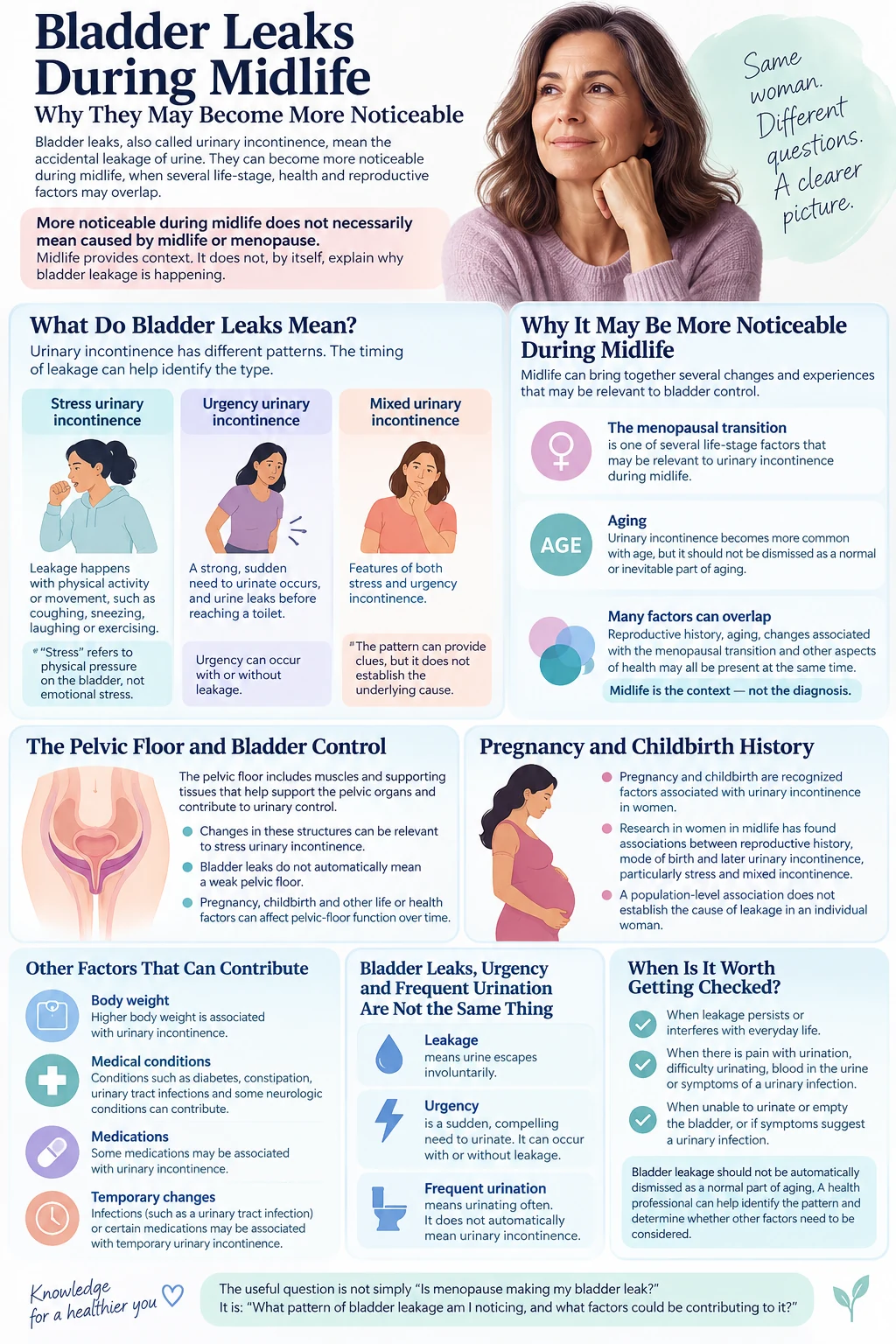
What Do Bladder Leaks Mean?
Urinary incontinence is not one single pattern of bladder leakage. Looking at when leakage occurs can help distinguish some of its common forms.
When leakage happens with coughing, sneezing or exercise
Stress urinary incontinence occurs when physical movement or activity puts pressure on the bladder and urine leaks. This can happen during coughing, sneezing, laughing, exercising or other physical activity.
The word stress here refers to physical pressure on the bladder. It does not mean emotional stress.
When a sudden urge is followed by leakage
Urgency urinary incontinence follows a different pattern. A strong, sudden need to urinate occurs, and urine leaks before the person can reach a toilet.
Urgency itself, however, does not always mean that leakage will occur. That distinction becomes important when separating urinary incontinence from other bladder symptoms.
When more than one pattern occurs
Some women experience features of both stress and urgency incontinence. This is known as mixed urinary incontinence.
Recognizing these patterns can provide useful clues about the type of leakage being experienced. It does not, however, establish the underlying cause.
Why Bladder Leaks May Become More Noticeable During Midlife
Midlife can bring together several changes and experiences that may be relevant to bladder control. Some may be associated with the menopausal transition, while others reflect aging, reproductive history or other health factors.
That makes a single-cause explanation particularly unreliable.
The menopausal transition may be part of the picture
The menopausal transition is one of several life-stage factors that may be relevant to urinary incontinence during midlife.
But relevance is not the same as proving that menopause caused an individual woman's bladder leaks.
Other factors may be present at the same time, so bladder leakage during midlife should not automatically be attributed to menopause or hormonal changes alone.
Aging can matter too
Urinary incontinence becomes more common with age, but becoming older does not by itself explain why an individual woman develops bladder leaks.
And although urinary incontinence is common, it should not simply be dismissed as a normal or inevitable part of aging.
Why midlife does not point to a single cause
A woman in midlife may have several relevant factors at the same time, including reproductive history, aging, changes associated with the menopausal transition and other aspects of health.
These factors can overlap. They are not interchangeable explanations.
How the Pelvic Floor Can Be Related to Bladder Control
The pelvic floor includes muscles and supporting tissues that help support the pelvic organs and contribute to urinary control.
Pelvic support can be particularly relevant when considering stress urinary incontinence, but bladder leakage does not automatically identify a problem with the pelvic floor.
The pelvic floor and urinary support
When coughing, laughing, exercising or another activity increases pressure on the bladder, the structures involved in urinary control help prevent urine from escaping.
Changes affecting the muscles or supporting tissues around the bladder and urethra can be relevant to stress leakage.
Why bladder leaks do not automatically mean a weak pelvic floor
Pelvic-floor weakness can contribute to stress urinary incontinence, but urinary leakage has more than one pattern and more than one possible contributor.
Experiencing bladder leaks therefore does not, by itself, establish that a weak pelvic floor is the cause.
The pattern of symptoms and a woman's broader health history provide more information than leakage alone.
Why pelvic floor function can change over time
Pregnancy, childbirth and other life or health factors can affect structures involved in pelvic support and bladder control.
Their effects vary between women, so bladder leakage alone cannot tell us how the pelvic floor is functioning.
This is another reason to avoid reducing urinary incontinence to a simple explanation such as “the pelvic floor became weak.”
How Pregnancy and Childbirth History Can Matter
Pregnancy and childbirth may remain relevant to bladder control years after the pregnancy itself.
Research in women in midlife has found associations between reproductive history, mode of birth and later urinary incontinence. This helps explain why reproductive history can remain relevant when bladder leakage appears or becomes more noticeable later in life.
Pregnancy and changes in pelvic support
Pregnancy and childbirth are recognized factors associated with urinary incontinence in women.
That does not mean pregnancy necessarily results in later bladder leakage. It is one factor that may contribute to an individual's broader history.
Vaginal childbirth and later urinary incontinence
Research has found associations between vaginal birth and later urinary incontinence.
A large 2024 cohort study examining reproductive history and urinary incontinence in midlife found associations involving mode of birth and later urinary incontinence, with much of the observed relationship involving stress and mixed urinary incontinence.
Why childbirth history is only one part of the picture
Some women who have given birth never develop urinary incontinence, while bladder leakage can occur in women with different reproductive histories.
Childbirth history therefore belongs in the explanation, but it should not become the explanation.
Other Factors That Can Contribute to Bladder Leaks
Bladder control can also be influenced by factors beyond menopause, aging and reproductive history.
Health conditions, medications and other circumstances may contribute to urinary leakage in some women, and more than one factor can be present at the same time.
Body weight and pressure on the bladder
Higher body weight is associated with urinary incontinence and is one of the factors considered when evaluating bladder-control problems.
That association does not mean body weight explains every case of leakage, nor does it identify the cause for an individual woman.
Medical conditions and other health factors
Constipation, urinary tract infections, some medications and conditions affecting the nervous system or other aspects of health can contribute to urinary incontinence in certain circumstances.
Some contributors, including urinary tract infections or certain medications, may also be associated with temporary urinary incontinence.
This is another reason the timing and context of symptoms matter.
Why more than one factor may be involved
A woman may have several relevant factors at the same time. Reproductive history, pelvic-floor function, age, health conditions and other influences can overlap.
Finding one plausible contributor does not prove that it is the only one — or establish that it explains the symptoms.
Bladder Leaks, Urgency and Frequent Urination Are Not the Same Thing
Urinary symptoms often appear in the same conversations, but their meanings should not be blurred together.
Leakage means urine escapes involuntarily
Urinary incontinence specifically involves involuntary or accidental leakage of urine.
That is the central symptom defining the territory of this article.
Urgency can occur with or without leakage
Urgency refers to a sudden, compelling need to urinate.
When that urgency is followed by involuntary leakage before reaching a toilet, the pattern may be consistent with urgency urinary incontinence.
Urgency and leakage are therefore related concepts, but they are not identical.
Frequent urination does not automatically mean urinary incontinence
Urinary frequency refers to urinating often. It can occur alongside other bladder symptoms, but frequency alone does not establish urinary incontinence.
A woman can therefore notice changes in how often she urinates without necessarily experiencing bladder leakage.
Why Bladder Leaks Alone Cannot Tell You the Cause
The circumstances surrounding leakage can provide useful information, but there is a limit to what symptoms can establish on their own.
The pattern can provide clues
Leakage during coughing, sneezing or physical activity points toward a different pattern from leakage associated with a sudden urge to urinate.
That distinction is one reason clinicians separate stress, urgency and mixed urinary incontinence.
Symptoms alone do not establish the underlying cause
Evaluating urinary incontinence involves more than identifying that leakage occurs. A woman's history, the pattern of symptoms and other relevant factors can help determine what may be contributing and whether further evaluation is needed.
So the pattern can provide clues about what is happening without necessarily establishing why it is happening.
When Is It Worth Getting Bladder Leaks Checked?
Because urinary incontinence is common, some women may assume that bladder leakage is simply something they have to accept as they get older.
It is not something that should automatically be dismissed as a normal or inevitable part of aging.
When leakage persists or affects everyday life
Bladder leakage that persists, causes concern or begins to interfere with everyday activities is worth discussing with a health professional.
An evaluation can help distinguish the pattern of urinary incontinence and determine whether other factors need to be considered.
When other urinary symptoms occur
Bladder leakage can sometimes occur alongside other urinary symptoms. Pain with urination, difficulty urinating, blood in the urine or symptoms suggesting a urinary infection deserve medical evaluation rather than being automatically attributed to midlife or menopause.
When changes deserve more prompt attention
Some urinary changes warrant more prompt medical attention.
Being unable to urinate or empty the bladder, seeing blood in the urine, or having painful urination with possible signs of infection should not simply be attributed to ordinary bladder leakage.
These signs do not reveal their cause on their own. They indicate that something more than routine observation of bladder leakage may be needed.
The Bottom Line
Bladder leaks may become more noticeable during women's midlife, but menopause alone should not be assumed to explain why they are happening.
The pattern may resemble stress, urgency or mixed urinary incontinence. Aging, pelvic-floor factors, pregnancy and childbirth history, health conditions and other influences may also be relevant.
The useful question is therefore not simply:
“Is menopause making my bladder leak?”
It is:
“What pattern of bladder leakage am I noticing, and what factors could be contributing to it?”
That distinction keeps midlife in its proper place: meaningful context, without turning it into the diagnosis or the cause.
Sources
- National Institute of Diabetes and Digestive and Kidney Diseases. Bladder Control Problems (Urinary Incontinence) — Definition & Facts. NIDDK
- National Institute of Diabetes and Digestive and Kidney Diseases. Bladder Control Problems — Symptoms & Causes. NIDDK
- National Institute of Diabetes and Digestive and Kidney Diseases. Bladder Control Problems — Diagnosis. NIDDK
- Reproductive history and urinary incontinence in midlife — 2024 cohort study. PubMed
- National Institute for Health and Care Excellence. Urinary incontinence and pelvic organ prolapse in women: management. NICE