Body Odor Changes During Midlife: What Women May Notice and What May Be Related
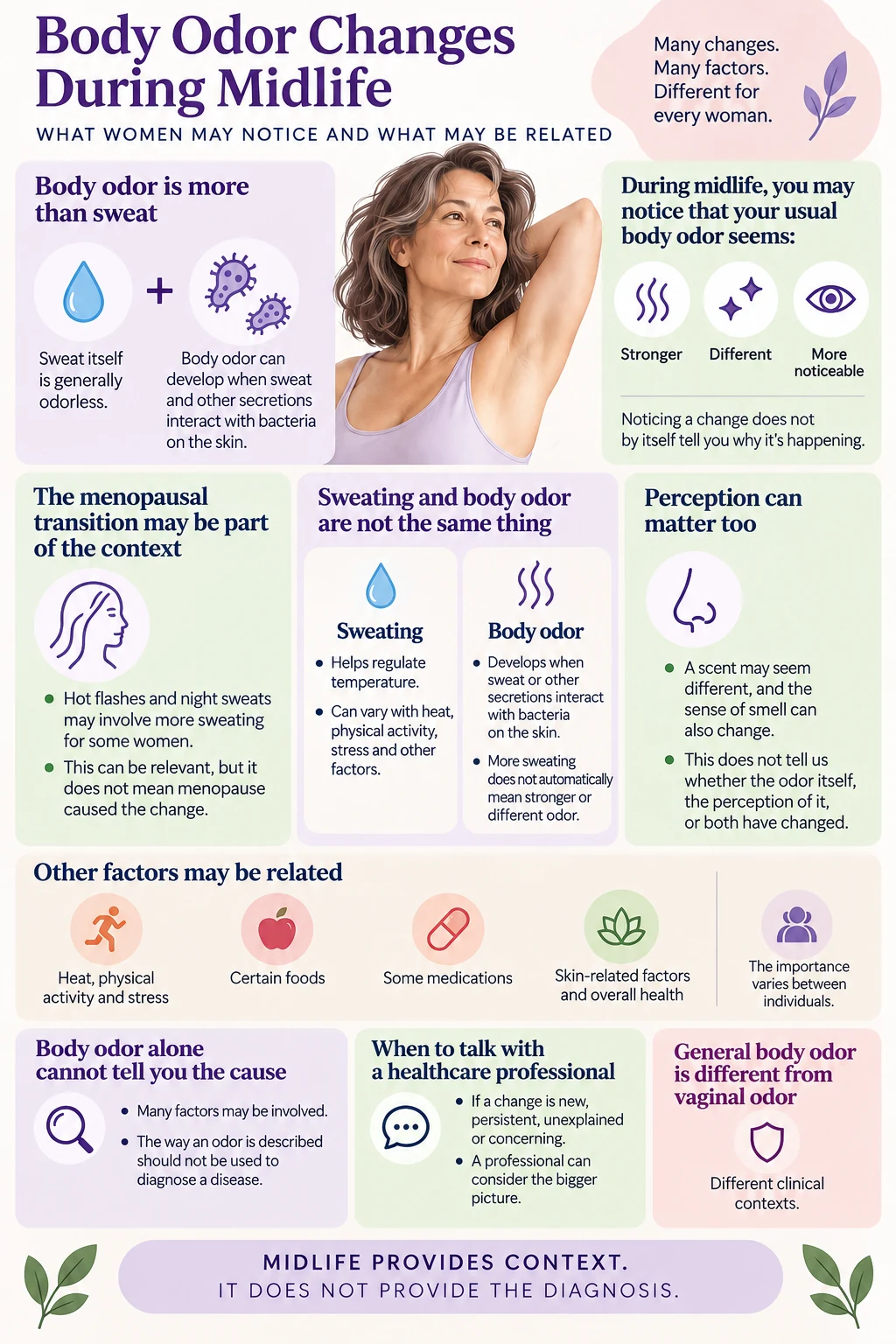
During midlife, some women may notice that their usual body odor seems different, stronger or simply more noticeable than before.
That observation can raise an understandable question: has something about the body's odor changed, or has the way the odor is perceived changed?
There is not always a simple answer. Body odor can be influenced by different factors, and noticing a change during midlife does not establish why it is happening.
The menopausal transition may be part of the context for some women. Changes in sweating, food, medications, skin-related factors, overall health and individual circumstances may also be relevant.
A change in body odor is an observation, not an explanation.
What Do Body Odor Changes Mean?
Body odor can develop when sweat and other secretions on the skin interact with bacteria that live there.
Sweat and body odor are therefore related, but they are not the same thing. Sweat itself is generally odorless; body odor develops when sweat or other secretions interact with bacteria on the skin.
A change in body odor may mean that a familiar scent seems stronger, different or more noticeable. However, describing the change does not identify why it occurred.
The observation also does not establish whether the odor itself has changed, whether its perception has changed, or whether both may be involved.
What a woman notices is meaningful, but it does not by itself identify the explanation.
Body Odor Can Seem Different or More Noticeable During Midlife
Some women may become more aware of changes in their usual body scent during midlife.
This may coincide with the menopausal transition, changes in sweating or other circumstances occurring during the same period of life.
But events that happen at the same time do not necessarily have the same cause.
A woman noticing a stronger or different scent during midlife therefore cannot determine from timing alone whether the change is related to the menopausal transition or to another factor.
Noticing a change during midlife does not establish that midlife or menopause caused it.
Why Midlife Does Not Point to a Single Explanation
Midlife involves many possible changes in health, daily routines, medications and individual circumstances.
Because several factors can coexist, the appearance of a body odor change during this period cannot identify one explanation.
Even when the change begins around perimenopause or menopause, timing alone does not establish a causal relationship.
The relevant context may differ substantially from one woman to another.
Life stage provides context, not the individual explanation.
How the Menopausal Transition May Be Related to Body Odor Changes
The menopausal transition is relevant because changes in sweating can occur during this stage of life. Hot flashes and night sweats, for example, may involve increased sweating for some women.
That can make sweating an important part of the context when a woman notices a change in body odor.
However, more sweating does not automatically mean that body odor will become stronger or different.
Changes in how odors are perceived have also been considered as one possible part of what some women notice during perimenopause. This possibility does not establish that a change in odor perception is occurring in an individual woman.
The available information therefore does not support assuming that menopause, declining estrogen or another specific hormonal change directly caused a woman's body odor to change.
The menopausal transition may be relevant context without providing the individual explanation.
Sweating and Body Odor Are Not the Same Thing
Sweating and body odor are closely related concepts, but one should not be used as a substitute for the other.
The amount a person sweats does not, by itself, determine how noticeable body odor will be.
Understanding that distinction is particularly important during midlife, when sweating may become more noticeable for some women.
Sweating
Sweating helps the body regulate temperature.
Sweat glands release sweat onto the skin, and sweating can vary with heat, physical activity, emotions and other individual circumstances.
During the menopausal transition, hot flashes and night sweats may also be accompanied by sweating.
But sweating itself does not tell us what a person's body odor will smell like or why a familiar scent seems different.
Body Odor
Body odor can develop when substances released onto the skin interact with microorganisms on the skin.
This helps explain why sweating and odor can be related without being identical.
It does not mean that the presence of more sweat automatically produces stronger odor, nor does it identify why a particular woman's scent may have changed.
More sweating does not automatically mean stronger or different body odor.
A Change in Body Odor May Also Involve How Odor Is Perceived
When a familiar body scent seems different, it is natural to focus on what may have changed on the skin.
But perception is another part of the experience.
Changes in the sense of smell can alter how odors are perceived, and researchers have investigated relationships between reproductive hormones and olfactory function. These relationships are complex and do not provide a simple explanation for an individual woman's experience.
For that reason, noticing that one's own scent seems different cannot establish whether the odor itself changed, the perception of that odor changed, or both are involved.
It would also be inappropriate to conclude from body odor alone that a woman has a smell disorder or another particular condition.
A perceived change in body odor does not necessarily tell us whether the odor itself, the perception of the odor, or both have changed.
Different Factors May Be Related to Body Odor Changes
Body odor can be influenced by different circumstances, and their relevance varies between individuals.
The presence of one possible factor does not establish that it explains the change a woman has noticed.
Sweating and Individual Circumstances
Changes in sweating may alter the circumstances in which body odor develops, but sweating is only one part of the picture.
Heat, physical activity, stress and other individual circumstances may affect when sweating or body odor becomes noticeable.
These factors provide context rather than a diagnosis or a universal explanation.
Food and Medications
Certain foods may influence body odor in some people.
Medications can also be relevant because some may affect sweating or body odor.
However, noticing a change while eating a particular food or taking a medication does not establish that it is responsible.
Medication changes should be discussed with an appropriate healthcare professional rather than made solely because body odor seems different.
Skin-Related and Overall Health Factors
Skin-related factors and overall health can also be relevant when body odor changes.
Their importance depends on the individual circumstances, and body odor alone cannot establish that a particular health condition is present.
For that reason, the way an odor is described should not be used as a shortcut to diagnose a disease.
Body odor can provide information without providing the diagnosis.
Why Body Odor Alone Cannot Tell You the Cause
A noticeable change in body odor may be worth paying attention to, but the odor alone does not identify its cause.
When the change began, whether it persists, changes in sweating, medications, food, skin-related factors, overall health and other circumstances may all provide useful context.
No single one of those details automatically provides the explanation.
General body odor should also be distinguished from vaginal odor. Vaginal odor, discharge and other vaginal symptoms involve a different clinical context and are not evaluated as general body odor in this discussion.
This distinction prevents one type of symptom from being used to interpret another.
A body odor change is an observation that may deserve context, not a diagnostic rule.
When Is It Worth Discussing a Body Odor Change With a Healthcare Professional?
If a body odor change is new, persistent, unexplained or concerning, discussing it with a healthcare professional may be appropriate.
A conversation may also be useful when the change occurs alongside other symptoms or significant changes in sweating.
Professional evaluation can consider the broader context, including medications, health history, skin-related factors and other individual circumstances.
Seeking advice does not mean that menopause or another particular health condition is necessarily responsible. It allows the change to be considered without assuming that its timing or the character of the odor provides the diagnosis.
Body odor can change or seem different during midlife without having one universal explanation.
Midlife provides context — it does not provide the diagnosis.