Brain Fog and Forgetfulness During Midlife: Why Your Thinking May Feel Different
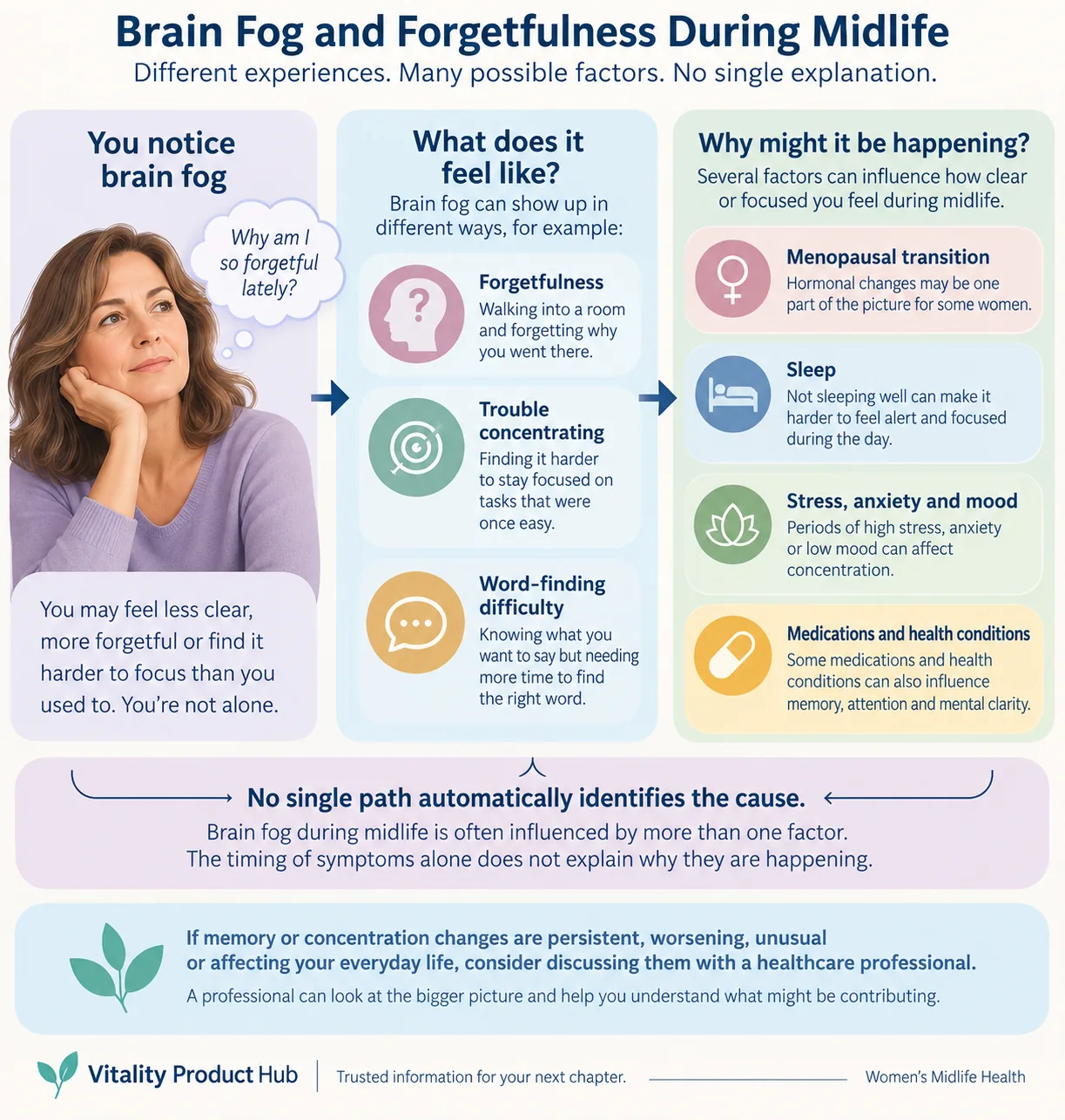
Walking into a room and forgetting why you went there. Losing your train of thought halfway through a conversation. Searching for a familiar word that normally comes easily. Finding it harder to stay focused on something that once required little effort.
Experiences like these are often described as brain fog, and they can become more noticeable for some women during midlife.
That timing naturally raises questions. Could the menopausal transition be involved? Could disrupted sleep or stress be affecting concentration? Or might something else be contributing?
There is not always a simple answer. Cognitive complaints are commonly reported around the menopausal transition, but midlife is also a time when sleep, stress, mood, medications, health conditions and other influences may affect how mentally clear or focused a woman feels.
Importantly, noticing changes in memory or concentration is not the same as demonstrating cognitive decline on objective testing.
Understanding brain fog during midlife means looking at the experience without assuming a single explanation.
What Does “Brain Fog” Feel Like During Midlife?
“Brain fog” is an everyday expression used to describe a range of subjective cognitive experiences rather than a specific medical diagnosis.
For one woman, forgetfulness may be the most noticeable change. Another may find it harder to concentrate, retrieve a familiar word or keep track of what she was doing.
The experience can therefore feel different from one person to another.
Forgetfulness, Trouble Concentrating and Losing Your Train of Thought
Some women describe becoming more easily distracted or having greater difficulty maintaining focus.
They may walk into another room and temporarily forget what they intended to do, lose the thread of a conversation or find themselves rereading a paragraph because their attention drifted.
Others notice everyday lapses, such as having more difficulty keeping track of something they intended to do.
These are examples of subjective cognitive symptoms — changes a person notices in her own memory, attention or thinking.
They describe the experience without explaining its cause.
Word-Finding Difficulty Can Be Part of the Experience
Another experience sometimes included under the label of brain fog is difficulty retrieving a familiar word.
A woman may know what she wants to say but need more time to find the word, only to remember it later.
Word-finding difficulty can occur in many circumstances and is not unique to midlife or the menopausal transition. Within the broader experience described as brain fog, however, it may appear alongside forgetfulness or difficulty concentrating.
“Brain Fog” Describes an Experience, Not a Diagnosis
The phrase can be useful because it gives a familiar name to a recognizable experience: thinking may feel less clear, attention less reliable or familiar mental tasks more effortful.
But “brain fog” does not identify a specific medical condition or explain why those changes are happening.
The menopausal transition may be relevant for some women, while sleep, stress, mood, medications, health conditions or other circumstances may also matter.
Why Can Thinking Feel Different During Midlife?
Midlife can bring several changes at once.
For some women, these years include the menopausal transition. At the same time, sleep patterns, stress levels, emotional well-being, medications, health and everyday responsibilities may also be changing.
These overlapping influences make it difficult to reduce a cognitive complaint to one explanation.
Cognitive Complaints Are Commonly Reported During the Midlife Years
Forgetfulness and difficulty concentrating are among the cognitive complaints reported by women around the menopausal transition.
Researchers study these experiences in different ways, including what women notice themselves and how they perform on objective cognitive measures.
Those perspectives provide different kinds of information.
A woman may genuinely notice that concentrating feels harder or that she is more forgetful than before, even when the degree of change she perceives is not reflected in the same way on objective cognitive measures.
More Than One Factor May Be Involved
Brain fog is often better understood in a broader context.
The menopausal transition may matter for some women, while sleep, stress, mood, medications and health conditions can also shape how alert, clear or focused someone feels.
Several influences may be present at the same time, which is why the timing of symptoms alone cannot identify their cause.
Could the Menopausal Transition Contribute to Brain Fog?
The menopausal transition may be part of the picture.
Women commonly report cognitive complaints during this stage, and researchers continue to investigate how reproductive aging and hormonal changes may relate to both subjective cognitive symptoms and aspects of cognitive performance.
Recognizing that relationship, however, is different from assuming that menopause explains every episode of forgetfulness or difficulty concentrating.
Subjective Cognitive Symptoms Are Reported During the Menopausal Transition
Research involving women around the menopausal transition has documented complaints involving memory, concentration and other aspects of perceived cognitive function.
These reports help explain why the term brain fog has become closely associated with this stage of life.
But experiencing these symptoms during the transition does not reveal what is causing them in an individual woman.
Hormonal Changes May Be One Part of the Picture
Hormonal changes during the menopausal transition are being studied as one possible influence on cognitive symptoms.
The relationship is complex, and hormonal changes alone cannot explain why a particular woman feels more forgetful or has difficulty concentrating.
It is more accurate to consider them as one possible contributor within the broader context of midlife.
Menopause Does Not Explain Every Cognitive Complaint
The menopausal transition can coincide with many other changes.
Sleep disruption, increased stress, mood symptoms, new medications or changes in health may also affect how alert or focused a woman feels.
Menopause can therefore be relevant without being the complete explanation.
What Else Can Make You Feel Mentally Foggy?
Attention and mental clarity can be influenced by circumstances beyond reproductive changes.
Sleep, psychological well-being, medications and health conditions are among the factors that may deserve consideration when new cognitive complaints appear.
Sleep Problems Can Affect How Alert and Focused You Feel
Sleep disruption can make it harder to feel alert and focused during the day.
That makes sleep relevant when considering brain fog during midlife, without making it the presumed cause.
A woman who is not sleeping well may find that concentration requires more effort or that she feels less mentally sharp during the day.
The reasons behind disrupted sleep are a separate question and can vary from one woman to another.
Stress, Anxiety and Mood Can Affect Concentration
Periods of high stress can make sustained attention more difficult.
Anxiety and mood symptoms may also affect concentration and how cognitive difficulties are experienced.
These factors can coexist with the menopausal transition rather than representing competing explanations. A woman may be navigating several influences at the same time.
Medications and Health Conditions May Also Matter
Some medications and health conditions can affect alertness, attention, memory or concentration.
That is another reason not to assume that forgetfulness appearing during midlife must have a hormonal explanation.
When cognitive changes are persistent, worsening, unusual or interfering with everyday life, a healthcare professional can consider them within the broader context of a woman's health, medications and circumstances.
Is Brain Fog the Same as Cognitive Decline?
No. The concepts should not be treated as interchangeable.
Brain fog describes what a person notices about her own thinking. Objective cognitive performance describes what structured testing measures.
They provide different kinds of information.
Subjective Cognitive Symptoms and Objective Cognitive Performance Are Different
Subjective measures ask people about changes they have noticed themselves. Objective measures assess aspects of cognitive performance through structured tasks or tests.
The two can be related, but they do not always correspond closely.
A woman's experience of greater forgetfulness or difficulty concentrating can be genuine and meaningful without being equivalent to demonstrated cognitive decline.
Feeling Forgetful Does Not Automatically Mean Your Memory Is Declining
Everyday cognitive lapses can feel concerning when they are new or more noticeable than before.
But feeling forgetful does not, by itself, show that progressive cognitive decline is occurring.
The nature of the change, whether it persists or worsens and how it affects everyday functioning all provide important context.
Brain fog therefore should not be dismissed — but neither should it automatically be interpreted as evidence of cognitive decline.
When Are Memory or Concentration Changes Worth Discussing With a Healthcare Professional?
Memory or concentration changes are worth discussing with a healthcare professional when they are persistent, worsening, noticeably different from usual, interfering with everyday activities or simply concerning enough that you want them evaluated.
A professional can consider the change alongside sleep, mood, medications, hormonal changes, health conditions and other relevant circumstances.
The purpose is not to assign a diagnosis based on a symptom such as forgetfulness.
It is to understand the change in the context of the individual woman's overall health and experience.
The Bigger Picture: Midlife Is Context, Not a Cognitive Diagnosis
Brain fog and forgetfulness can become noticeable during midlife, and the menopausal transition may contribute to cognitive symptoms for some women.
But it is only one part of a broader picture.
Sleep, stress, anxiety, mood, medications, health conditions and other circumstances may also influence how clear, focused or forgetful a woman feels.
And what a woman notices about her cognition is not automatically the same as a measurable decline in cognitive performance.
Instead of beginning with:
“Is menopause causing my brain fog?”
a more useful question may be:
“What could be contributing to the changes I'm noticing in my memory or concentration?”
That question leaves room for the menopausal transition without assuming it is the answer.
Midlife provides important context for understanding the change. It does not determine its cause.
Explore Women's Midlife Health
Midlife can affect different areas of health in different ways. Return to the main hub to explore other evidence-informed guides.
Sources
-
Furey C, et al.
Subjective versus objective cognition during menopause:
a systematic review and meta-analysis.
Journal of the International Neuropsychological Society. 2026.
PubMed -
Zhu D, et al.
Factors associated with subjective cognitive symptoms in
perimenopausal women.
Menopause. 2026.
PubMed -
Weber MT, Maki PM, McDermott MP.
Cognition and mood in perimenopause: a systematic review
and meta-analysis.
Journal of Steroid Biochemistry and Molecular Biology. 2014.
PubMed -
Maki PM, Weber MT.
A research primer for studies of cognitive changes across
the menopause transition.
Climacteric. 2021.
PubMed