Breast Pain During Midlife: What Women May Notice and What May Be Related
During midlife, some women may notice that their breasts feel sore, tender or painful in ways that seem different from before. The discomfort may come and go, affect one or both breasts, or simply become more noticeable at certain times.
When breast pain appears during the 40s, 50s or around the menopausal transition, it can naturally raise questions about whether hormonal changes or menopause may be involved. Breast discomfort can also cause concern because any new breast symptom may make a woman wonder whether something more serious could be happening.
Breast pain, soreness or tenderness is an observation, not a diagnosis. Noticing breast discomfort during midlife does not establish that menopause, hormonal changes, breast cancer or any particular condition caused it.
The timing and pattern of the pain may provide useful context, but they cannot identify the individual explanation on their own.
What Does Breast Pain Mean?
Breast pain describes discomfort or pain that is felt in the breast.
Women may describe the sensation in different ways. The breast may feel sore, tender, aching, heavy, burning, throbbing or sharp. The discomfort may affect one breast or both and may be felt in a particular area or more broadly.
Breast tenderness and soreness can therefore be ways of describing breast discomfort rather than separate diagnoses.
The way the pain feels does not establish why it is occurring.
A woman can accurately describe the location, sensation, timing and pattern of her breast pain without those observations identifying the underlying cause.
Breast Pain Can Become More Noticeable During Midlife
A woman may first become more aware of breast discomfort during her 40s, 50s or another stage of midlife.
She may notice tenderness that was not previously familiar, breast soreness that seems to come and go, or a pattern of discomfort that feels different from what she experienced earlier in life.
Because these changes may appear around the same time as perimenopause or menopause, it is understandable to wonder whether the menopausal transition may be relevant.
However, the appearance of breast pain during midlife does not establish why the symptom is occurring.
Midlife provides useful context, but timing alone cannot identify the cause of breast pain in an individual woman.
Why Midlife Does Not Point to a Single Explanation
There is no single explanation for every episode of breast pain.
A woman's age, menstrual pattern or stage of the menopausal transition may provide relevant information, but none of these factors can determine the cause from breast pain alone.
Medication use, individual health circumstances and discomfort arising from nearby areas of the body may also be relevant in some situations.
More than one circumstance can also be present at the same time.
For this reason, noticing that breast pain began during midlife should not be treated as evidence that menopause or hormonal changes caused it.
The symptom deserves context rather than a single explanation based only on age or timing.
How the Menopausal Transition May Be Related to Breast Pain
The menopausal transition can provide relevant context when breast symptoms are considered.
Changes in menstrual patterns can occur during the menopausal transition, and breast discomfort may also be discussed within this broader midlife context. The menopausal transition is among the contexts considered when breast pain is discussed.
That association does not establish the explanation for an individual woman's symptoms.
Breast pain can occur in different circumstances, including circumstances unrelated to the menopausal transition.
A woman who notices breast tenderness or soreness during perimenopause therefore cannot determine from the timing alone whether hormonal changes are responsible.
The menopausal transition may be relevant to the discussion without providing the individual diagnosis or cause.
Breast Pain Can Follow Different Patterns
Breast pain does not always follow the same pattern.
Some breast pain varies in relation to the menstrual cycle. Other breast pain does not follow a regular cycle-related pattern.
Recognizing a pattern may provide useful information when a woman describes what she is experiencing.
The pattern itself, however, does not establish the individual cause.
Cyclic Breast Pain
Cyclic breast pain follows a pattern associated with the menstrual cycle.
The discomfort may become more noticeable around particular parts of the menstrual cycle and then lessen at other times.
For a woman who is still menstruating during midlife, noticing whether breast discomfort seems to follow a recurring menstrual pattern may provide useful descriptive information.
But observing a cyclic pattern does not establish that hormonal changes are the individual cause of the pain.
Cyclic describes the pattern. It does not provide the diagnosis.
Noncyclic Breast Pain
Noncyclic breast pain does not follow a regular pattern related to the menstrual cycle.
It may be persistent or intermittent and may sometimes be more localized.
Noncyclic does not mean that the pain is necessarily more serious, nor does it establish that a particular breast condition is present.
As with cyclic pain, the pattern can help describe the symptom without identifying its cause.
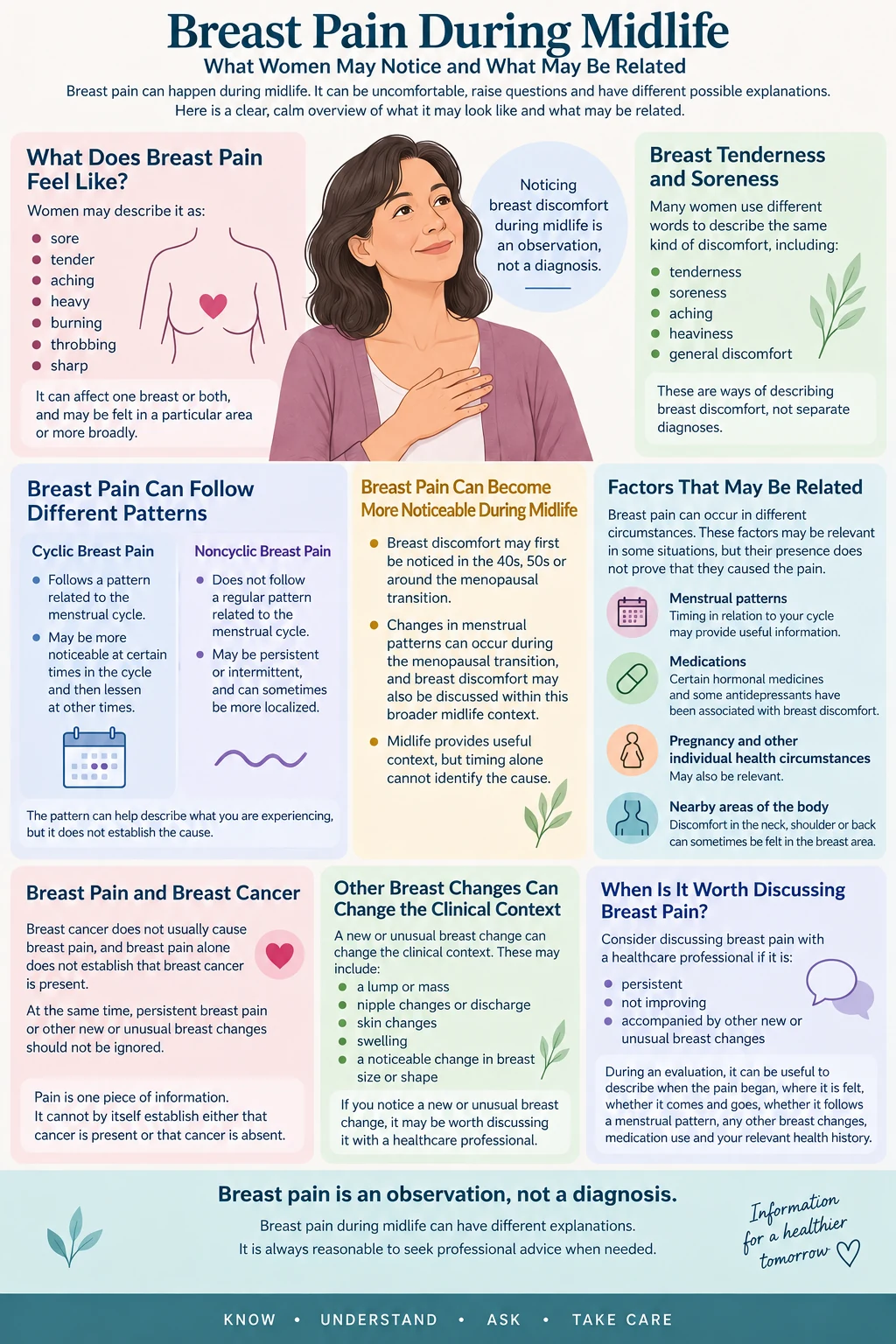
Breast Tenderness and Soreness Are Ways Women May Describe Breast Discomfort
Women do not always use the term “breast pain” for what they are experiencing.
One woman may say that her breasts feel tender. Another may describe soreness, aching, heaviness or general discomfort.
These descriptions can help communicate what the symptom feels like, but they should not be treated as separate diagnoses.
Tenderness does not establish that the symptom is hormonal.
Soreness does not identify a particular breast condition.
And the intensity or type of sensation alone cannot determine the cause.
The woman's description is valuable because it helps characterize the experience — not because one particular word reveals the explanation.
Different Factors May Be Related to Breast Pain
Breast pain can occur in different circumstances.
Rather than assuming one explanation, it can be useful to consider the symptom alongside menstrual patterns, medications, health history, other breast changes and discomfort involving nearby areas of the body.
These factors provide context.
Their presence does not prove that any one of them caused the breast pain.
Menstrual Patterns and Individual Health Context
For women who are still having menstrual cycles, the timing of breast discomfort in relation to those cycles may provide useful information.
Some breast pain follows a recurring cycle-related pattern, while other breast pain does not.
Pregnancy and other individual health circumstances may also be relevant when breast discomfort is evaluated, although breast pain alone cannot establish any of them.
A woman's broader health history and other symptoms may therefore matter when breast pain is evaluated.
The purpose of considering this context is not to match the symptom to a diagnosis at home. It is to describe the situation more completely.
Medications and Other Individual Circumstances
Medication use may be relevant when breast pain is considered.
Some medications, including certain hormonal medicines and some antidepressants, have been associated with breast discomfort.
That does not mean that a medication is responsible whenever breast pain develops in someone who uses it.
The timing of medication use, health history and other circumstances may need to be considered together.
A medication should not be stopped or changed solely because breast pain has appeared without discussing the situation with the appropriate healthcare professional.
Pain Can Sometimes Be Felt in the Breast From Nearby Areas
Not every sensation perceived as breast pain necessarily originates within breast tissue.
Discomfort involving nearby areas, including the neck, shoulder or back, can sometimes be felt as pain in the breast area.
This possibility does not allow a woman to determine at home that her breast pain is musculoskeletal or that the breast itself can be excluded.
The location of the discomfort and other symptoms may provide additional context when appropriate.
The important distinction is that where pain is felt does not always establish where it originated.
Breast Pain Alone Does Not Establish Breast Cancer
Breast pain can understandably cause concern about breast cancer.
Breast cancer does not usually cause breast pain, and breast pain alone does not establish that breast cancer is present.
At the same time, that information should not be used to dismiss persistent breast pain or other new or unusual breast changes.
Pain is one piece of information. It cannot by itself establish either that cancer is present or that cancer is absent.
The appropriate response is therefore neither to assume the worst nor to assume that a persistent or changing symptom can safely be ignored.
A healthcare professional can consider the pain together with other breast changes, health history and clinical findings when evaluation is appropriate.
Other Breast Changes Can Change the Clinical Context
Breast pain does not occur in isolation in every situation.
A new lump or mass, nipple changes or discharge, changes involving the skin of the breast, swelling, or a noticeable change in breast size or shape can change the clinical context.
These changes are not interchangeable with breast pain and should not be interpreted as diagnoses from a checklist.
Their importance is that a woman describing breast pain should also mention other new or unusual breast changes rather than assuming that everything belongs to the same explanation.
Likewise, the fact that breast cancer does not usually cause breast pain should not be used to dismiss other breast changes.
A new or unusual breast change may be worth discussing with a healthcare professional based on the individual situation.
Why Breast Pain Alone Cannot Tell You the Cause
A woman can accurately notice breast pain without being able to determine why it occurred.
Breast pain during midlife does not establish that menopause caused it.
Tenderness or soreness does not establish a hormonal imbalance.
A cyclic pattern does not establish the individual cause.
A noncyclic pattern does not establish that a serious breast condition is present.
Medication use does not prove that a medication caused the symptom.
And breast pain alone neither establishes breast cancer nor rules it out.
Different circumstances may provide useful context, but identifying what is relevant to one woman requires more information than matching one symptom to one possible explanation.
Breast pain is an experience that can be described carefully without turning the description into a diagnosis.
When Is It Worth Discussing Breast Pain With a Healthcare Professional?
Persistent breast pain or breast pain that is not improving may be worth discussing with a healthcare professional, particularly when other new or unusual breast changes are also present.
A lump or mass, nipple changes or discharge, skin changes, swelling, or a change in breast size or shape can alter the context and should not simply be attributed to midlife or menopause.
During an evaluation, it can be useful to describe when the pain began, where it is felt, whether it affects one or both breasts, whether it comes and goes, whether it seems to follow a menstrual pattern, and whether other breast changes are present.
Medication use and relevant health history may also provide useful context.
Evaluation of a breast symptom is not the same thing as routine breast-cancer screening. This article does not determine which screening schedule, imaging test or diagnostic procedure an individual woman needs.
A healthcare professional can consider the symptom and the broader clinical context and decide whether further evaluation is appropriate.
Breast pain, soreness or tenderness is an observation, not a diagnosis.
Midlife provides context — it does not provide the diagnosis.