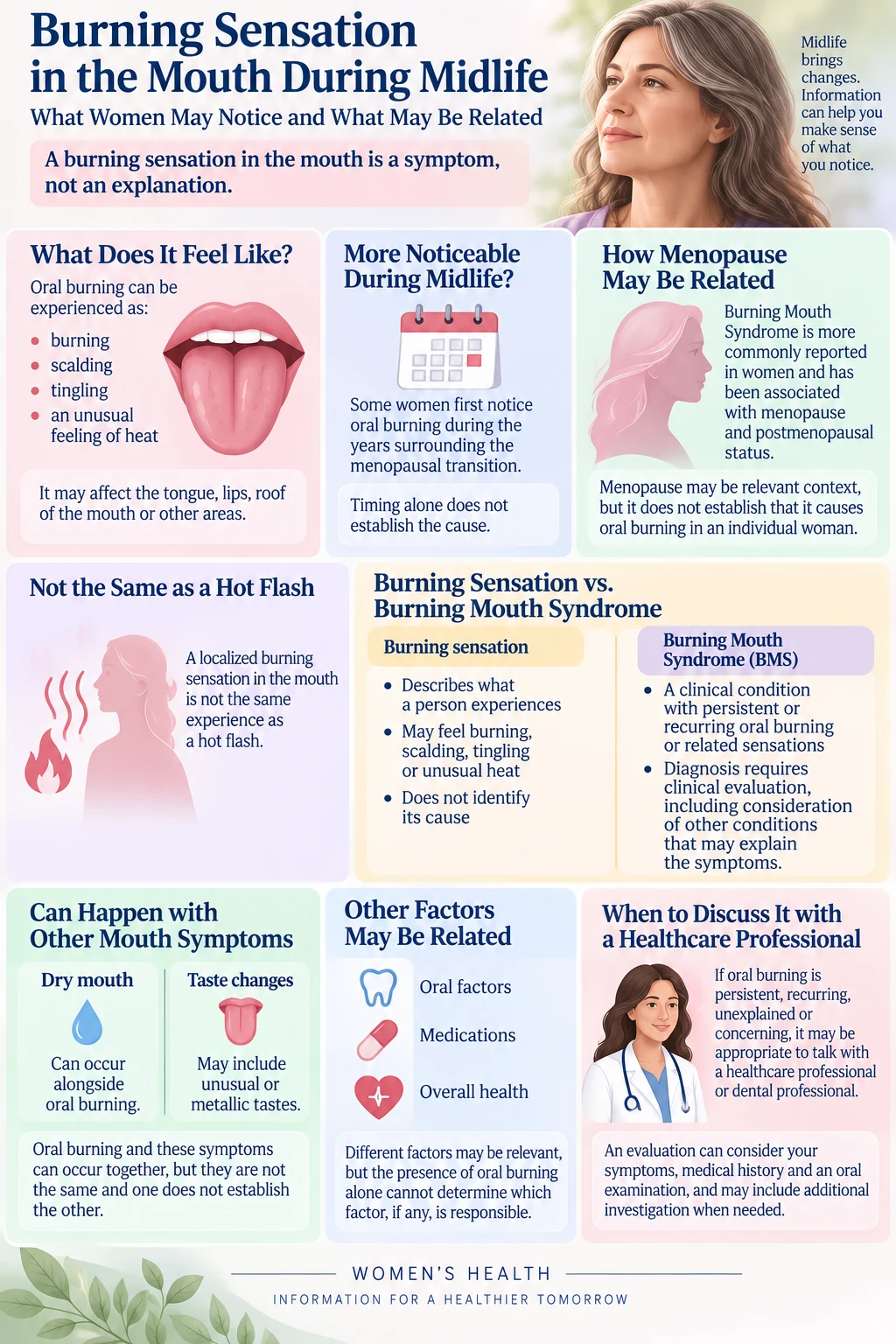
Burning Sensation in the Mouth During Midlife: What Women May Notice and What May Be Related
During midlife, some women may notice a burning, hot, scalding or tingling sensation in the mouth or tongue.
The sensation may be surprising, especially when there is no obvious reason for the mouth to feel as though it has been burned. But oral burning is a symptom, not an explanation, and the sensation alone cannot identify what is causing it.
The menopausal transition may be relevant to the broader context for some women. Burning Mouth Syndrome is more commonly reported in women and has been associated particularly with postmenopausal status. However, noticing oral burning during midlife does not establish that menopause, hormonal changes or Burning Mouth Syndrome explain the experience.
Other oral symptoms, medications, overall health and individual circumstances may also be relevant.
A burning sensation in the mouth is a symptom, not an explanation.
What Does a Burning Sensation in the Mouth Mean?
Oral burning can be described in different ways. A person may notice burning, scalding, tingling or an unusual feeling of heat inside the mouth.
The tongue is a commonly described location, but the lips, roof of the mouth or other areas may also be involved.
The sensation can vary between people, and its description does not identify its cause.
A localized burning sensation in the mouth is not the same experience as a hot flash.
What the sensation feels like can help describe the experience without providing the diagnosis.
Oral Burning Can Become More Noticeable During Midlife
Some women first notice oral burning during the years surrounding the menopausal transition.
That timing can naturally raise questions about whether menopause is responsible.
However, symptoms that appear during the same stage of life do not necessarily have the same explanation. Midlife can coincide with changes in health, medications and other individual circumstances.
The appearance of oral burning during this period therefore cannot establish from timing alone why it is occurring.
Noticing oral burning during midlife does not establish that midlife, menopause or hormonal changes caused it.
Why Midlife Does Not Point to a Single Explanation
Oral burning can occur in different clinical and individual contexts.
Some people may have another oral or health-related factor associated with the sensation. In other cases, a healthcare evaluation may not identify another condition that adequately explains persistent burning symptoms.
That distinction matters because the term Burning Mouth Syndrome has a specific clinical meaning and should not be applied simply because the mouth or tongue feels hot or burning.
Midlife therefore provides useful context, but it does not narrow the symptom to one explanation.
Life stage provides context, not the individual explanation.
How the Menopausal Transition May Be Related to Oral Burning
Burning Mouth Syndrome occurs more often in women, and studies have reported an association with menopause and postmenopausal status.
This association makes menopause relevant to the discussion, but it does not establish that menopause causes oral burning in an individual woman.
It also does not provide a simple hormonal pathway that can explain the symptom. The fact that oral burning begins during perimenopause or after menopause is not enough to conclude that declining estrogen or another hormonal change caused it.
A woman experiencing oral burning during this stage of life may have a different explanation, or more than one relevant factor may need to be considered.
The menopausal transition may be relevant context without providing the individual explanation for oral burning.
A Burning Sensation Is Not the Same as Burning Mouth Syndrome
The distinction between a symptom and a clinical condition is particularly important here.
Someone can experience burning in the mouth without having Burning Mouth Syndrome.
Burning Mouth Syndrome is a clinical condition involving persistent or recurring intraoral burning or related sensations. Diagnosing BMS requires clinical evaluation, including consideration of other conditions that may explain the symptoms.
Diagnosis therefore depends on more than the presence of burning alone.
Burning Sensation in the Mouth
A burning sensation describes what a person experiences.
It may affect the tongue or other areas of the mouth and may be described as burning, scalding, tingling or unusual heat.
Different oral, medical, medication-related and individual factors may be relevant to that experience.
The sensation itself does not identify which factor, if any, is responsible.
Burning Mouth Syndrome
Burning Mouth Syndrome is a clinical condition rather than another name for every episode of oral burning.
People with BMS may experience persistent or recurring burning, and the mouth may appear normal during examination.
Research into BMS has investigated sensory and neuropathic mechanisms involving oral sensation, pain and taste.
That does not mean that oral burning by itself demonstrates nerve damage or dysfunction. Nor does a mouth that appears normal establish a diagnosis of BMS.
A healthcare professional may need to consider the symptom pattern, health history, oral examination and other appropriate evaluation before determining whether BMS or another explanation is relevant.
A burning sensation in the mouth is not the same as a diagnosis of Burning Mouth Syndrome.
Oral Burning Can Occur Alongside Other Mouth Symptoms
Oral burning does not always occur in isolation.
Some people with burning symptoms may also notice dryness or changes in taste. These accompanying experiences can provide useful context, but they should not be treated as interchangeable symptoms.
Dry Mouth
A feeling of dry mouth can occur alongside oral burning.
Dry mouth can also occur for many reasons independently of burning, and feeling that the mouth is dry does not establish why oral burning is present.
Likewise, experiencing oral burning does not establish that a person has dry mouth or reduced salivary flow.
Oral burning and dry mouth can occur together, but they are not the same symptom and one does not establish the other.
Taste Changes
Some people experiencing oral burning may also report changes in taste, including unusual or metallic tastes.
But altered taste is a separate sensory experience.
A taste change does not establish the cause of oral burning, and burning does not establish that a taste disorder is present.
Oral burning and altered taste can occur together, but burning alone does not establish a taste disorder.
Different Factors May Be Related to Oral Burning
Because oral burning can occur in different contexts, understanding the broader picture can be more useful than trying to identify a cause from the sensation alone.
Possible factors need to be considered in relation to the individual rather than used as a checklist for self-diagnosis.
Oral and Individual Factors
Different oral factors can sometimes be associated with burning sensations. However, the presence of oral burning alone cannot determine whether a particular oral factor is responsible.
For that reason, a normal-looking mouth should not be interpreted as proof that nothing is happening, nor should it be interpreted as proof of Burning Mouth Syndrome.
Medications and Overall Health
Medications and aspects of overall health may also be relevant when oral burning is investigated.
Their importance differs between individuals, and the symptom alone cannot determine whether a medication or health condition is responsible.
A person should not stop or change a medication solely because oral burning has appeared without discussing the situation with an appropriate healthcare professional.
Different possible factors provide context; oral burning alone does not assign the cause.
Why Oral Burning Alone Cannot Tell You the Cause
The location, intensity or description of a burning sensation can help communicate what a woman is experiencing, but none of those features alone provides the explanation.
Burning tongue does not automatically mean Burning Mouth Syndrome.
A normal-looking mouth does not establish BMS.
Dry mouth or altered taste occurring alongside burning does not establish BMS either.
And experiencing oral burning during the menopausal transition does not establish that hormonal changes caused it.
This is why distinguishing the symptom from its possible explanations is important.
A burning sensation deserves context, not a diagnostic shortcut.
When Is It Worth Discussing Oral Burning With a Healthcare Professional?
If oral burning is persistent, recurring, unexplained or concerning, discussing it with a healthcare professional or dental professional may be appropriate.
An evaluation can consider when the sensation began, where it occurs, how it behaves over time, other mouth symptoms, medications, health history and findings from an oral examination.
Additional evaluation may sometimes be appropriate depending on the individual circumstances.
The purpose is not to assume that the symptom represents Burning Mouth Syndrome or that menopause caused it. It is to consider the burning sensation within the broader clinical picture.
Midlife provides context — it does not provide the diagnosis.