Constipation During Midlife: What Women May Notice and What May Be Related
Constipation can be noticed during midlife, but it does not look exactly the same for every woman. Some women may notice that bowel movements are less frequent, while others may have harder stools, more difficulty passing stool or a feeling that not all stool has passed.
These changes can occur during the years around the menopausal transition, but timing alone does not explain why constipation is happening. Bowel habits vary between people, and several circumstances may be relevant when constipation develops or changes.
Understanding the different ways constipation can appear can make it easier to describe what has changed without assuming a cause from the symptom alone.
What Does Constipation Mean?
Constipation describes a pattern of bowel movements that may involve stools that are hard, dry or lumpy, difficulty or discomfort when passing stool, fewer bowel movements than usual, or a feeling that not all stool has passed.
Not every woman with constipation experiences all of these features. One woman may mainly notice harder stools, while another may notice more straining or a change in how often she has a bowel movement.
This is why constipation is broader than simply counting trips to the bathroom.
Constipation May Be Noticed During Midlife
A woman may first notice constipation, or changes in an existing bowel pattern, during midlife.
The change may involve frequency, stool consistency, difficulty passing stool or more than one of these features. What feels different can also depend on a woman's usual bowel pattern.
Noticing the change during midlife provides useful context, but it does not identify what is causing it.
Why Midlife Does Not Point to a Single Explanation
Many physical, health and lifestyle circumstances can change during the same years of life. Because these circumstances can overlap, the timing of constipation cannot determine its explanation on its own.
A symptom beginning during midlife does not automatically mean that age or the menopausal transition explains it.
The important distinction is between when a change is noticed and why that change is occurring.
How the Menopausal Transition May Be Related to Constipation
Constipation can be experienced during the menopausal transition, and digestive symptoms are reported by some women during this stage of life.
However, this does not mean that the menopausal transition explains an individual woman's constipation.
Research specifically examining constipation during the menopausal transition has not supported a simple explanation based on reproductive hormone levels. Other circumstances may be relevant, and their importance can differ between women.
For that reason, the menopausal transition is best understood as part of the context rather than as an automatic explanation for a change in bowel habits.
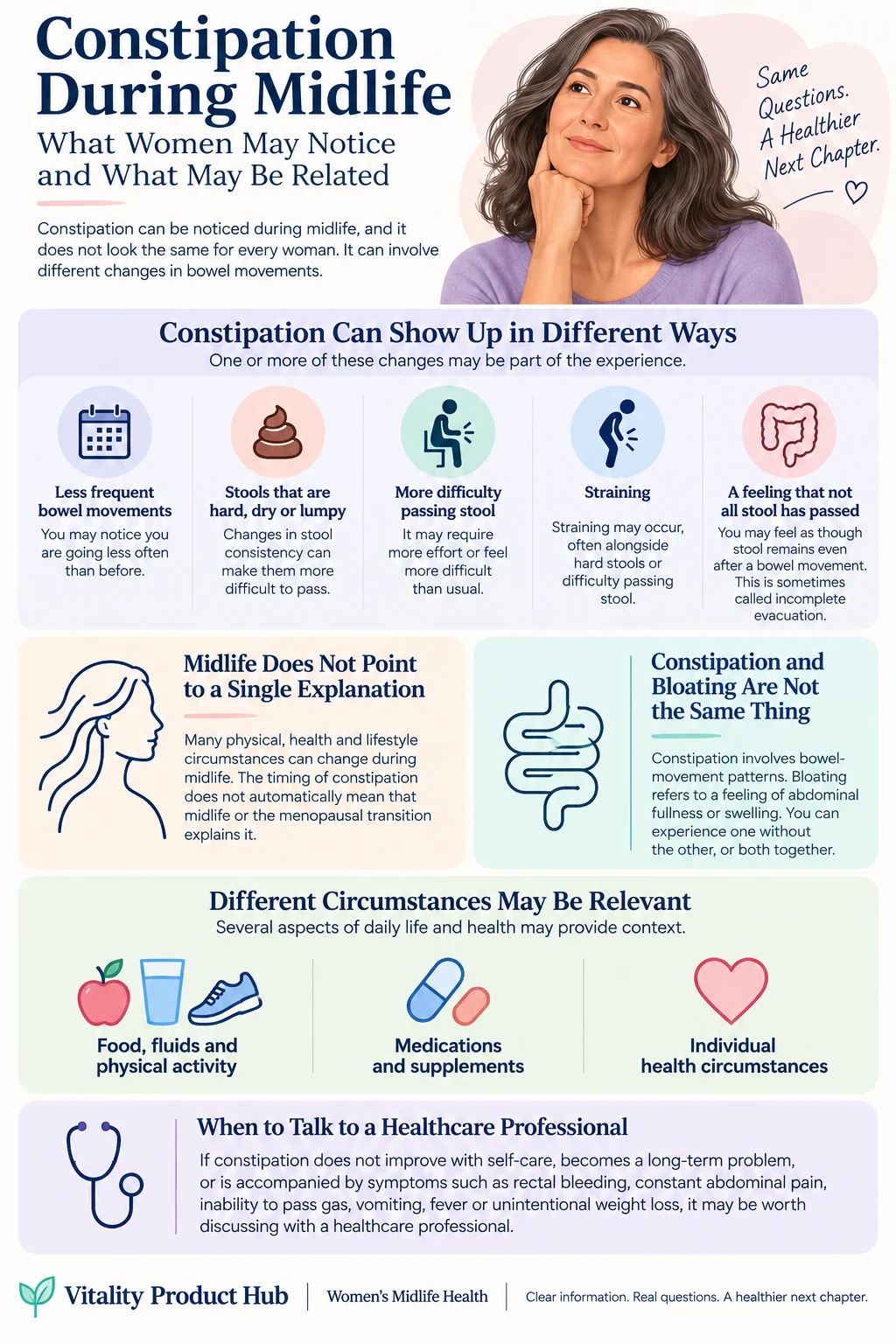
Constipation Can Show Up in Different Ways
Constipation does not have to look the same from one woman to another. Several changes in bowel movements may be part of the experience.
Bowel Movements May Become Less Frequent
Some women may notice that they are having bowel movements less often than before.
Clinical descriptions of constipation sometimes include fewer than three bowel movements a week, but frequency is only one part of the picture. A woman's usual bowel pattern also matters when describing what has changed.
Stools May Be Hard, Dry or Lumpy
Changes in stool consistency can also be part of constipation.
Stools may become harder, drier or lumpier and therefore more difficult to pass. This can occur even when bowel-movement frequency is not the change that a woman notices most.
Passing Stool May Become More Difficult
Some women may find that passing stool requires more effort or feels more difficult than it did previously.
Difficulty passing stool can be part of constipation, but the symptom by itself does not reveal why it is happening.
Straining May Occur
Straining during a bowel movement is another feature that may occur with constipation.
It may accompany hard stools or difficulty passing stool, but straining alone does not identify a particular underlying condition.
Some Women May Feel That Not All Stool Has Passed
Another possible experience is the feeling that a bowel movement has not completely emptied the bowel.
A woman may feel as though stool remains even after she has finished using the bathroom. This sensation is sometimes described clinically as incomplete evacuation.
Like the other features of constipation, it does not identify its cause on its own.
Why Frequency Alone Does Not Define Every Experience of Constipation
There is no single bowel-movement frequency that describes every person's normal pattern.
Although infrequent bowel movements can be one feature of constipation, a woman may instead notice harder stools, difficulty passing stool, straining or a feeling of incomplete evacuation.
This is why frequency should be considered as one part of the overall bowel pattern rather than as the only way to recognize constipation.
A change from a woman's usual pattern may also provide useful context when describing what she is experiencing.
What Does “Incomplete Evacuation” Mean?
“Incomplete evacuation” is a clinical expression for the feeling that not all stool has passed after a bowel movement.
The term describes the sensation; it does not explain why the sensation is occurring.
Experiencing incomplete evacuation therefore does not, by itself, establish that a woman has a particular gastrointestinal or pelvic-floor disorder.
Why Constipation Alone Cannot Tell You the Cause
Constipation describes a bowel-movement pattern; by itself, it does not explain why bowel habits have changed.
Different circumstances can contribute to constipation, and more than one factor may sometimes be relevant. The same pattern of hard stools or difficult bowel movements can therefore occur in different contexts.
Neither the presence of constipation nor its timing during midlife is enough to determine an individual cause.
Different Circumstances May Be Relevant to Constipation
Several aspects of daily life and health may provide useful context when constipation appears or changes. Their presence does not automatically mean that any one of them is responsible.
Food, Fluids and Physical Activity May Provide Context
Fiber intake, fluid intake and physical activity are among the factors that can be relevant to bowel habits.
Changes in eating patterns, inadequate fiber, not getting enough fluids or lower levels of physical activity may contribute to constipation in some circumstances.
These factors should not be treated as a universal explanation, however. Constipation can occur in different contexts and may have more than one contributing factor.
Medications and Supplements May Provide Context
Some medications and dietary supplements can contribute to constipation.
If constipation appears after a change in medication or supplement use, the timing may be useful information to discuss with a healthcare professional. It does not prove that the medication or supplement is responsible.
Medication should not be stopped or changed solely because constipation has appeared without discussing the situation with an appropriate healthcare professional.
Individual Health Circumstances May Also Be Relevant
Some health conditions can affect bowel function or be associated with constipation.
Tension and anxiety have been studied in relation to constipation severity during the menopausal transition. In one longitudinal study, both were associated with constipation severity in initial analyses, while tension remained significant in the multivariable model. These findings describe associations and do not establish what caused constipation in an individual woman.
Because several circumstances can overlap, the symptom alone cannot distinguish among possible explanations.
Constipation and Bloating Are Not the Same Thing
Constipation and bloating can occur at the same time, but they describe different experiences.
Constipation concerns bowel-movement patterns such as stool consistency, difficulty passing stool, frequency and incomplete evacuation.
Bloating refers to a sensation of abdominal fullness, pressure or swelling and is not interchangeable with constipation.
A woman can experience one without the other, or both together. Having bloating alongside constipation does not by itself explain why either symptom is occurring.
Read more about bloating during midlife.
When Is It Worth Discussing Constipation With a Healthcare Professional?
Constipation that does not improve with self-care or becomes a long-term problem may be worth discussing with a healthcare professional.
Medical attention is also important when constipation occurs with symptoms such as rectal bleeding or blood in the stool, constant abdominal pain, inability to pass gas, vomiting, fever or unintentional weight loss.
A healthcare professional can consider the broader context, including symptoms, medications, health history and other individual circumstances, when deciding whether further evaluation is appropriate.