Bloating During Midlife: What Women May Notice and What May Be Related
During midlife, some women may notice that bloating feels more frequent or more noticeable than it did before.
The abdomen may feel unusually full or swollen at times. For some women, the sensation may be occasional, while for others it may return more often or become bothersome enough to attract greater attention.
Bloating can occur in many different circumstances, and several changes may also occur during the same stage of life.
Noticing bloating during midlife therefore does not, by itself, explain why it is occurring.
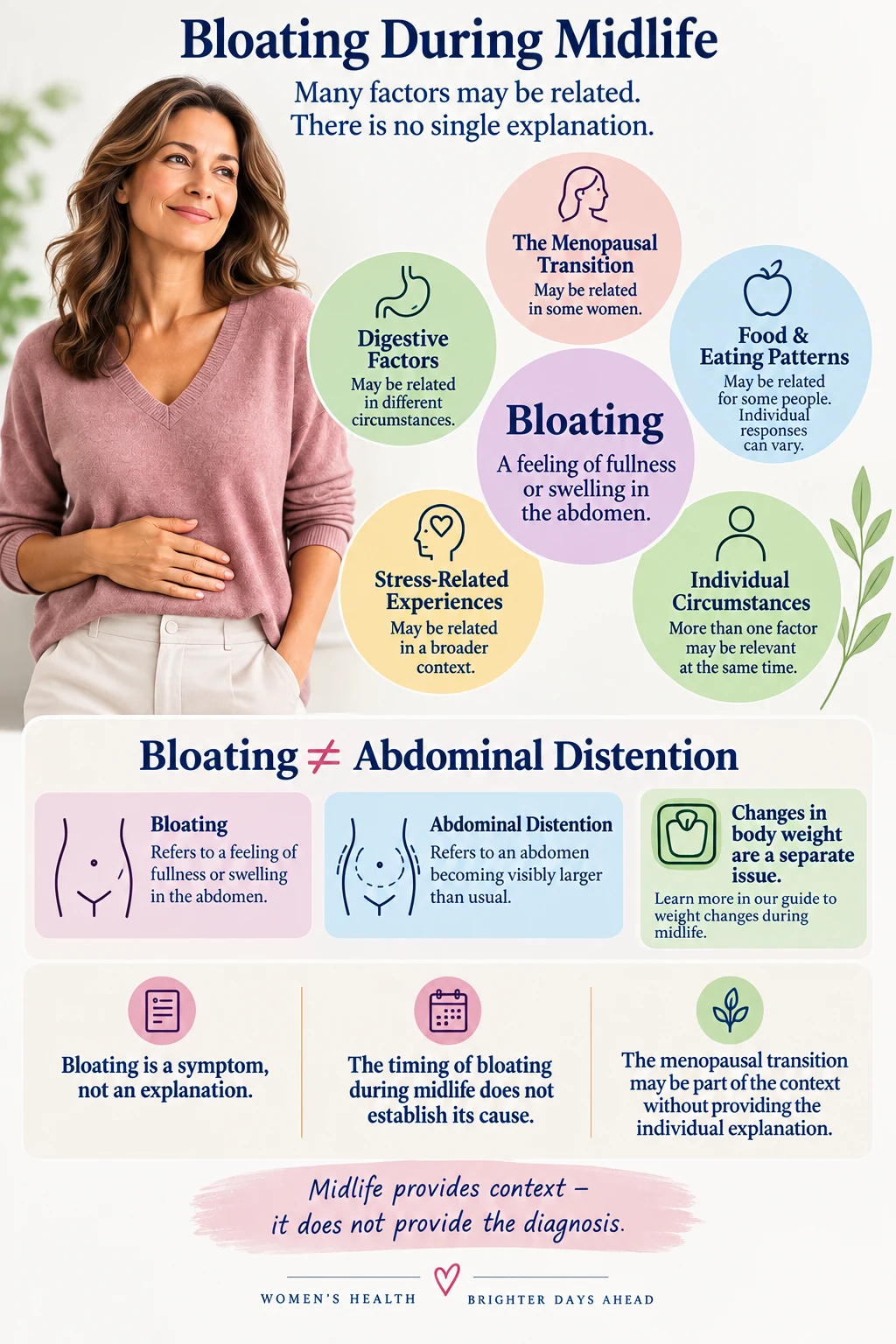
Bloating is a symptom, not an explanation.
What Does Bloating Mean?
Bloating describes a feeling of fullness or swelling in the abdomen.
The sensation can vary between people and may also vary at different times in the same person. It may occur occasionally or more frequently, and some people may experience abdominal discomfort along with it.
Bloating is often discussed together with gas and abdominal distention, but these terms do not all describe the same thing.
A woman may feel bloated without knowing what is producing the sensation.
The symptom itself therefore cannot identify its cause.
Bloating Can Become More Noticeable During Midlife
Some women may notice bloating during midlife or feel that an existing tendency to become bloated has changed during this period.
Research has examined bloating specifically in women moving through reproductive aging. A longitudinal study of women in the Seattle Midlife Women's Health Study found associations between stages of the menopausal transition and bloating severity.
That does not mean every woman will experience bloating during midlife, nor does it establish why the symptom occurs in an individual woman.
Several changes can occur during the same period, and their relevance can differ from one person to another.
For this reason, age or life stage alone cannot determine the explanation for bloating.
Why Midlife Does Not Point to a Single Explanation
When a symptom appears or becomes more noticeable during midlife, it can be tempting to connect the timing directly with this stage of life.
But timing does not establish cause.
Bloating occurs outside the menopausal transition as well and can appear in different digestive and individual contexts. More than one factor may also be relevant at the same time.
The fact that bloating begins or becomes more noticeable during midlife therefore does not establish that midlife itself is responsible.
The timing of bloating during midlife does not establish its cause.
How the Menopausal Transition May Be Related to Bloating
The menopausal transition is relevant to the discussion because researchers have observed associations between reproductive aging and bloating in groups of women.
In a 2026 longitudinal analysis from the Seattle Midlife Women's Health Study, stages of the menopausal transition were associated with bloating severity. The researchers examined reproductive aging alongside age, reproductive and stress-related biomarkers, and stress-related perceptions.
Those findings describe relationships observed within a group of women. They do not establish that the menopausal transition, a particular hormone or a hormonal change caused bloating in an individual woman.
They also do not support a simple chain in which hormonal changes automatically slow digestion and produce bloating.
The menopausal transition may be part of the context without providing the individual explanation.
Bloating and Abdominal Distention Are Not the Same Thing
Bloating and abdominal distention are related, but they describe different experiences.
Bloating refers to the sensation of fullness or swelling in the abdomen. Distention refers to an abdomen becoming visibly larger than usual.
A woman can therefore feel bloated without necessarily having visible abdominal distention.
Bloating and abdominal distention describe different experiences from changes in body weight. Changes in body weight are considered separately in our guide to weight changes during midlife.
Keeping these concepts separate helps prevent the appearance or sensation of the abdomen from being used as evidence of a change in body weight.
Different Factors May Be Related to Bloating
Bloating can occur in different circumstances, and there is no single explanation that applies to every woman who experiences it.
Digestive factors, foods and eating patterns, stress-related experiences and individual circumstances may all be relevant in different situations.
Their presence does not establish that any one of them caused the symptom in a particular woman.
Digestive and Gastrointestinal Factors
Bloating can occur in different gastrointestinal contexts.
Gas-related symptoms can include bloating, but feeling bloated does not necessarily mean that a person has an excessive amount of gas. Bloating may also occur alongside constipation, abdominal discomfort or other digestive changes.
These symptoms can occur in different circumstances and should not be interpreted on their own as evidence of a particular digestive condition.
Bloating alone cannot determine which, if any, particular gastrointestinal condition is present.
Food and Eating Patterns
Foods and eating patterns may be relevant to bloating for some people, and individual responses can vary.
Some people may notice that particular foods or drinks seem to accompany more gas-related symptoms or bloating, while others may not notice the same pattern.
There is no universal list of foods that explains bloating, and the presence of the symptom does not by itself establish a food intolerance or another digestive condition.
For that reason, bloating during midlife should not automatically lead to broad dietary restrictions or the assumption that a particular food is responsible.
Stress and Individual Circumstances
Stress-related experiences may also be relevant when bloating is considered within a broader individual context.
In the 2026 longitudinal study of women during the menopausal transition, tension was associated with greater bloating severity in the multivariable analysis.
That finding does not mean that stress caused bloating in an individual woman or that a physical symptom should be dismissed as psychological.
Instead, it illustrates why bloating may need to be considered within a broader context rather than attributed automatically to menopause, hormones, stress or any other single factor.
Why Bloating Alone Cannot Tell You the Cause
Bloating tells a woman what she is experiencing, but it does not necessarily explain why she is experiencing it.
Details such as when the symptom occurs, whether it is occasional or persistent, whether abdominal distention is also present, and whether other digestive changes occur alongside it may provide useful information during a clinical assessment.
Those details provide context rather than diagnostic rules.
A particular pattern, food, age or stage of reproductive aging cannot, by itself, establish one explanation.
A symptom can be meaningful without identifying its cause.
When Is It Worth Discussing Bloating With a Healthcare Professional?
If bloating occurs frequently, becomes bothersome, changes noticeably, affects everyday activities or is causing concern, discussing it with a healthcare professional may be appropriate.
A conversation may also be useful when the reason for the symptom is unclear or when bloating occurs alongside other changes a woman has noticed.
Seeking professional advice does not mean that a particular digestive condition is necessarily present.
It allows the symptom pattern, health history and individual circumstances to be considered together rather than assuming that midlife, menopause, food, stress or any other single factor provides the explanation.
Bloating during midlife can be meaningful without having one universal cause.
Midlife provides context — it does not provide the diagnosis.
Explore Women's Midlife Health
Midlife can affect different areas of health in different ways. Return to the main hub to explore other women-centered topics.
Sources
- Bloating During the Menopause Transition. PubMed. PubMed
- National Institute of Diabetes and Digestive and Kidney Diseases. Symptoms & Causes of Gas in the Digestive Tract. NIDDK
- National Institute of Diabetes and Digestive and Kidney Diseases. Eating, Diet & Nutrition for Gas in the Digestive Tract. NIDDK
- National Institute of Diabetes and Digestive and Kidney Diseases. Diagnosis of Gas in the Digestive Tract. NIDDK