Dizziness During Midlife: What Women May Notice and What May Be Related
During midlife, some women may notice episodes of dizziness that seem new, different or more noticeable than before.
The experience may vary, and the word dizziness itself can mean different things to different people. One woman may describe feeling lightheaded, while another may describe a sense of spinning or unsteadiness.
Because these experiences can occur in many different circumstances, noticing dizziness during midlife does not, by itself, explain why it is happening.
Several factors may also be present during the same stage of life.
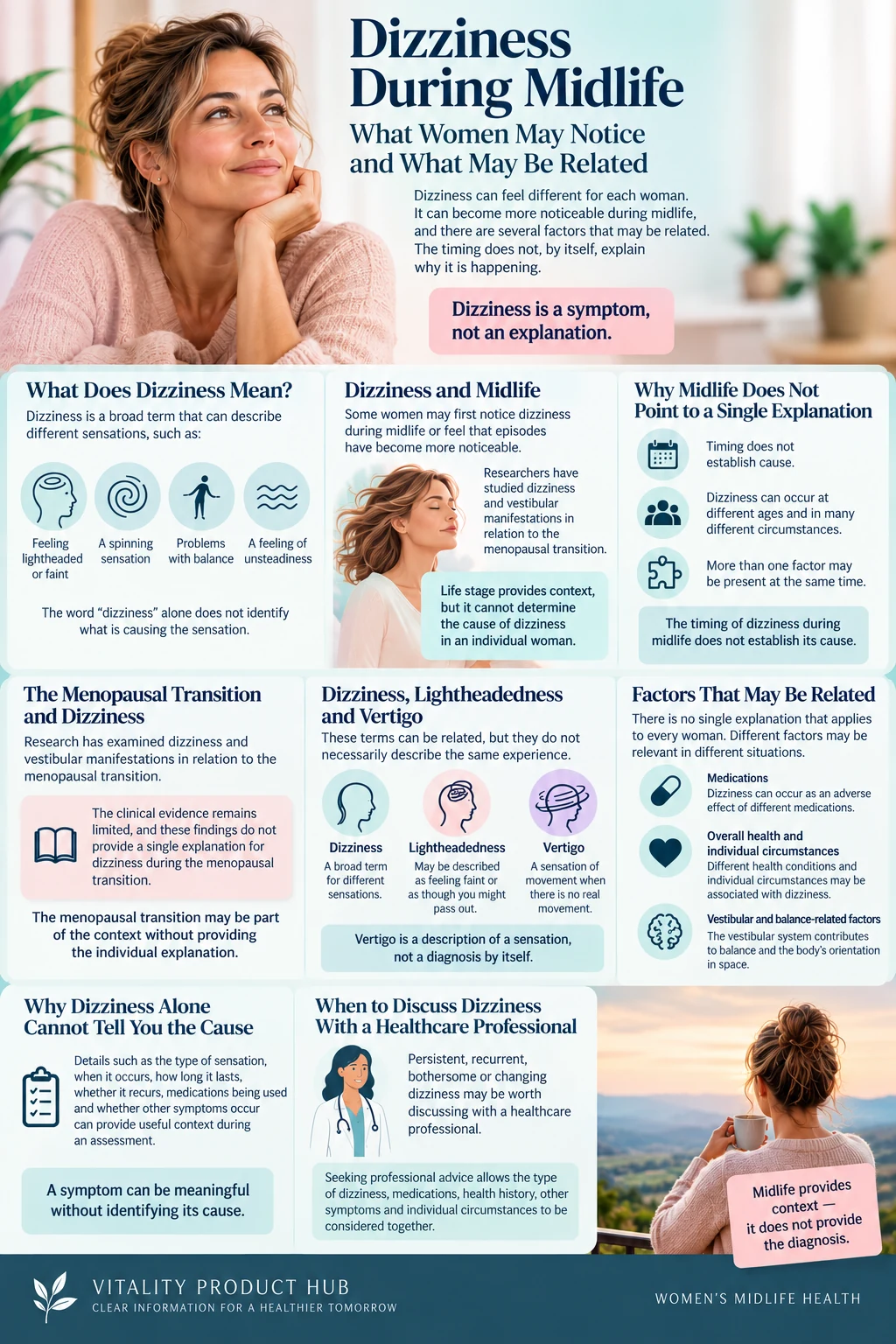
Dizziness is a symptom, not an explanation.
What Does Dizziness Mean?
Dizziness is a broad term that people may use to describe different sensations rather than one single experience.
Some people use the word when they feel lightheaded or faint. Others may use it to describe a spinning sensation, problems with balance or a feeling of unsteadiness.
These descriptions can provide useful information about what a person is experiencing, but the word dizziness alone does not identify what is causing the sensation.
This distinction matters because different experiences grouped under the same everyday word do not necessarily have the same explanation.
Dizziness can describe different sensations rather than one single experience.
Dizziness Can Become More Noticeable During Midlife
Some women may first notice dizziness during midlife or feel that episodes they have experienced before have become more noticeable during this period.
Researchers have studied dizziness and vestibular manifestations in relation to the menopausal transition. The available evidence does not establish one explanation that applies to every woman.
Different physical, health and individual circumstances may also be relevant during the same period.
This means that experiencing dizziness during midlife does not establish that midlife itself is responsible for the symptom.
Life stage provides context, but it cannot determine the cause of dizziness in an individual woman.
Why Midlife Does Not Point to a Single Explanation
When dizziness appears during midlife, its timing may make the life stage seem like the most obvious explanation.
But timing does not establish cause.
Dizziness can occur at different ages and in many different circumstances. Medication use, health conditions, vestibular or balance-related factors and individual circumstances may all be relevant in different people.
More than one factor may also be present at the same time.
For this reason, the fact that dizziness begins or becomes more noticeable during midlife does not establish why it is occurring.
The timing of dizziness during midlife does not establish its cause.
How the Menopausal Transition May Be Related to Dizziness
The menopausal transition is relevant to this discussion because researchers have investigated dizziness and vestibular symptoms in women moving through reproductive aging.
Research has examined dizziness and vestibular manifestations in relation to the menopausal transition.
Researchers have also investigated possible relationships between reproductive aging, hormonal changes and vestibular function.
However, the clinical evidence remains limited, and these findings do not provide a single explanation for dizziness during the menopausal transition.
Other factors may be present at the same time and may influence what is observed in individual women and in research populations.
The available evidence therefore does not establish that menopause, declining estrogen or another particular hormonal change caused dizziness in an individual woman.
It also does not justify a simple chain in which menopause automatically produces vestibular changes that then cause dizziness.
The menopausal transition may be part of the context without providing the individual explanation.
Dizziness, Lightheadedness and Vertigo Do Not Necessarily Describe the Same Experience
Dizziness is often used as an umbrella term for sensations that can feel quite different.
Lightheadedness and vertigo can both be described within the broader experience of dizziness, but they do not necessarily describe the same sensation.
Understanding how a woman describes what she feels can therefore provide more useful context than relying on the word dizziness alone.
Lightheadedness
Lightheadedness may be described as feeling faint or as though a person might pass out.
A woman may use the word dizzy for this sensation even when she does not feel that she or her surroundings are spinning.
The description can help distinguish the experience from other forms of dizziness, but lightheadedness by itself does not identify why the sensation is occurring.
Vertigo
Vertigo describes a sensation of movement when there is no corresponding movement occurring. It is often experienced as a feeling that the person or the surroundings are spinning or moving.
Vertigo can be described as dizziness, but not every episode of dizziness is vertigo.
The presence of vertigo also does not, by itself, identify the underlying explanation.
Lightheadedness and vertigo can be described as forms of dizziness, but they do not necessarily describe the same experience.
Vertigo is a description of a sensation, not a diagnosis by itself.
Different Factors May Be Related to Dizziness
There is no single explanation that applies to every woman who experiences dizziness.
Medication use, overall health, individual circumstances and factors involving balance or the vestibular system may all be relevant in different situations.
Their presence does not establish that any one of them caused dizziness in a particular woman.
Medications
Medication use can be relevant when dizziness is being considered because dizziness can occur as an adverse effect of different medications.
This does not mean that a medication is responsible whenever dizziness occurs while a woman is taking it.
Medication history can instead provide one part of the context considered when persistent, recurrent or bothersome dizziness is evaluated.
Medication changes should be discussed with an appropriate healthcare professional rather than made solely because dizziness has appeared.
Overall Health and Individual Circumstances
Different health conditions and individual circumstances may be associated with dizziness.
The relevance of these factors varies from one person to another, and the presence of dizziness does not establish that a particular health condition is present.
Other symptoms, health history and the circumstances surrounding an episode may provide additional context during an assessment.
For this reason, a list of possible conditions should not be used to diagnose the explanation for dizziness from the symptom alone.
Vestibular and Balance-Related Factors
The vestibular system contributes to balance and the body's orientation in space.
Factors involving the vestibular system may therefore be relevant to some experiences described as dizziness, particularly sensations involving vertigo or imbalance.
But dizziness does not automatically mean that a vestibular disorder is present.
People may use the word dizziness for experiences that do not necessarily involve the same systems or have the same explanation.
The type of sensation therefore provides context rather than a diagnosis.
Why Dizziness Alone Cannot Tell You the Cause
Dizziness tells a woman something about what she is experiencing, but it does not necessarily explain why she is experiencing it.
Details such as the type of sensation, when it occurs, how long it lasts, whether it recurs, medications being used and whether other symptoms occur alongside it may provide useful context during an assessment.
A healthcare professional may also consider medical history, medications and findings from an appropriate examination.
Those details help characterize the experience, but they are not diagnostic rules that can be interpreted in isolation.
A particular age, menopausal stage, medication or pattern of dizziness cannot, by itself, establish one explanation.
A symptom can be meaningful without identifying its cause.
When Is It Worth Discussing Dizziness With a Healthcare Professional?
If dizziness is persistent, recurrent, bothersome, affects balance or daily activities, or is causing concern, discussing it with a healthcare professional may be appropriate.
A conversation may also be useful when dizziness is new, has changed from a woman's usual experience or occurs alongside other symptoms.
Seeking professional advice does not mean that a particular vestibular or health condition is necessarily present.
It allows the type of dizziness, medications, health history, other symptoms and individual circumstances to be considered together rather than assuming that midlife, menopause, hormones or any other single factor provides the explanation.
Dizziness during midlife can be meaningful without having one universal cause.
Midlife provides context — it does not provide the diagnosis.