Dry Eyes During Midlife: Why They May Become More Noticeable
Dry, gritty or irritated eyes can become more noticeable during midlife. Some women may also notice burning or stinging, watery eyes, blurred vision or increased sensitivity to light.
These symptoms can be consistent with dry eye, but they cannot establish a diagnosis or identify the cause on their own. Dry eye is multifactorial, meaning that several factors may be involved at the same time.
For women navigating midlife health, the menopausal transition may be part of the picture. Aging, screen habits, contact lens use, medications, environmental conditions and other health factors may also play a role.
Hormonal changes during the menopausal transition may influence the tear film and ocular surface, but the relationship is complex. Symptoms that appear during perimenopause or menopause should not automatically be attributed to hormonal changes.
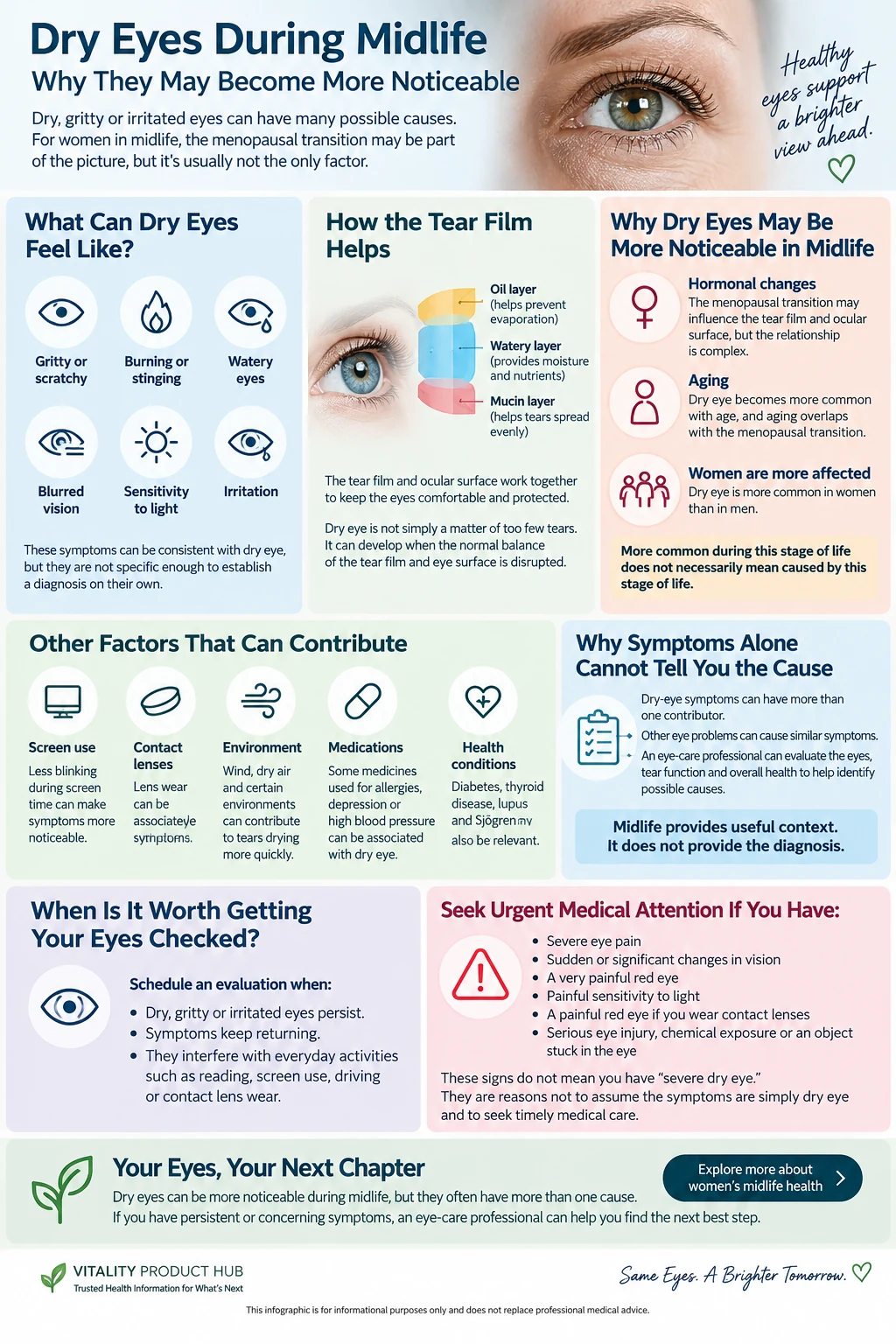
What Can Dry Eyes Feel Like?
Dry eye does not always feel simply “dry.”
Some people describe a gritty or scratchy sensation, irritation or the feeling that something is in the eye. Burning or stinging can occur as well. Blurred vision and sensitivity to light may also accompany dry-eye symptoms.
Dryness, grittiness and irritation
A gritty or scratchy feeling can occur with dry eye. Irritation may come and go or become more persistent.
These sensations are not specific enough to identify the cause by themselves. Other eye problems can produce overlapping symptoms, which is one reason persistent symptoms may need an eye-care evaluation rather than self-diagnosis.
Why dry eyes can sometimes feel watery
It may seem contradictory for eyes to feel dry and watery at the same time, but increased tearing can sometimes occur alongside dry-eye symptoms.
Watery eyes alone, however, do not establish that dry eye is the cause. The symptom needs to be considered alongside other symptoms and possible contributing factors.
Burning, blurred vision and light sensitivity
Burning or stinging, blurred vision and sensitivity to light can occur with dry eye.
They are not unique to dry eye, however. Their severity, timing and surrounding circumstances matter, particularly when pain or a significant change in vision is present.
How the Tear Film Helps Keep the Eyes Comfortable
Tears do more than make the eyes feel wet. The tear film and ocular surface work together to protect the eye and maintain a comfortable, stable surface.
Dry eye is not simply a matter of producing too few tears. It can develop when the normal balance of the tear film and eye surface is disrupted, and tear-film instability is one part of that process.
What helps keep the tear film stable
Several interacting components help maintain the tear film and ocular surface.
When this balance is disrupted, the tear film may become less stable. Different mechanisms can be involved, which is one reason there is no single explanation for every case of dry eye.
Why evaporation can matter
Tears can sometimes dry from the ocular surface too quickly. The oily component of the tear film helps limit evaporation and contributes to tear-film stability.
Changes that interfere with this function can contribute to evaporative dry eye, although evaporation is not the only mechanism involved.
The role of the meibomian glands
The meibomian glands, located along the eyelids, produce oils that help stabilize the tear film and reduce evaporation.
Changes in how these glands function can be an important contributor to evaporative dry eye.
Why Dry Eyes May Become More Noticeable During Midlife
Dry eye becomes more common with age, and women are more likely than men to experience it. But neither age nor sex alone explains why one particular person develops symptoms.
The menopausal transition occurs during overlapping years, adding another possible influence to consider.
The menopausal transition may play a role
Hormonal changes during perimenopause and menopause may influence the tear film and ocular surface.
That makes the menopausal transition relevant when looking at dry-eye symptoms during midlife, but timing alone does not establish the cause. Other factors may be present at the same time.
Hormones and the ocular surface
Sex hormones can influence tissues that help maintain the eye surface and tear film. But that relationship is complex.
For that reason, dry eye should not be reduced to a simple explanation such as “estrogen falls, so the eyes become dry.”
Hormonal changes may be one part of the picture without being the only explanation for symptoms.
Aging can matter too
Dry eye becomes more common with increasing age, and aging overlaps with the years when many women experience the menopausal transition.
That overlap makes it particularly important not to assume that symptoms appearing during perimenopause or menopause are hormonal simply because they occur at the same time.
Other Factors That Can Contribute to Dry Eye Symptoms
Several factors can shape how dry-eye symptoms show up, and they often overlap.
Screen use and reduced blinking
Long periods of screen use may make dry-eye symptoms more noticeable because people tend to blink less while concentrating on a screen.
For someone already dealing with other contributing factors, that can add another source of eye discomfort.
Contact lenses and environmental conditions
Contact lens wear can be associated with dry-eye symptoms.
Environmental conditions can matter too. Wind and dry environments, for example, can contribute to tears drying more quickly and may make symptoms more noticeable.
These influences can overlap with changes occurring during midlife rather than acting as a single explanation.
Medications and other health conditions
Some medications and health conditions can be relevant when evaluating dry-eye symptoms.
Certain medicines used for allergies, depression or high blood pressure, for example, have been associated with dry eye. Health conditions including diabetes, thyroid disease, lupus and Sjögren syndrome may also be relevant.
This does not mean a person should stop a medication because their eyes feel dry.
Instead, persistent symptoms are worth discussing with a clinician who can consider medications, health history and other possible contributors as part of the overall picture.
Why Symptoms Alone Cannot Tell You the Cause
Dryness, grittiness, burning or watery eyes may be consistent with dry eye, but symptoms alone cannot tell you why they are happening.
An eye-care professional may evaluate the ocular surface, eyelids and tear function while also considering whether another eye problem could be producing similar symptoms.
Dry eye can have more than one contributor
Different contributors can be involved, and more than one may be present at the same time.
This is why looking for a single “root cause of menopausal dry eye” can be misleading.
Other eye problems can sometimes cause similar symptoms
Redness, irritation, blurred vision and sensitivity to light are not unique to dry eye.
Other eye conditions can produce overlapping symptoms. Persistent or unusual symptoms therefore should not automatically be attributed to menopause or dry eye.
An eye examination can help determine what may be contributing and whether another problem needs attention.
When Is It Worth Getting Your Eyes Checked?
There is an important difference between symptoms that warrant a routine eye-care evaluation and symptoms that may require more urgent assessment.
When symptoms persist or interfere with daily life
Consider an eye-care evaluation when dry, gritty or irritated eyes persist, keep returning or begin interfering with everyday activities such as reading, screen use, driving or comfortable contact lens wear.
Evaluation can help identify possible contributors and determine whether additional assessment or care is appropriate.
When eye symptoms need more prompt attention
Some eye symptoms need urgent assessment rather than routine dry-eye care.
Seek urgent medical attention for severe eye pain, sudden or significant changes in vision, a very painful red eye or painful sensitivity to light.
A painful red eye in someone who wears contact lenses also warrants prompt assessment because other eye problems, including infection, may need to be considered.
Serious eye injury, chemical exposure or an object stuck in the eye requires immediate medical attention rather than routine dry-eye evaluation.
These signs do not mean that someone has “severe dry eye.” They are reasons not to assume the symptoms are simply dry eye and to seek timely medical care.
The Bottom Line
Dry eyes can become more noticeable during women's midlife, and the menopausal transition may be one part of the picture.
Hormonal changes can influence the tear film and ocular surface, while aging, screen use, contact lenses, medications, environmental conditions and other health factors may also matter.
Dryness, grittiness or irritation can be consistent with dry eye, but symptoms alone cannot establish the diagnosis or identify the cause.
More common during this stage of life does not necessarily mean caused by this stage of life.
Persistent or recurring symptoms are worth discussing with an eye-care professional. Severe pain, sudden or significant vision changes, a very painful red eye or other concerning symptoms may require more urgent assessment.
Sources
- TFOS DEWS III. Diagnostic Methodology. American Journal of Ophthalmology, 2025. PubMed
- TFOS DEWS III. Digest, 2025. PubMed
- TFOS DEWS III. Executive Summary. PubMed
- National Eye Institute. Dry Eye. National Eye Institute
- National Eye Institute. Causes of Dry Eye. National Eye Institute
- Johns Hopkins Medicine. Perimenopause, Menopause and Dry Eyes. Johns Hopkins Medicine
- NHS. Dry eyes. NHS