Dry Skin During Midlife: Why It May Become More Noticeable
Dry skin can occur at any age, but some women notice that their skin feels different during midlife. It may seem rougher, tighter or more prone to flaking, and changes that were once occasional may become harder to ignore.
The menopausal transition may be part of that picture. Hormonal changes can influence several aspects of skin physiology, including processes involved in hydration. But menopause is not the only possible explanation. Aging, environmental conditions, everyday skin-care habits, medications and certain health conditions can also contribute to dry skin.
Understanding what dry skin is — and what it is not — can help put these changes into context without assuming a cause from the stage of life alone. For women navigating midlife health, several factors may overlap.
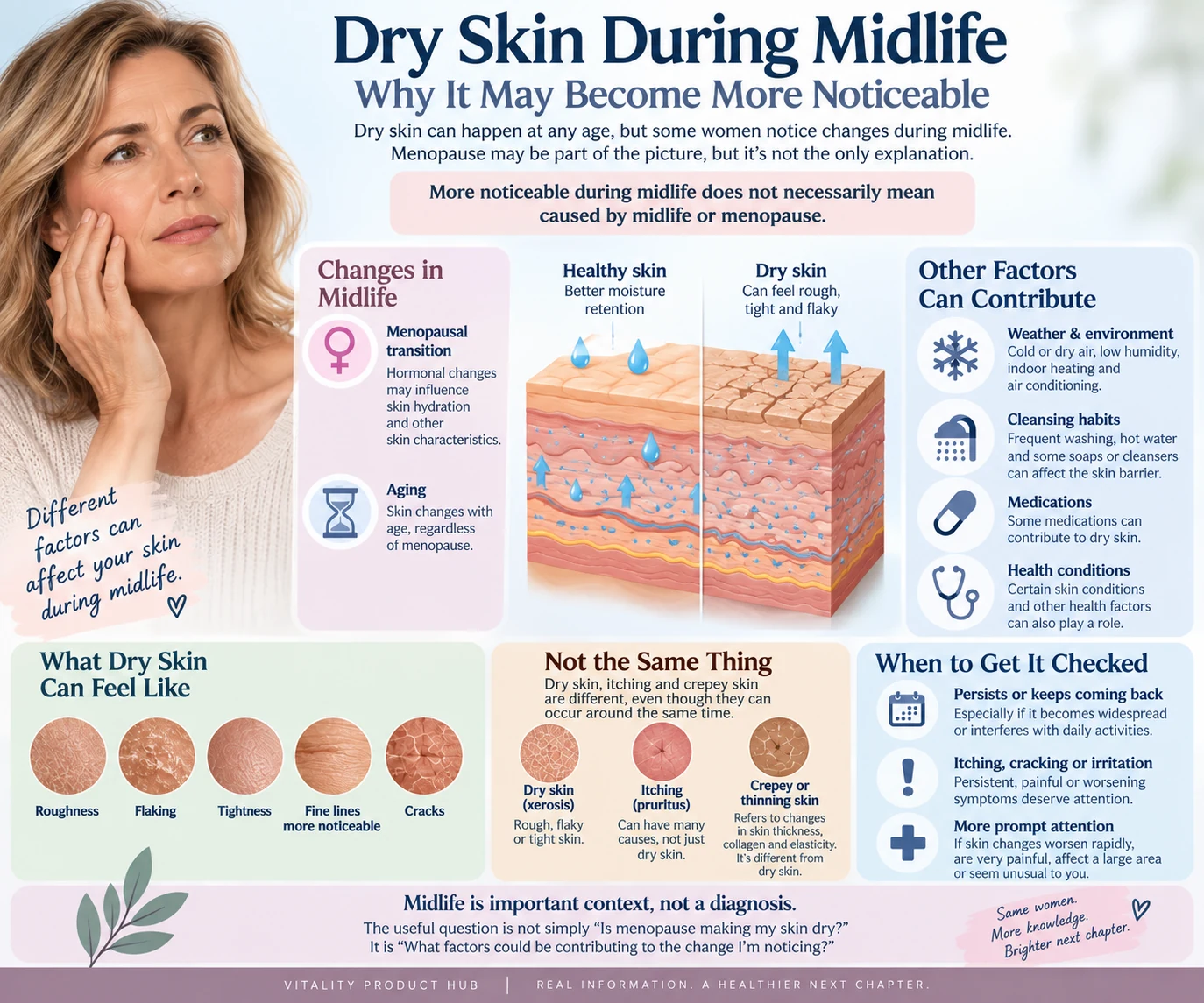
What Can Dry Skin Feel and Look Like?
Dry skin, also called xerosis, does not always look or feel the same from one person to another. Sometimes the change is mainly noticeable as discomfort. In other cases, changes can be seen on the skin surface.
Roughness, flaking and tightness
Dry skin may feel rough, tight or less comfortable than usual. The surface may look flaky or scaly, and fine surface lines can sometimes become more noticeable when the skin is dry.
The degree of dryness can vary between different areas of the body and may change with season, environment and everyday exposures.
These features can be consistent with dry skin, but appearance alone cannot tell you why the dryness developed.
When dry skin also feels itchy
Dry skin can sometimes feel itchy. When the skin becomes very dry, changes in the outer barrier and accompanying irritation may contribute to discomfort and itching.
But itching is not specific to dry skin. It can occur for many other reasons, including dermatologic and other health conditions.
That distinction matters during midlife: new or persistent itching should not automatically be attributed to menopause — or to dry skin.
Why cracks can sometimes develop
Very dry skin may become less flexible, and small cracks or fissures can develop.
Cracking can become uncomfortable and may be more noticeable in areas exposed to frequent washing, friction or environmental stress.
Persistent, painful or worsening cracks deserve attention rather than being assumed to be simply another normal feature of midlife skin.
How the Skin Helps Hold On to Moisture
The skin is more than a surface covering. Its outer layers form a protective barrier that helps limit excessive water loss while protecting the body from the surrounding environment.
When this balance is disrupted, dryness can become more noticeable.
The skin barrier and water retention
The outermost layer of the skin, the stratum corneum, contains cells, lipids and other components that work together to support barrier function and hydration.
An effective skin barrier helps the outer layers maintain moisture. Changes in that barrier can leave the skin feeling rough, flaky or uncomfortable.
What can happen when the skin loses moisture
The skin continually interacts with its environment, and maintaining adequate hydration depends on both the condition of the skin barrier and the circumstances surrounding it.
Changes in barrier function, low humidity and other environmental conditions can affect how well the outer skin maintains hydration.
This does not mean that every case of dry skin results from the same mechanism. Xerosis can have multiple contributors, and the combination may differ from one person to another.
Why oil and barrier function can matter
Natural lipids at and within the skin help support barrier function and moisture retention.
Their amount and composition can change over time, and other changes associated with aging may also affect how the skin maintains hydration.
Oil is only one part of the picture, however. Dry skin is not simply a matter of having “too little oil,” and several factors can influence how the skin feels and functions.
Why Dry Skin May Become More Noticeable During Midlife
Midlife can bring together several processes that affect the skin at the same time. Chronological aging continues while some women are also moving through perimenopause and menopause.
The effects of aging and those associated with the menopausal transition can overlap, making it difficult to assign a skin change to one factor alone.
The menopausal transition may play a role
Changes in the skin are reported during and after the menopausal transition, and dry skin can be among the concerns women notice during this period.
That does not mean menopause is responsible for every case of dryness.
Women enter this stage of life with different skin characteristics, environments, health conditions, medications and patterns of everyday exposure. These factors continue to matter during midlife.
Hormonal changes and skin moisture
Estrogen is involved in several aspects of skin physiology, so hormonal changes during the menopausal transition may influence skin hydration and other skin characteristics.
The relationship, however, is more complex than a simple chain of “estrogen falls, therefore skin becomes dry.”
Hormonal change occurs alongside chronological aging and many other influences on the skin, and the evidence is not equally strong for every proposed mechanism.
Hormonal changes are therefore better understood as one possible contributor within a broader picture, rather than an automatic explanation for dry skin.
Aging can matter too
Skin changes with age regardless of menopause.
Age-related changes can affect the skin barrier, lipids and the skin's ability to maintain hydration. Environmental exposures accumulated over time can also influence how the skin behaves later in life.
This overlap is important. Dryness may first become noticeable around perimenopause or menopause without hormonal changes being the only reason it appeared.
Other Factors That Can Contribute to Dry Skin
Dry skin can have more than one contributor. Looking beyond menopause helps prevent a common symptom from being given an overly simple explanation.
Weather, indoor air and environmental exposure
Cold or dry weather and low humidity can make it harder for the skin to maintain moisture. Indoor heating and air conditioning may also create dry environments in which existing dryness becomes more noticeable.
Environmental conditions can change over time, which is one reason dry skin may fluctuate between seasons or settings.
Cleansing and everyday skin-care habits
Frequent washing, prolonged exposure to hot water and some soaps or cleansers can contribute to dryness by affecting natural lipids and the skin barrier.
The effect varies according to factors such as frequency, water temperature, the products used and the individual's skin.
The point is not to turn dry skin into a skin-care routine. It is to recognize that everyday exposures can contribute to dryness and may coexist with age- or menopause-related changes.
Medications and health conditions
Some medications can contribute to dry skin, and xerosis can also occur alongside dermatologic or systemic health conditions.
Because the possible contributors are varied, persistent or unexplained dryness should not automatically be labeled as hormonal.
Noticing dry skin while taking a medication also does not establish that the medication caused it.
The possibility that a medication may contribute to dry skin does not mean someone should stop taking it without medical guidance.
Dry Skin, Itchy Skin and Crepey Skin Are Not the Same Thing
Several skin changes may become noticeable around the same stage of life, and everyday descriptions can sometimes blur the boundaries between them.
Dryness, itching and changes in skin thickness or texture, however, are not interchangeable.
Dry skin can sometimes itch
Itching can accompany dry skin, particularly when dryness becomes more pronounced or the skin barrier is disrupted.
But the presence of itching alone does not establish dry skin as its cause.
Itching can have causes other than dryness
Itching, or pruritus, can occur for many reasons. Some are related to skin conditions, while others may involve different health factors.
A woman experiencing itching during perimenopause or menopause therefore should not assume that hormonal changes or dry skin must be responsible.
For the same reason, persistent, significant or unexplained itching may need to be evaluated on its own rather than treated simply as another name for dryness.
Skin thinning and crepey texture are different changes
Skin that looks thinner, more fragile or crepey can coexist with dryness, particularly as skin ages, but these descriptions refer to different changes.
Changes in skin thickness, collagen and elasticity are not simply another name for xerosis.
Dryness can make fine surface lines more noticeable, but it does not explain every change in skin texture, thickness or firmness.
Keeping these concepts separate avoids turning the broad label of “menopausal skin” into an explanation for several different processes.
Why Dry Skin Alone Cannot Tell You the Cause
Dry skin is not a fingerprint for one particular cause.
Its presence can provide useful information about what is happening at the skin surface, but it cannot by itself identify why the change developed.
More than one factor may be involved
Hormonal changes, chronological aging, environment, everyday exposures, medications and health conditions can overlap.
The relative importance of those contributors may differ from one person to another and can also change over time.
That is why the timing of dry skin — even when it begins during perimenopause or menopause — is not enough by itself to establish causation.
Other skin conditions can sometimes look or feel similar
Roughness, flaking, irritation and itching are not unique to uncomplicated dry skin. Dermatologic conditions can produce symptoms that overlap with xerosis.
Persistent, spreading, markedly irritated or otherwise unusual changes may therefore warrant professional evaluation rather than continued assumptions about their cause.
When Is It Worth Getting Dry Skin Checked?
Mild, occasional dryness is common and can fluctuate with weather, environment and everyday exposures. Some patterns, however, are worth discussing with a healthcare professional.
The goal is not to turn every episode of dry skin into a medical problem. It is to recognize when the pattern is persistent, significant or unusual enough to deserve evaluation.
When dryness persists or keeps coming back
Dryness that persists, repeatedly returns, becomes widespread or begins to interfere with comfort or daily activities is worth getting checked.
An evaluation can help distinguish uncomplicated dryness from changes that may have another contributor.
When itching, cracking or irritation becomes significant
It is also reasonable to seek medical advice when dryness is accompanied by significant or persistent itching, painful cracking or substantial irritation.
These features do not necessarily indicate a serious condition, but they can make it more important to understand what is contributing to the symptoms.
When skin changes need more prompt attention
Skin changes that worsen rapidly, become significantly painful, affect a large area or are otherwise concerning deserve more prompt medical attention.
Other unusual or rapidly changing skin findings should not automatically be assumed to be ordinary dryness or a normal consequence of menopause.
The appropriate urgency depends on the symptoms and the individual situation.
The Bottom Line
Dry skin may become more noticeable during women's midlife, and changes associated with the menopausal transition may be one part of the picture. But aging, environment, everyday exposures, medications and health conditions can also matter.
The useful question is therefore not simply: “Is menopause making my skin dry?”
It is: “What factors could be contributing to the change I'm noticing?”
That distinction keeps midlife in its proper place: important context, without turning it into a diagnosis.
Sources
- American Academy of Dermatology. Dry skin: Signs and symptoms. American Academy of Dermatology
- DermNet. Dry skin (xeroderma). DermNet
- Vandiver AR, et al. Age-related skin barrier dysfunction. Journal of the American Academy of Dermatology. PubMed
- Gold LS, et al. Mature skin xerosis: Clinical considerations and management. PubMed
- Viscomi B, et al. Menopausal skin changes: A narrative review. Journal of Cosmetic Dermatology, 2025. PubMed