Feeling More Anxious During Midlife: What Women May Notice and What May Be Related
Feeling anxious from time to time is part of many people's lives. During midlife, however, some women may notice that feelings of worry, nervousness or uneasiness seem more noticeable than they were before.
For some women, this may feel like a new experience. For others, anxiety may already have been familiar but may seem different or more noticeable during this stage of life. Other women may notice little or no change.
There is no single pattern that applies to every woman. Midlife can coincide with changes in reproductive aging, sleep, health, stress and life circumstances, and several of these factors may be relevant at the same time.
Noticing more anxiety during midlife therefore does not, by itself, explain why the change is happening.
What Does Feeling More Anxious Mean?
Feeling more anxious can describe different experiences. A woman may notice more worry than usual, feel nervous or tense more often, or simply feel that anxiety has become more noticeable in her daily life.
These experiences do not automatically mean that she has an anxiety disorder.
Anxiety can occur in response to stressful situations and can also be experienced at other times. How often it occurs, how distressing it feels and how much it affects everyday life can vary considerably between individuals.
This distinction matters because noticing anxiety is not the same as establishing a clinical diagnosis.
Anxiety Can Become More Noticeable in Different Ways During Midlife
Women do not follow one universal pattern of anxiety during midlife.
Some may notice anxiety that feels new or more prominent. Others who have experienced anxiety previously may notice changes in how often or how strongly they experience it. Some women may not notice a meaningful change at all.
Research following women through midlife and the menopausal transition also suggests that patterns of anxiety are not identical across women. Previous experiences with anxiety and a woman's broader health and life context may be relevant when these patterns are considered.
This variability is one reason midlife should not be treated as a stage when women are expected to become anxious.
Why Midlife Does Not Point to a Single Explanation
When anxiety becomes more noticeable during midlife, it can be tempting to attribute the change to age or menopause alone.
But timing does not establish cause.
Midlife can coincide with reproductive aging as well as changes in sleep, physical health and personal or life circumstances. Stressful events may also occur during this period.
These experiences can overlap, and their relevance differs from one woman to another.
A change in anxiety therefore cannot be explained simply by the age at which a woman notices it.
How the Menopausal Transition May Be Related to Anxiety
The menopausal transition may be associated with changes in anxiety for some women, but the relationship is not the same for everyone.
Longitudinal research has found that patterns of anxiety during the menopausal transition can differ depending on women's previous levels of anxiety and other factors. This makes it difficult to reduce the experience to a simple pattern in which menopause causes anxiety.
Hormonal changes are part of the menopausal transition, but they do not by themselves explain why an individual woman feels anxious.
Feeling more anxious should therefore not automatically be interpreted as evidence that hormonal changes or menopause are the individual cause.
The menopausal transition can be part of the context without being assumed to be the individual explanation.
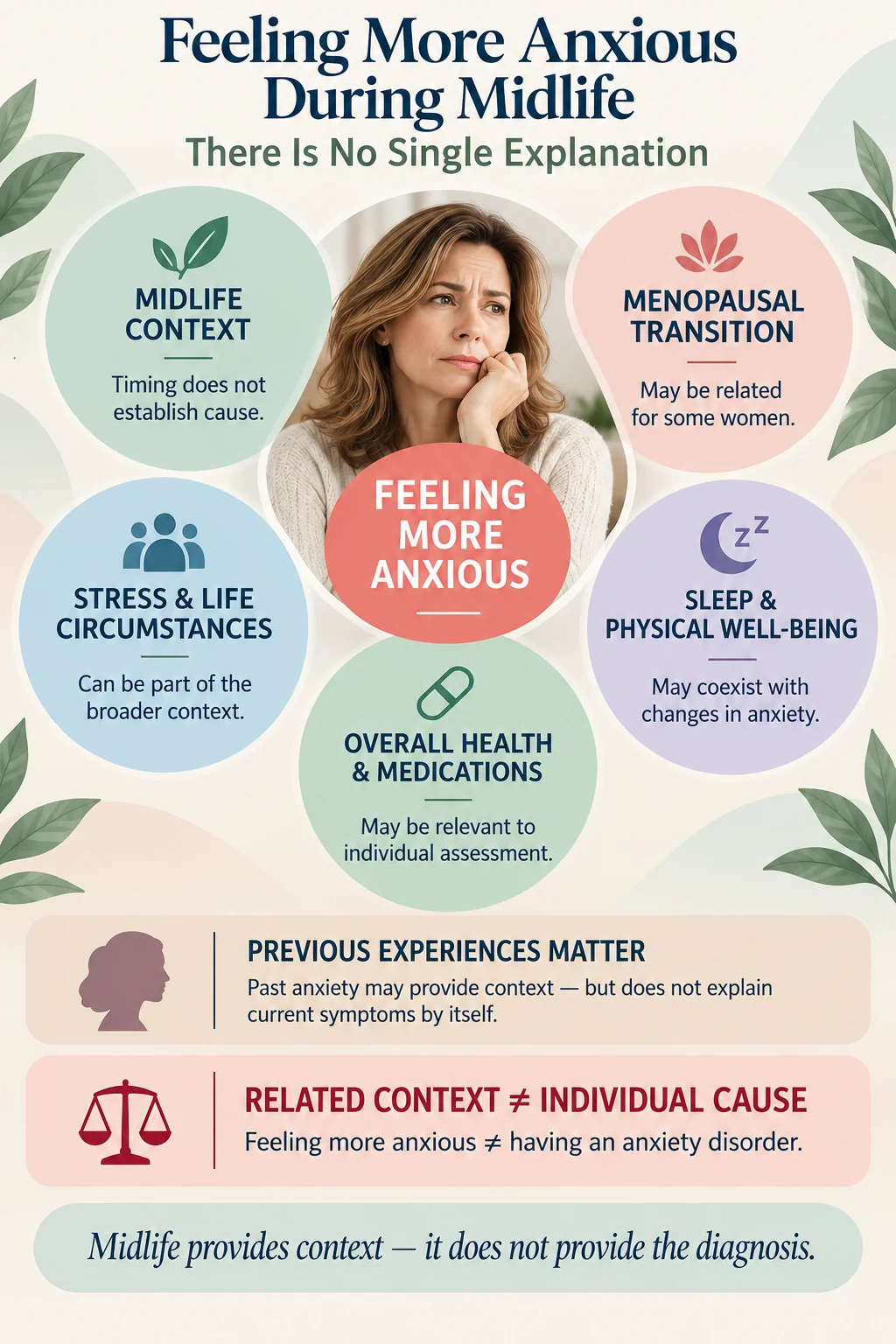
Multiple Factors May Be Related to Feeling More Anxious
Changes in anxiety may occur within a broader physical, emotional and personal context.
Research examining anxiety during midlife has considered a range of health, psychological and social factors. Some may coexist with changes in anxiety, but identifying one of these factors does not establish that it is the cause for an individual woman.
Stress and Life Circumstances
Stressful events and ongoing life pressures can occur during midlife, as they can at other stages of life.
Stress and anxiety can overlap, but they are not the same experience.
A stressful circumstance may be relevant to how a woman feels without proving why anxiety has become more noticeable. Likewise, experiencing anxiety during a stressful period does not by itself indicate an anxiety disorder.
Sleep and Physical Well-Being
Sleep difficulties and anxiety can occur together, and sleep may be relevant when considering a woman's broader well-being.
However, the presence of both does not establish which is responsible for the other, and their relationship may differ between individuals.
Changes in nighttime sleep can also be considered separately rather than assuming that anxiety explains every sleep change.
Overall Health and Medications
Physical health can also be relevant when considering changes in emotional well-being.
Overall health and medication use can be relevant parts of a clinical assessment when anxiety changes.
A medication should not be stopped or changed solely because anxiety has become more noticeable. Concerns about possible medication effects are better discussed with a healthcare professional.
Previous Experiences With Anxiety
A woman's previous experience with anxiety can provide important context.
Longitudinal research suggests that women with different levels of anxiety before the menopausal transition may show different patterns as they move through it.
That population-level observation cannot determine why a particular woman is feeling more anxious now.
A previous history of anxiety does not mean that current symptoms should automatically be attributed to the past. In the same way, experiencing anxiety for the first time during midlife does not establish that menopause caused it.
Physical Sensations Do Not Identify the Cause
Anxiety can sometimes occur alongside physical sensations, such as a racing or pounding heartbeat. Similar sensations, however, can occur in other contexts as well.
A physical sensation by itself does not establish that anxiety is responsible for it.
Likewise, experiencing a racing heart or another uncomfortable physical sensation does not automatically mean that a woman is having a panic attack, and having a panic attack is not the same as having panic disorder.
Trying to identify the cause of a physical symptom from the symptom alone can therefore be misleading.
Feeling More Anxious Does Not Automatically Mean an Anxiety Disorder
Feeling anxious and having an anxiety disorder are not interchangeable.
Anxiety disorders are clinical conditions that are evaluated using more than the presence of occasional worry, nervousness or physical sensations. The persistence of symptoms, the level of distress and their effect on everyday functioning can all be relevant in a clinical assessment.
There is therefore no single feeling or symptom in this article that can tell a woman whether she has an anxiety disorder.
Similarly, anxiety occurring during midlife or the menopausal transition should not automatically be labeled as a specific mental health condition.
When Is It Worth Discussing Anxiety With a Healthcare Professional?
If anxiety is persistent, difficult to manage, distressing or interfering with daily life, discussing it with a healthcare professional may be appropriate.
A conversation may also be useful when a woman has questions about physical symptoms, health conditions or medications that occur alongside changes in anxiety.
Seeking professional advice does not mean that an anxiety disorder is necessarily present. It allows the woman's symptoms, health history and individual circumstances to be considered together rather than assuming that midlife, menopause or any single factor explains what she is experiencing.
Feeling more anxious during midlife can be a meaningful change for a woman. Understanding that change begins by recognizing her individual experience while avoiding assumptions about its cause.
Sources
- Bromberger JT, et al. Does Risk for Anxiety Increase During the Menopausal Transition? PMC
- Bryant C, Judd FK, Hickey M. Anxiety during the menopausal transition: a systematic review. PubMed
- National Institute of Mental Health. Anxiety Disorders. NIMH
- National Institute of Mental Health. Generalized Anxiety Disorder: What You Need to Know. NIMH
- National Institute of Mental Health. I’m So Stressed Out! NIMH
- National Institute of Mental Health. Panic Disorder: What You Need to Know. NIMH
- Mayo Clinic. Anxiety disorders — Symptoms and causes. Mayo Clinic
- Mayo Clinic. Generalized anxiety disorder — Diagnosis and treatment. Mayo Clinic