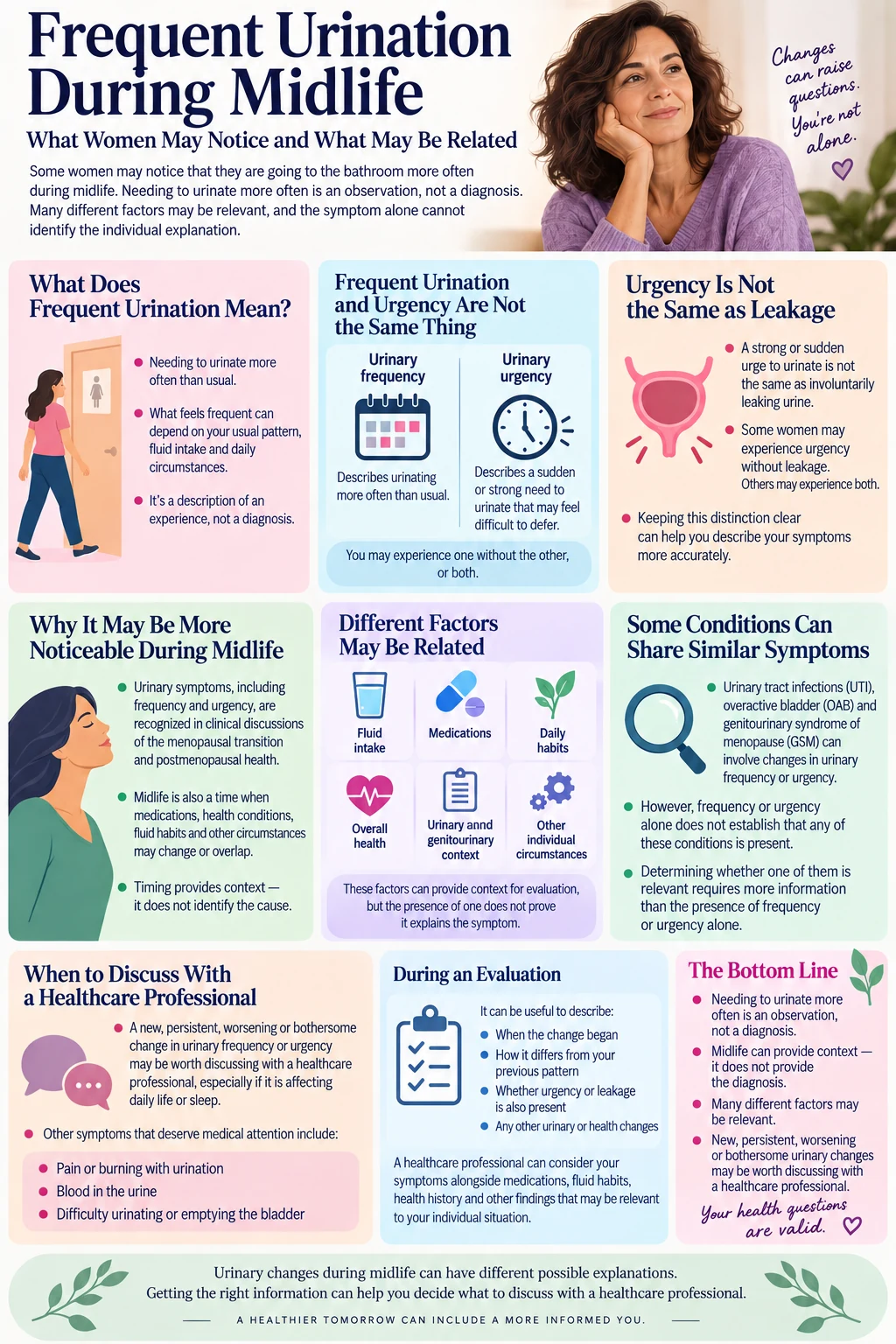
Frequent Urination During Midlife: What Women May Notice and What May Be Related
During midlife, some women may notice that they are going to the bathroom more often than before. They may find themselves urinating more frequently during the day, feeling that bathroom trips have become more noticeable, or sometimes experiencing a stronger or more sudden need to urinate.
These changes can naturally raise questions, particularly when they appear around the same time as perimenopause, menopause or other midlife changes.
Needing to urinate more often is an observation, not a diagnosis. Noticing urinary frequency during midlife does not establish that menopause, hormonal changes or any particular condition caused it.
Urinary patterns can vary in different circumstances, and the symptom alone cannot identify the individual explanation.
Needing to urinate more often is an observation, not a diagnosis.
What Does Frequent Urination Mean?
Frequent urination generally describes needing to urinate more often than usual.
What feels frequent can depend partly on a person's usual pattern, fluid intake and daily circumstances. A change from what is normal for that woman may therefore be more noticeable than a particular number of bathroom trips.
Frequent urination is also a description of an experience rather than a diagnosis.
It does not by itself establish whether the change is related to the menopausal transition, a urinary condition, a medication, fluid intake, another health factor or something else.
Describing when the change began and how it differs from the woman's previous pattern can provide useful context without identifying the cause.
Frequent Urination Can Become More Noticeable During Midlife
A woman may first notice that she is urinating more frequently during her 40s, 50s or later.
The timing may naturally make her wonder whether perimenopause or menopause may be relevant.
Urinary symptoms, including frequency and urgency, are recognized in clinical discussions of the menopausal transition and postmenopausal health. However, midlife is also a period in which medications, health conditions, fluid habits and other individual circumstances may change or overlap.
The appearance of frequent urination during this stage of life therefore does not establish why it is occurring.
Timing provides context — it does not identify the cause.
Why Midlife Does Not Point to a Single Explanation
There is no single explanation for every change in urinary frequency.
A woman's age or menopausal status may be relevant information, but neither can determine from frequent urination alone what is happening in her individual case.
Fluid intake, daily habits, medications, urinary conditions, overall health and other individual circumstances may also provide relevant context.
Even when urinary changes appear at the same time as other midlife symptoms, their coexistence does not establish that they share one cause.
Midlife should therefore be treated as part of the context rather than as a diagnostic explanation.
How the Menopausal Transition May Be Related to Urinary Changes
The menopausal transition can provide relevant context when urinary changes are discussed.
Clinical guidance recognizes urinary symptoms, including frequency and urgency, within the broader range of genitourinary changes that may occur around and after menopause.
That does not mean that menopause explains every new urinary symptom in a woman during midlife.
Urinary frequency and urgency can occur in different contexts, and similar symptoms may also appear with urinary conditions, medications, health conditions or other individual circumstances.
For this reason, a hormonal explanation should not be assumed from urinary frequency alone.
The menopausal transition may provide relevant context without providing the individual diagnosis or cause.
Frequent Urination and Urinary Urgency Are Not the Same Thing
Urinary frequency and urinary urgency are related experiences, but they do not mean exactly the same thing.
A woman may experience one without clearly experiencing the other, or she may notice both.
Keeping them separate helps describe the urinary change more accurately without turning either symptom into a diagnosis.
Urinary Frequency
Urinary frequency describes urinating more often than usual.
A woman may notice that the interval between bathroom trips has become shorter or that she is going more often than she previously did.
The observation does not determine why the pattern changed.
Frequency alone does not establish menopause, a urinary tract infection, overactive bladder, diabetes, GSM or another particular condition.
Urinary Urgency
Urinary urgency describes a sudden or strong need to urinate that may feel difficult to defer.
That experience is different from simply noticing more bathroom trips.
Urgency can occur together with frequency, but the presence of one does not automatically establish the other.
Urgency is also a symptom rather than a diagnosis. Experiencing urgency does not by itself establish overactive bladder or another urinary condition.
Urinary Urgency Is Not the Same as Bladder Leakage
A sudden or strong urge to urinate is not the same thing as involuntarily leaking urine.
Some women may experience urgency without leakage. Others may experience both.
Their coexistence does not make the terms interchangeable.
Urinary urgency describes the sensation of needing to urinate, while bladder leakage describes involuntary loss of urine.
Keeping this distinction clear is important because a woman who notices a stronger urge to urinate is not necessarily experiencing incontinence.
Likewise, the presence of urgency alone cannot determine whether a bladder condition is present.
Different Factors May Be Related to Frequent Urination
Different circumstances can affect urinary patterns.
Rather than pointing to one explanation, frequent urination may need to be considered alongside fluid intake, daily habits, medication use, urinary symptoms, health history and other individual factors.
These circumstances provide context for evaluation. They should not be used as a checklist for diagnosing the cause at home.
Fluids, Daily Habits and Medications
Fluid intake can be relevant when urinary frequency is considered.
Daily routines may also change when and how often fluids are consumed, making urinary patterns more noticeable at certain times.
Medication use may also be relevant when changes in urinary patterns are evaluated. Medication use is therefore one part of the broader health history that may be relevant when urinary frequency changes.
However, noticing frequent urination does not establish that fluid intake, a particular habit or a medication is responsible.
A medication should not be stopped or changed solely because urinary frequency has appeared without discussing the situation with the appropriate healthcare professional.
Health and Urinary Context
Overall health and urinary history can also matter when frequent urination or urgency is evaluated.
Urinary tract infections, overactive bladder and some health conditions can involve changes in urinary frequency or urgency. Some health conditions, including diabetes, may also be relevant when urinary frequency is evaluated, but the symptom alone does not establish that such a condition is present.
But frequent urination alone does not establish any of these conditions.
The presence of a possible factor does not prove that it explains the symptom in an individual woman.
Other symptoms, health history and appropriate clinical evaluation may be needed to understand what is relevant.
Other Urinary Conditions Can Share Similar Symptoms
Frequency and urgency are not unique to menopause.
Similar urinary symptoms can occur in several different clinical contexts. This overlap is one reason a new urinary change should not automatically be assigned to the menopausal transition simply because it appeared during midlife.
Likewise, recognizing that a symptom can occur with a condition does not mean that the condition is present.
UTI, Overactive Bladder and GSM Are Not Diagnosed From Frequency or Urgency Alone
Urinary frequency and urgency can occur with a urinary tract infection, but these symptoms alone do not establish that an infection is present.
Urgency is also an important symptom considered in overactive bladder, but experiencing urgency does not by itself establish that clinical syndrome.
Urinary symptoms including frequency and urgency may also occur within the broader clinical context of genitourinary syndrome of menopause, or GSM.
However, frequency or urgency alone does not establish GSM.
These conditions can share symptoms while remaining clinically distinct. Determining whether one of them is relevant requires more information than the presence of frequency or urgency alone.
Why Frequent Urination Alone Cannot Tell You the Cause
A woman can accurately notice that she is urinating more often without knowing why the change occurred.
Frequent urination does not by itself establish menopause or hormonal changes as the explanation.
It does not establish a urinary tract infection.
It does not establish diabetes or another metabolic condition.
Urinary urgency does not by itself establish overactive bladder.
And frequency or urgency alone does not establish GSM.
Fluid intake, daily habits, medications, urinary health, overall health and other individual circumstances may provide relevant context depending on the person.
Determining what is relevant requires more than matching one symptom to one possible explanation.
Frequent urination deserves context, not a diagnostic shortcut.
When Is It Worth Discussing Urinary Changes With a Healthcare Professional?
A new, persistent, worsening or bothersome change in urinary frequency or urgency may be worth discussing with a healthcare professional, particularly when it is affecting daily life or sleep.
Other urinary symptoms can also change the context. Pain or burning with urination, blood in the urine, or difficulty urinating or emptying the bladder are examples of changes that deserve medical attention rather than being automatically attributed to midlife or menopause.
During an evaluation, it can be useful to describe when the urinary change began, how it differs from the woman's previous pattern, whether urgency or leakage is also present, and what other urinary or health changes have occurred.
A healthcare professional can consider urinary symptoms alongside medications, fluid habits, health history and other findings that may be relevant to the individual situation.
The purpose of evaluation is not to assume that menopause caused the change or that a particular urinary condition is present. It is to understand the individual situation more carefully.
Needing to urinate more often is an observation, not a diagnosis.
Midlife provides context — it does not provide the diagnosis.