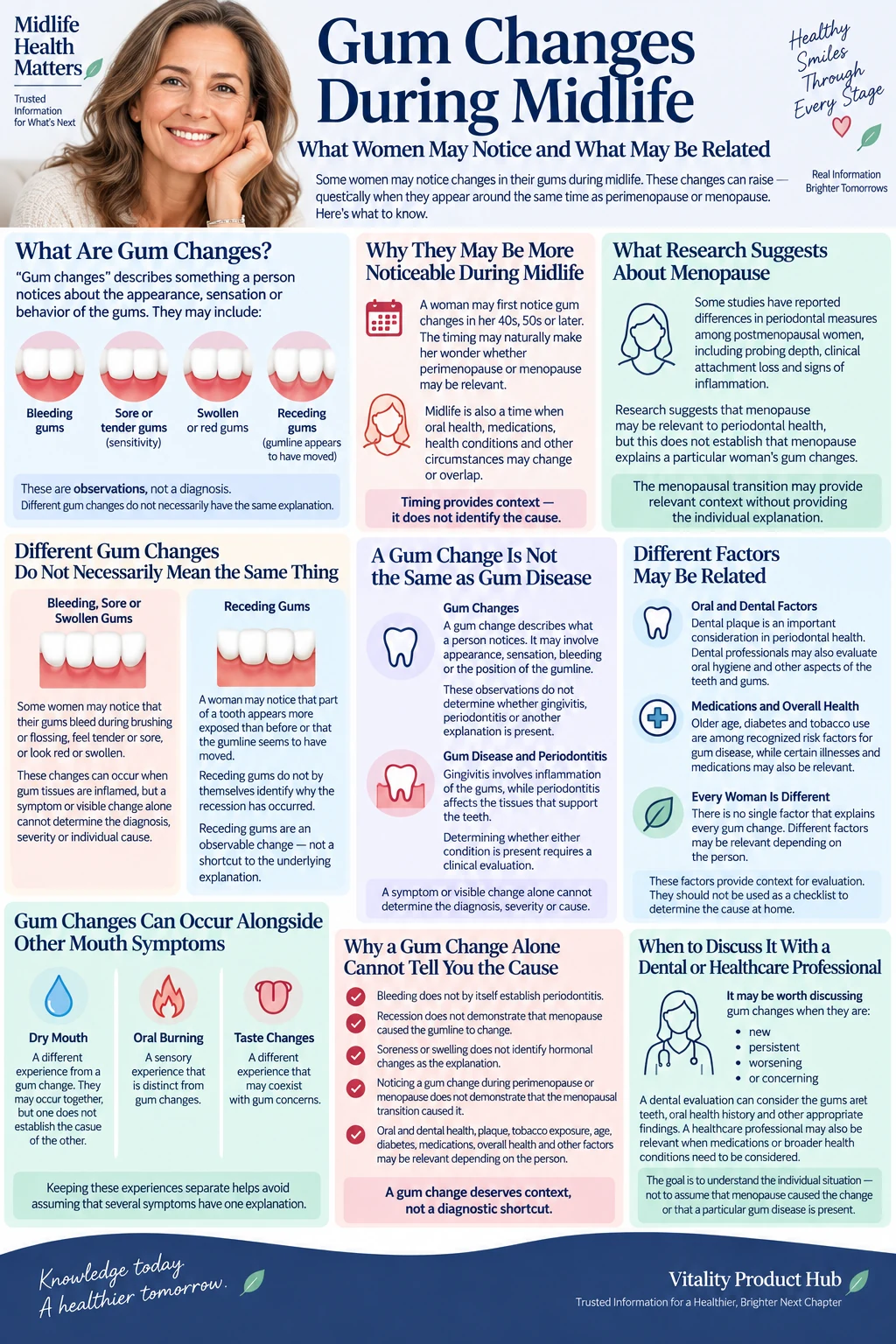
Gum Changes During Midlife: What Women May Notice and What May Be Related
During midlife, some women may notice that their gums seem different than before. They may notice bleeding when brushing or flossing, soreness or tenderness, swelling, or areas where the gums appear to be receding.
These changes can naturally raise questions, particularly when they appear around the same time as perimenopause, menopause or other midlife changes.
A change in the gums is an observation, not a diagnosis. Noticing gum changes during midlife does not establish that midlife, menopause or hormonal changes caused them.
Different gum changes can occur in different oral and health contexts, and the change alone cannot identify the individual explanation.
A change in the gums is an observation, not a diagnosis.
What Do Gum Changes Mean?
“Gum changes” is a broad way of describing something a person notices about the appearance, sensation or behavior of the gums.
For example, the gums may bleed more easily, feel sore or tender, appear swollen or red, or seem to be pulling away from the teeth.
These observations can provide useful information about what has changed, but they do not establish a diagnosis or explain why the change is occurring.
Bleeding, soreness, swelling, tenderness and recession are also not interchangeable. Different gum changes do not necessarily have the same explanation.
A noticeable change therefore deserves context rather than an immediate conclusion about its cause.
Gum Changes Can Become More Noticeable During Midlife
A woman may first become aware of changes in her gums during her 40s, 50s or later.
The timing may naturally make her wonder whether perimenopause or menopause may be relevant.
Midlife, however, is also a period in which oral health, medications, health conditions and other individual circumstances may change or overlap.
The appearance of a gum change during this stage of life therefore does not establish why it is occurring.
Timing provides context — it does not identify the cause.
Why Midlife Does Not Point to a Single Explanation
Gum changes can occur in different oral, dental and health contexts.
A woman's age or menopausal status may be relevant information, but neither can determine from a gum change alone what is happening in her individual case.
The same principle applies when several changes occur together. Bleeding gums and soreness, for example, may provide more information to discuss during an evaluation, but their coexistence still does not identify the cause by itself.
Midlife should therefore be treated as part of the context rather than as a diagnostic explanation.
How the Menopausal Transition May Be Related to Gum Changes
Researchers have investigated periodontal health in women before and after menopause.
Some studies have reported differences in periodontal measures among postmenopausal women, including probing depth, clinical attachment loss and signs of inflammation.
However, the available research does not provide a simple explanation for an individual woman's gum changes. Studies differ in their methods and populations, and other factors that affect periodontal health may also be relevant.
Research therefore suggests that menopause may be relevant to periodontal health, but this does not establish that menopause explains a particular woman's bleeding, soreness, swelling or gum recession.
A hormonal explanation should not be assumed from the gum change alone.
The menopausal transition may provide relevant context without providing the individual explanation.
Different Gum Changes Do Not Necessarily Mean the Same Thing
The word “gum changes” can include several different observations.
Separating those observations can help describe what a woman is experiencing without assuming that they share one explanation.
Bleeding, Sore or Swollen Gums
Some women may notice that their gums bleed during brushing or flossing, feel tender or sore, or look red or swollen.
These changes can occur when gum tissues are inflamed and can be relevant when oral and periodontal health are evaluated.
But a symptom or visible change alone cannot determine the diagnosis, severity or individual cause.
Bleeding gums should not automatically be attributed to menopause or hormonal changes simply because they first became noticeable during midlife.
Likewise, soreness or swelling does not by itself establish periodontitis.
Receding Gums
A woman may notice that part of a tooth appears more exposed than before or that the gumline seems to have moved.
Gum recession is a meaningful observation to discuss with a dental professional, particularly when it is new, progressing or concerning.
However, receding gums do not by themselves identify why the recession has occurred.
The appearance of recession during perimenopause or after menopause also does not demonstrate that menopause or changes in estrogen caused it.
Receding gums are an observable change — not a shortcut to the underlying explanation.
A Gum Change Is Not the Same as Gum Disease
Changes in the gums can be among the signs considered when dental professionals evaluate periodontal health.
That does not mean that every person who notices bleeding, swelling, tenderness or recession has gum disease.
Clinical evaluation considers the broader oral picture rather than assigning a diagnosis from one observation.
This distinction is particularly important in midlife, when the timing of a new symptom can make a hormonal explanation seem intuitive even when the individual cause has not been established.
Gum Changes
A gum change describes what a person notices.
It may involve appearance, sensation, bleeding or the position of the gumline.
Those observations can be useful when describing a concern to a dental professional, but they do not determine whether gingivitis, periodontitis or another explanation is present.
Observation and diagnosis are not the same thing.
Gum Disease and Periodontitis
Gum disease involves conditions affecting the tissues surrounding and supporting the teeth.
Gingivitis involves inflammation of the gums, while periodontitis affects the tissues that support the teeth.
Determining whether either condition is present requires appropriate dental evaluation rather than interpretation of a single symptom at home.
A dental professional may consider the appearance of the gums, bleeding, periodontal measurements, gum recession, the teeth and other findings depending on the individual situation.
W23 therefore does not treat bleeding gums, soreness, swelling or recession as proof of periodontal disease.
Different Factors May Be Related to Gum Changes
There is no single factor that explains every gum change.
Oral and dental circumstances, health conditions, medications, tobacco exposure, age and other individual factors may be relevant depending on the person.
These factors provide context for evaluation. They should not be used as a checklist for determining the cause at home.
Oral and Dental Factors
Dental plaque is an important consideration in periodontal health, and dental professionals may also evaluate oral hygiene and other aspects of the teeth and gums when someone reports a change.
The importance of any particular oral factor depends on the individual situation.
For that reason, noticing bleeding, tenderness, swelling or recession cannot determine by itself which oral or dental factor, if any, is responsible.
Regular dental care can also provide an opportunity to compare current findings with earlier oral health and identify changes that may deserve attention.
Medications and Overall Health
Overall health and health history can also be relevant when gum or periodontal concerns are evaluated. Older age, diabetes and tobacco use are among recognized risk factors for gum disease, while certain illnesses and medications may also be relevant to periodontal health.
Their presence, however, does not establish that they explain a particular gum change.
Medication use should therefore be considered as part of the person's broader health history rather than treated as an automatic explanation.
A medication should not be stopped or changed solely because a gum change has appeared without discussing the situation with the appropriate healthcare professional.
Gum Changes Can Occur Alongside Other Mouth Symptoms
A woman noticing changes in her gums may also experience other oral symptoms.
Dryness, oral burning or changes in taste can occur in the same general period, but these experiences are distinct.
Their coexistence may provide useful context without establishing that one symptom caused another.
Dry Mouth
Dry mouth is a different experience from a gum change.
A woman may experience both, but having dry mouth does not establish why her gums are bleeding, sore, swollen or receding.
Likewise, a gum change does not establish that dry mouth or reduced salivary flow is present.
Persistent or bothersome dry mouth deserves its own context and evaluation rather than being treated as an explanation for every gum concern.
Oral Burning and Taste Changes
Oral burning and changes in taste are also distinct from gum changes.
A burning sensation describes an oral sensory experience, while a taste change describes a difference in how taste or food seems to a person.
Either may coexist with gum concerns, but their presence does not diagnose periodontal disease or identify the cause of a gum change.
Keeping these experiences separate helps avoid turning several simultaneous midlife symptoms into one assumed explanation.
Why a Gum Change Alone Cannot Tell You the Cause
A woman can accurately notice that her gums have changed without knowing why the change occurred.
Bleeding does not by itself establish periodontitis.
Recession does not demonstrate that menopause caused the gumline to change.
Soreness or swelling does not identify hormonal changes as the explanation.
And noticing a gum change during perimenopause or menopause does not demonstrate that the menopausal transition caused it.
Oral and dental health, plaque, tobacco exposure, age, diabetes, medications, overall health and other individual circumstances may provide relevant context depending on the person.
Determining what is relevant requires more than matching a symptom to a possible factor.
A gum change deserves context, not a diagnostic shortcut.
When Is It Worth Discussing Gum Changes With a Dental or Healthcare Professional?
New, persistent, worsening or concerning changes in the gums may be worth discussing with a dental professional.
Bleeding, soreness, swelling, tenderness or apparent recession can be described during an evaluation along with when the change began, whether it has progressed and any other oral or health changes that may be relevant.
A dental evaluation can consider the gums and teeth, oral health history and other appropriate findings. Depending on the individual situation, additional assessment may also be appropriate.
A healthcare professional may also be relevant when medications or broader health conditions need to be considered as part of the person's overall context.
The purpose of evaluation is not to assume that menopause caused the change or that a particular gum disease is present. It is to understand the individual situation more carefully.
A change in the gums is an observation, not a diagnosis.
Midlife provides context — it does not provide the diagnosis.