Hair Thinning and Hair Loss During Midlife: Why They May Become More Noticeable
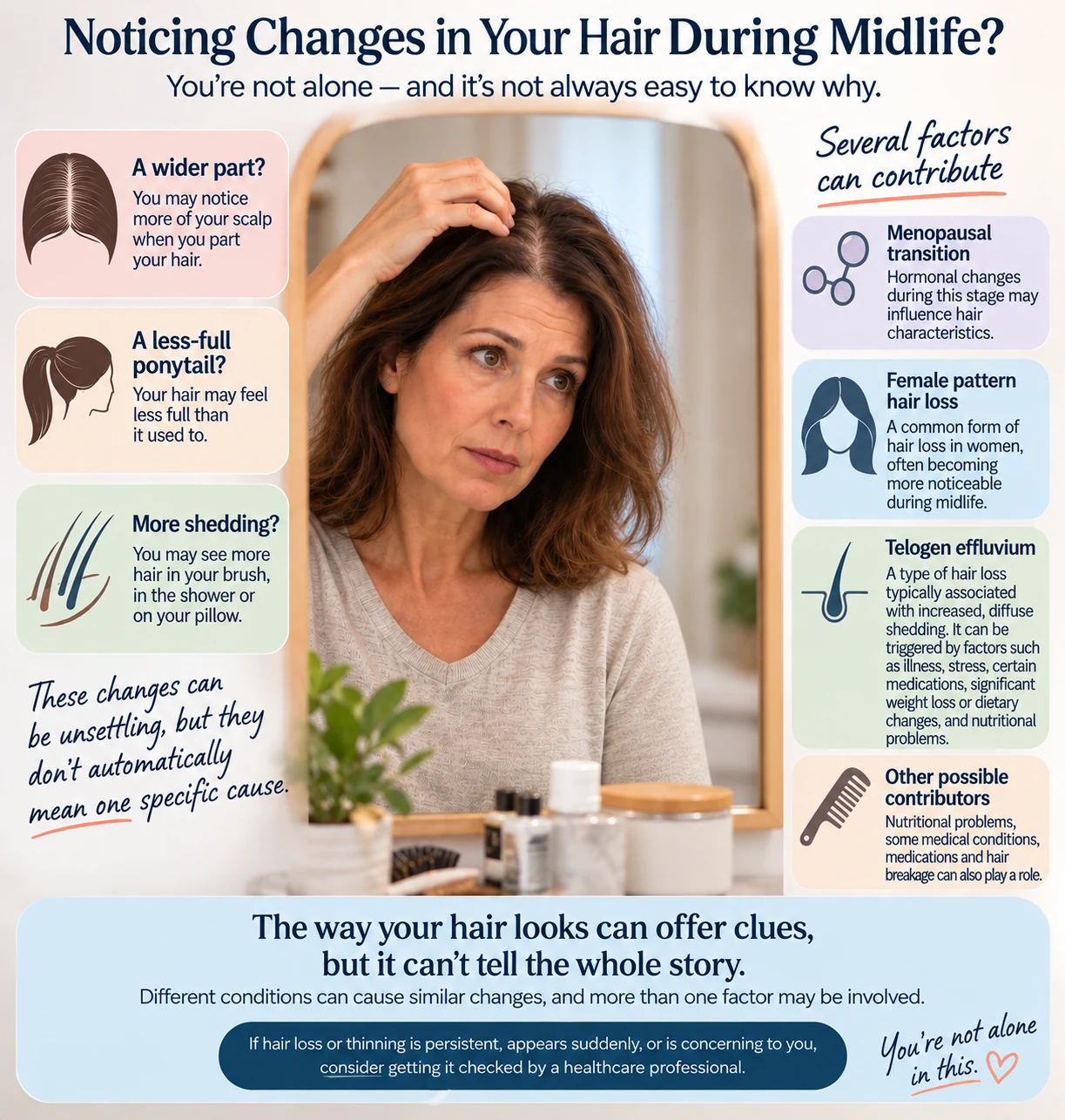
Noticing that your hair looks thinner than it used to can be unsettling. You may see more of your scalp when you part your hair, feel that your ponytail is less full, or simply notice that your hair seems different from a few years ago.
For some women, thinning or changes in shedding become more noticeable during midlife. But noticing them during this stage of life does not necessarily mean that midlife — or menopause — is the cause.
Hair thinning and hair loss can appear in different patterns and for different reasons. Understanding those differences can help put the changes into context without assuming a diagnosis from appearance alone.
What Do Hair Thinning and Hair Loss Mean?
Hair thinning generally describes a noticeable reduction in hair density or fullness. A woman may notice that her part looks wider, that more scalp is visible, or that her hair feels less full than before.
Hair loss is a broad everyday term, but clinicians distinguish among different patterns of hair change, including thinning and excessive shedding.
Everyone normally sheds some hair as part of the hair-growth cycle. When shedding increases noticeably, however, the pattern may be different from gradual thinning.
These distinctions matter because two women who both feel that they are “losing hair” may actually be noticing different types of change.
Why Hair Thinning and Hair Loss May Become More Noticeable During Midlife
Midlife is a period when several factors that can influence hair may overlap.
Female pattern hair loss, for example, commonly becomes apparent during adulthood and may first become noticeable for many women in their 40s, 50s or 60s. Other forms of hair change or increased shedding can also occur during this period.
Illness, significant physiological stress, some medications, significant weight loss or dietary changes, and nutritional problems can contribute to certain forms of hair shedding.
This does not mean that being in midlife itself causes hair loss. Instead, this stage of life can provide the context in which different hair changes become noticeable.
Hair Thinning and Hair Shedding Are Not the Same Thing
Gradual thinning and increased shedding can both result in hair appearing less full over time. They do not, however, describe exactly the same type of change.
With thinning, a woman may gradually notice less density, a wider part or more visible scalp.
With increased shedding, the most noticeable change may instead be an increase in the amount of hair being shed.
This distinction can provide useful context, but it cannot identify the underlying cause. Different conditions can produce thinning or shedding, and more than one pattern can sometimes occur at the same time.
How the Menopausal Transition May Be Related to Hair Changes
The menopausal transition is one of several factors that may be relevant when hair changes become noticeable during midlife.
Research has examined changes in hair growth and characteristics around menopause. Hormonal changes during the menopausal transition may influence aspects of the hair cycle and hair characteristics, and some forms of hair loss become more common during this stage of life.
Female pattern hair loss, for example, is more common after menopause.
However, the relationship between menopause, hormones and hair is complex. The role of estrogen in female pattern hair loss is not fully understood, and hair thinning or shedding during the menopausal transition should not automatically be attributed to declining estrogen or to menopause itself.
Other factors may be present at the same time. For that reason, the menopausal transition is better understood as part of the life-stage and clinical context rather than as a universal explanation for hair loss during midlife.
Different Patterns and Conditions Can Contribute to Hair Changes
Hair loss in women is not a single condition. Different patterns and conditions can affect hair density, growth and shedding.
Two that are particularly relevant when discussing hair changes in adult women are female pattern hair loss and telogen effluvium.
Female Pattern Hair Loss
Female pattern hair loss is a common form of hair loss in women.
It typically develops gradually. One of the changes a woman may notice is widening of the part, along with reduced hair density or a less full ponytail. The pattern can become increasingly noticeable over time.
Female pattern hair loss often becomes apparent during midlife and is more common after menopause. However, these observations do not mean that a woman with a widening part or thinner hair necessarily has female pattern hair loss.
Other forms of hair loss can produce similar changes, so appearance alone cannot establish the diagnosis.
Telogen Effluvium
Telogen effluvium is a different type of hair-loss condition that is typically associated with increased, diffuse shedding.
It can occur after certain physiological or emotional stressors and may also be associated with factors such as illness, significant weight loss or dietary change, some medications or nutritional problems.
In telogen effluvium, increased shedding can be the most noticeable feature.
Even so, increased shedding does not by itself establish telogen effluvium. Other explanations are possible, and telogen effluvium and female pattern hair loss can sometimes occur together.
Hair breakage and changes to the hair shaft can also make hair appear less full without representing the same process as hair loss from the follicle.
Together, these possibilities help explain why “my hair is getting thinner” can describe more than one underlying process.
Why Hair Changes Alone Cannot Tell You the Cause
The way hair changes can provide clues, but those clues have limits.
A widening part, reduced density or gradual thinning may occur with female pattern hair loss. Increased diffuse shedding may occur with telogen effluvium. But these observations are not enough on their own to determine what is happening.
Hair loss can have multiple possible contributors, and different conditions may sometimes resemble one another or occur together.
Clinical evaluation can consider the pattern and timing of hair changes alongside relevant health history and other factors.
The visible change is important information. It is not, by itself, a diagnosis.
This is why noticing hair thinning during midlife should not automatically lead to the conclusion that menopause, a nutritional deficiency or any particular hair-loss condition is responsible.
When Is It Worth Getting Hair Loss or Thinning Checked?
Hair changes do not all follow the same pattern. Some develop gradually, while others may appear more suddenly.
If hair loss or thinning is persistent, appears suddenly, or is concerning to you, getting it evaluated can help clarify the pattern and possible contributors. Evaluation may also be useful when the reason for the change is unclear.
The goal is not to assume that every change signals a medical problem. It is to recognize that several different conditions and circumstances can affect hair, and distinguishing among them may require more than looking at the hair alone.
Hair thinning or loss may become noticeable during midlife, but the timing of the change does not tell the whole story. Understanding the pattern — and avoiding assumptions about the cause — is an important first step.
Sources
- American Academy of Dermatology — Female Pattern Hair Loss
- American Academy of Dermatology — Hair Loss or Hair Shedding?
- DermNet — Female Pattern Hair Loss
- DermNet — Telogen Effluvium
- PubMed — Managing Hair Loss in Midlife Women
- PubMed — Menopause and Hair Loss in Women: Exploring the Hormonal Transition
- PubMed — Diffuse Hair Loss in an Adult Female
- PubMed — Female Pattern Hair Loss and Telogen Effluvium