Heart Palpitations During Midlife: Why Your Heart May Race, Pound or Flutter
Feeling your heart suddenly race, pound or flutter can be unsettling, especially when the sensation seems to become more noticeable during midlife.
Heart palpitations are reported by some women during the menopausal transition, but midlife is also a time when hormonal, health and lifestyle factors can overlap. Experiencing palpitations during this stage does not, by itself, show that menopause or hormonal changes are the cause.
Palpitations describe what you feel. They do not, on their own, identify the heart rhythm occurring at that moment or establish a heart-rhythm diagnosis.
What Do Heart Palpitations Feel Like?
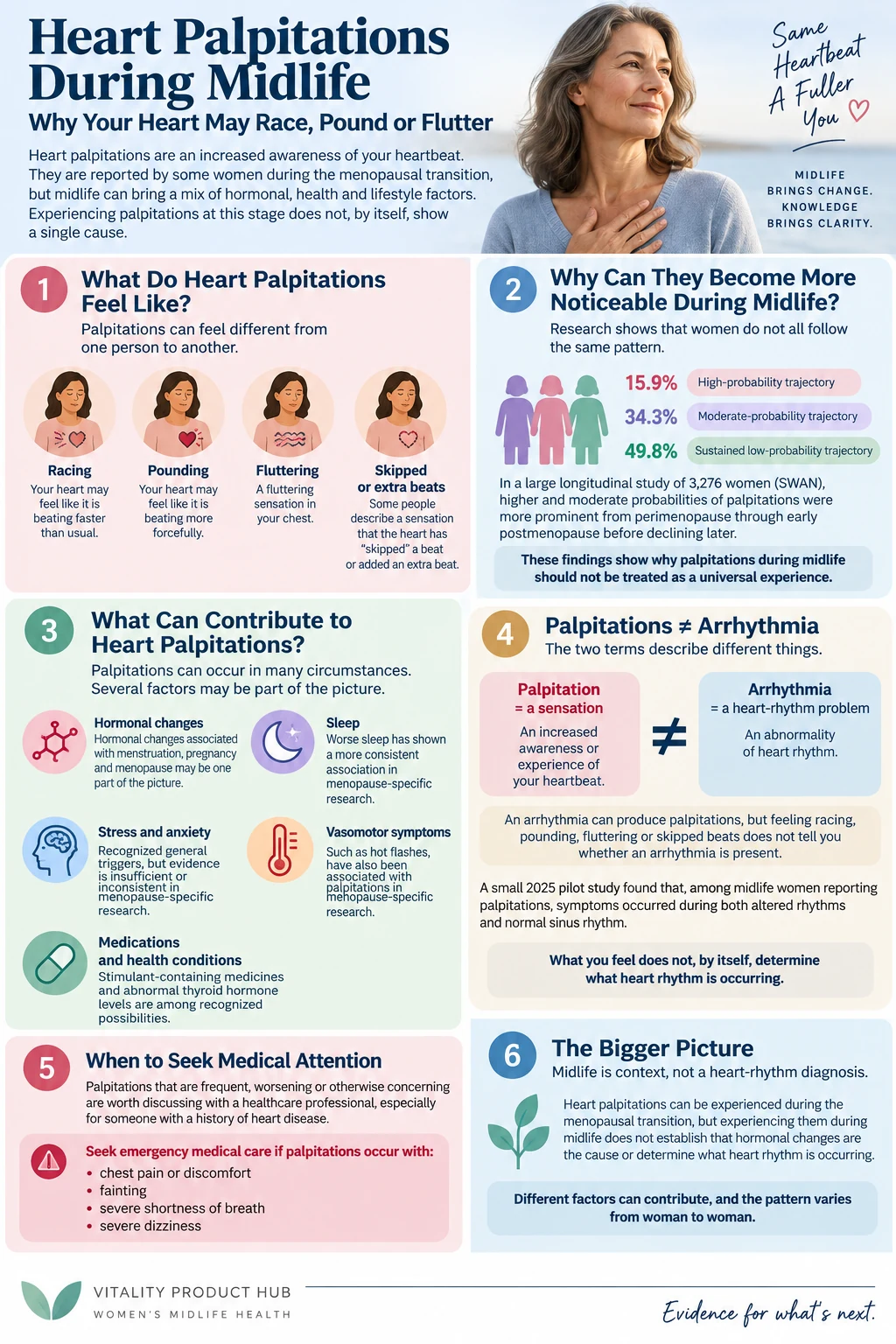
Heart palpitations are an increased awareness of your heartbeat. They may occur during activity or while resting and can be experienced in the chest, throat or neck.
Your Heart May Feel Like It Is Racing, Pounding or Fluttering
A palpitation may feel as though your heart is suddenly racing, beating more forcefully than usual or fluttering inside your chest.
These descriptions are useful because they capture the experience itself. They do not explain why the sensation is happening.
Some People Describe a Sensation of Skipped or Extra Beats
Some people describe palpitations as though the heart has “skipped” a beat or an extra beat has occurred.
That language describes a perceived sensation. It should not be interpreted by itself as a description of what the heart actually did electrically.
Palpitations Describe What You Feel, Not a Diagnosis
“Heart palpitations” describes a symptom or perceived experience, not a specific diagnosis.
An abnormal heart rhythm can sometimes cause palpitations, but the presence of palpitations alone does not establish that an arrhythmia is occurring.
This distinction is particularly useful during midlife, when it can be tempting to attribute a new sensation either to menopause or to a heart problem without knowing its cause.
Why Can Heart Palpitations Become More Noticeable During Midlife?
Palpitations have been studied across the menopausal transition, and longitudinal research shows that women do not all follow the same pattern.
Midlife therefore provides a useful context for understanding the symptom without becoming an explanation for it.
Palpitations Are Reported by Some Women During the Midlife Years
A large longitudinal analysis from the Study of Women's Health Across the Nation (SWAN) examined palpitations in 3,276 women and identified three different trajectories over time.
About 15.9% of the women followed a high-probability trajectory and 34.3% a moderate-probability trajectory, with both patterns more prominent from perimenopause through early postmenopause before declining later. Another 49.8% remained in a sustained low-probability trajectory.
These findings show why palpitations during midlife should not be treated as a universal experience.
Their Pattern Can Differ From Woman to Woman
The different SWAN trajectories also highlight individual variation.
Some women may notice palpitations more prominently during portions of the menopausal transition, while others may experience them much less often. The pattern can also change over time.
Being at a similar stage of midlife therefore does not mean that two women will have the same experience or that the same factor explains their symptoms.
Could the Menopausal Transition Contribute to Heart Palpitations?
Perimenopause is part of the menopausal transition, a period in which reproductive hormone patterns change. Palpitations have been reported and studied across this transition.
That makes the menopausal transition relevant to the question. It does not make it an automatic explanation.
Hormonal Changes May Be One Part of the Picture
Hormonal changes associated with menstruation, pregnancy and menopause are among the contexts in which palpitations can occur.
During the menopausal transition, hormonal changes may therefore be one part of a broader picture. However, the available evidence does not justify a simple universal pathway in which a particular hormonal change inevitably produces palpitations.
This is also why the article does not assume that estrogen changes explain an individual woman's symptoms.
Timing Does Not Establish Hormonal Causation
A palpitation becoming noticeable during perimenopause does not demonstrate that perimenopause caused it.
Research examining palpitations around menopause has identified several possible correlates, and the evidence for some factors — including menopausal status itself — has not been consistent across studies.
Palpitations can occur during the menopausal transition, but their timing alone does not establish hormonal causation.
What Else Can Contribute to Heart Palpitations?
Palpitations can occur in many circumstances outside the menopausal transition, and sometimes their cause is not immediately apparent.
Considering other factors does not mean trying to diagnose the symptom from a list. It helps explain why a palpitation that appears during midlife should not automatically be labeled a menopause symptom.
Stress, Sleep and Stimulants Can Be Part of the Picture
Stress and anxiety are recognized general triggers of palpitations, and stimulants such as caffeine can also trigger them in some people.
The menopause-specific literature requires a little more nuance. A scoping review found a more consistent relationship between worse sleep and palpitations, while the available evidence for stress and anxiety as correlates of menopausal palpitations was insufficient or inconsistent.
Vasomotor symptoms, such as hot flashes, have also been associated with palpitations in menopause-specific research. An association, however, does not show that one symptom caused the other.
Medications and Health Conditions May Also Matter
Some medications and health conditions can contribute to palpitations. Stimulant-containing medicines and abnormal thyroid hormone levels are among recognized possibilities.
These are examples, not a checklist for identifying the cause. Their relevance is that palpitations have explanations beyond the menopausal transition, and determining what is responsible for an individual's symptoms may require clinical evaluation.
Are Heart Palpitations the Same as an Arrhythmia?
No. The two terms describe different things.
A palpitation is the experience or awareness of a heartbeat. An arrhythmia is an abnormality of heart rhythm.
They can overlap, but they are not interchangeable.
Palpitations Describe a Sensation; Arrhythmia Describes a Heart-Rhythm Problem
An arrhythmia can produce palpitations. But feeling racing, pounding, fluttering or seeming skipped beats does not tell a person whether an arrhythmia is present.
Two opposite assumptions should therefore be avoided:
“I felt a palpitation, so I must have an arrhythmia.”
and
“I'm in midlife, so the palpitations must be hormonal.”
Neither conclusion can be made from the sensation alone.
The Sensation Alone Cannot Tell You What Heart Rhythm Is Occurring
A small 2025 hypothesis-generating pilot study illustrates this distinction.
The study included 30 midlife women — 15 with palpitations and 15 without — who wore ambulatory ECG patches for 14 to 28 days. Among the women reporting palpitations, recorded symptoms occurred during both altered rhythms and normal sinus rhythm.
Because this was a small pilot study, the findings should not be treated as proof of what occurs in all women with palpitations. Instead, they provide a useful example of why the perceived symptom and the recorded heart rhythm should not be assumed to be the same thing.
What you feel does not, by itself, determine what heart rhythm is occurring.
When Are Heart Palpitations Worth Discussing With a Healthcare Professional?
Palpitations that are frequent, worsening or otherwise concerning are worth discussing with a healthcare professional, especially for someone with a history of heart disease. A clinician can consider the symptoms in their full context and determine whether further evaluation is appropriate.
Some combinations of symptoms require more urgent attention. Emergency medical care should be sought when heart palpitations occur with chest pain or discomfort, fainting, severe shortness of breath or severe dizziness.
An educational article about palpitations during midlife cannot determine the cause or level of risk for an individual person.
The Bigger Picture: Midlife Is Context, Not a Heart-Rhythm Diagnosis
Heart palpitations are experienced by some women during midlife, and research shows that their pattern can vary across the menopausal transition.
Hormonal changes may be relevant, but they are not the only possible influence. Sleep, vasomotor symptoms, stress, stimulants, medications and health conditions can also be part of the broader context, with different levels of evidence supporting their associations.
The symptom itself has an equally important boundary. Racing, pounding, fluttering or seeming skipped beats describe how the heartbeat feels. Those sensations cannot identify the underlying heart rhythm.
Heart palpitations can be experienced during the menopausal transition, but experiencing them during midlife does not establish that hormonal changes are the cause or determine what heart rhythm is occurring.
Explore Women's Midlife Health
Midlife can bring changes across sleep, joints, cognition, migraine, vaginal health, weight and other areas of well-being. Explore the broader Women's Midlife Health hub for more educational articles.
Sources
- Carpenter JS, Cortés YI, Tisdale JE, et al. Palpitations Across the Menopause Transition in SWAN: Trajectories, Characteristics, and Associations with Subclinical Cardiovascular Disease. Menopause. 2023;30(1):18–27. PubMed
- Carpenter JS, Jaynes HA, Alzahrani MA, et al. Palpitations in midlife women: the Menopause Racing Heart Pilot Study. Menopause. 2025;32(7):571–582. PubMed
- Carpenter JS, et al. Correlates of palpitations during menopause: A scoping review. Women's Midlife Health. 2022. PubMed
- Mayo Clinic. Heart palpitations — Symptoms & causes. Mayo Clinic
Medical information notice: This article provides general educational information and is not a diagnosis or a substitute for individualized medical care.