Migraine During the Menopausal Transition: Why Attacks May Change
If you have lived with migraine for years, you may already recognize some of the patterns surrounding your attacks.
Then, during midlife, those patterns may begin to feel different. Attacks may become more frequent or severe, or a pattern that once seemed relatively predictable may become harder to anticipate.
For some women, these changes occur during the menopausal transition, also called perimenopause. This stage involves changing ovarian function and substantial hormonal variability, and research has documented changes in migraine patterns during this period.
The timing naturally raises a question: could the menopausal transition be contributing?
It may be part of the picture. But migraine does not change in exactly the same way for every woman, and hormonal changes occur alongside other midlife experiences, including changes in sleep, vasomotor symptoms, mood and health.
Understanding migraine during this stage therefore begins with the woman's existing pattern — and what has changed.
How Can Migraine Change During the Menopausal Transition?
Migraine patterns can vary across different reproductive stages, which is one reason researchers have focused on the menopausal transition.
For some women, frequency is the most noticeable difference. For others, attacks may feel more severe or become harder to predict.
The important change is not necessarily one specific feature. It may be that migraine no longer behaves in the way a woman has come to recognize as usual for her.
Attacks May Become More Frequent or Severe
Studies have found associations between the menopausal transition and higher headache frequency among women with migraine, while recent reviews describe increased frequency or severity as possible patterns during perimenopause.
For a woman who previously experienced occasional attacks, a noticeable increase may stand out because it represents a departure from her established pattern.
Severity can change too. Attacks that were once relatively manageable may feel more disruptive during parts of the transition.
These patterns have been observed in research, but they are not inevitable. Migraine trajectories vary considerably among women.
A Previously Stable Pattern May Become Less Predictable
A change in predictability can be just as noticeable as a change in frequency.
A woman who previously recognized a fairly consistent migraine pattern may find that attacks become more erratic during perimenopause.
Recent research has associated hormonal instability during this stage with changes in migraine frequency and predictability.
That makes predictability an important part of the experience: the change may not simply be “more migraine,” but migraine that behaves differently from before.
Why Might Migraine Change During Perimenopause?
Migraine patterns often vary across reproductive stages, and perimenopause creates a particularly dynamic biological context.
Ovarian function is changing, menstrual cycles may become less regular and reproductive hormone levels can fluctuate substantially.
Those features have made the menopausal transition an important area of migraine research.
The relationship is more complicated, however, than a steady fall in hormone levels followed by a predictable change in migraine.
Hormone Levels Can Fluctuate During the Menopausal Transition
It can be tempting to imagine menopause as a gradual, steady decline in reproductive hormones.
Perimenopause is more complicated than that.
Hormone levels can vary considerably during the transition. Research describes substantial variability in hormones including estradiol and progesterone rather than a simple straight-line decline.
That distinction matters for migraine because researchers have long examined relationships between changing reproductive hormone patterns and migraine across a woman's reproductive life.
During perimenopause, therefore, the question is not only how much of a particular hormone is present. Fluctuation itself is part of the biological context.
Why Estrogen Fluctuation May Matter for Migraine
Estrogen is among the hormones most closely studied in relation to migraine.
Changes in estrogen have been examined across reproductive stages, including the menstrual cycle and the menopausal transition. During perimenopause, changing and unstable estrogen patterns may be one factor associated with changes in migraine.
That relationship should not be reduced to a simple formula.
Research specifically separating women by menopausal stage and migraine characteristics still has important limitations, and estrogen cannot explain every change in an individual woman's attacks.
It is more useful to view hormonal variability as one possible part of a changing migraine pattern during this stage of life.
Hormonal Changes Are Not the Only Possible Influence
The menopausal transition happens alongside other changes.
Sleep may be disrupted. Hot flashes or night sweats may appear. Stress and mood can change, and other health circumstances may also be evolving during the same years.
Several of these experiences can coexist with migraine.
That overlap makes timing informative, but not definitive: noticing that migraine changed during perimenopause does not identify a single explanation for why it changed.
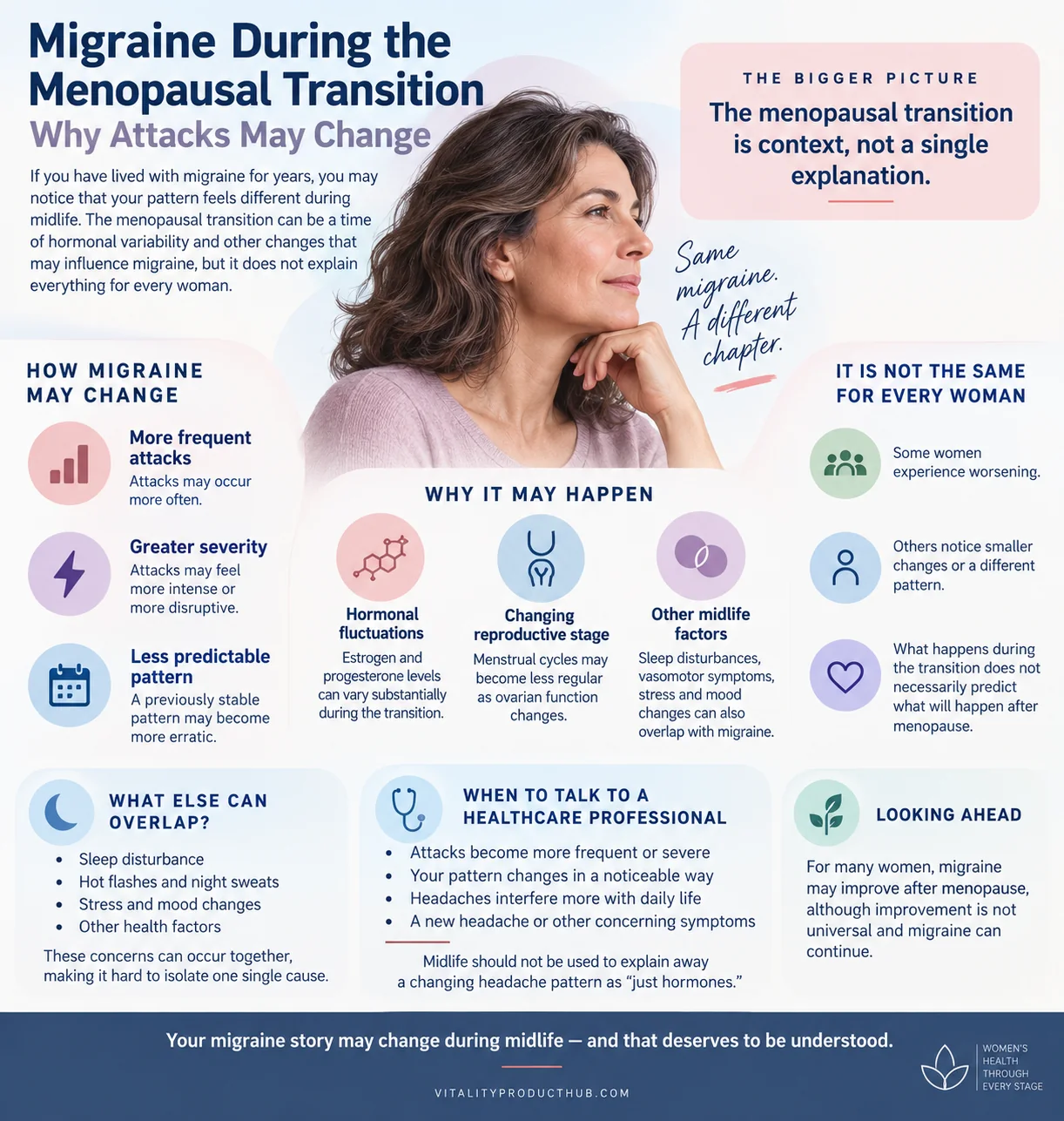
Why Can Perimenopause Be an Unpredictable Time for Migraine?
Perimenopause is a transition, not a single biological event.
Its stages can differ in menstrual patterns and hormonal activity, and a woman's experience may change as she moves through them.
Migraine can change along the way as well.
This helps explain why a woman may recognize a shift in her attacks without seeing one simple or consistent pattern throughout the entire transition.
The Menopausal Transition Is Not a Single Hormonal Event
Menopause is identified retrospectively after 12 consecutive months without menstruation, when another physiological or pathological cause does not explain the absence of periods.
Perimenopause is the changing transition leading up to that point.
The hormonal environment during this transition is not the same as the more stable reproductive hormonal state after menopause.
For migraine, that distinction matters. Research therefore often considers perimenopause and postmenopause separately rather than treating them as interchangeable stages.
Migraine Patterns Can Vary From Woman to Woman
Population-level trends cannot predict exactly what will happen to one woman.
Some women experience a noticeable worsening of migraine during the menopausal transition. Others notice smaller changes, different patterns or relatively little difference.
A woman's previous migraine history and its relationship with reproductive events may also help explain why trajectories differ.
So while migraine can change during perimenopause, neither the direction nor the degree of change is universal.
What Else Can Overlap With Migraine During Midlife?
Hormonal variability is only one part of the midlife picture.
Sleep disturbance, vasomotor symptoms and changes in mood can occur during the same stage of life as changes in migraine.
These concerns can overlap, which makes it difficult to isolate one factor behind a changing migraine pattern.
The goal is not to assemble a long list of presumed migraine “triggers,” but to recognize that the menopausal transition occurs within a broader health context.
Sleep Disturbance Can Be Part of the Picture
Sleep problems become an important concern for many women during midlife, and sleep disturbance and migraine can intersect during perimenopause.
A woman whose sleep has changed may therefore be dealing with more than one concern at the same time as her migraine pattern changes.
That does not make poor sleep the presumed explanation for her attacks. It simply makes sleep one relevant part of the broader picture.
The reasons a woman may be waking during the night or sleeping poorly are a separate question.
Vasomotor Symptoms, Stress and Mood May Also Overlap
Hot flashes and night sweats can become prominent during the menopausal transition and often occur during the same years as changes in sleep and emotional well-being.
Stress, anxiety or changes in mood may also be present while a woman's migraine pattern is changing.
These concerns can occur together rather than following a simple one-way pathway.
A changing migraine pattern is therefore better understood in context than as a checklist of isolated factors.
Does Migraine Always Get Worse During the Menopausal Transition?
No.
Worsening is an important pattern described during perimenopause, but it is not an inevitable outcome.
Some women notice substantial changes in migraine frequency, severity or predictability. Others notice relatively little.
And what happens during the hormonally variable perimenopausal years does not necessarily predict what will happen after menopause.
Worsening Is One Possible Pattern, Not the Only One
Research describes increased migraine frequency and severity during perimenopause for some women, particularly among those whose migraine has previously shown sensitivity to reproductive hormonal changes.
But group-level patterns cannot determine an individual woman's trajectory.
This distinction matters because statements such as “menopause makes migraine worse” turn a variable association into a universal rule.
The evidence supports a more careful conclusion: migraine may worsen during the menopausal transition for some women, while others experience a different course.
Migraine May Change Again After Menopause
Migraine patterns can shift again after the menopausal transition.
Research generally describes a tendency for migraine to improve after natural menopause for many women, although improvement is not universal and migraine can continue after menopause.
This reinforces an important distinction between perimenopause and postmenopause.
A migraine pattern that becomes more frequent, severe or unpredictable during the transition does not necessarily remain that way afterward.
When Is a Change in Migraine Worth Discussing With a Healthcare Professional?
A meaningful change in an established migraine pattern can be worth discussing with a healthcare professional, especially when attacks become substantially more frequent or severe, feel different from the usual pattern, interfere more with everyday activities or simply cause concern.
Midlife should not be used to explain away a changing headache pattern as “just hormones.”
A healthcare professional can consider what has changed alongside a woman's previous migraine history, current symptoms, medications and broader health circumstances.
A new headache, a major departure from a person's usual headache pattern or a headache accompanied by concerning new symptoms deserves medical assessment rather than being assumed to be part of the menopausal transition.
Those situations require individual clinical evaluation; they are not something that can be explained from the timing of midlife or menopause alone.
The Bigger Picture: The Menopausal Transition Is Context, Not a Single Explanation
Migraine can change during the menopausal transition. For some women, attacks become more frequent, severe or difficult to predict.
Hormonal variability — including changes involving estrogen — may be relevant. But the transition occurs alongside changes in sleep, vasomotor symptoms, mood and other aspects of health, and no single factor explains every woman's experience.
So instead of beginning with:
A more useful question may be:
That leaves room for the menopausal transition to matter without turning it into an automatic explanation.
The menopausal transition may help explain why migraine changes for some women. It does not, by itself, establish the cause of every change in an individual woman's attacks.
Learn how different areas of health may change during midlife and why this life stage provides context rather than a diagnosis.
Explore Women's Midlife Health →Sources
- Friedman Korn T, Bernstein C. Migraine across the menopausal transition and beyond: A narrative review. Headache. 2026;66(6):1390-1404. PubMed
- Kamourieh S, MacGregor EA. Perimenopausal migraine: a narrative review. Climacteric. 2026;29(4):507-515. PubMed
- Martin VT, Pavlovic J, Fanning KM, Buse DC, Reed ML, Lipton RB. Perimenopause and Menopause Are Associated With High Frequency Headache in Women With Migraine: Results of the American Migraine Prevalence and Prevention Study. Headache. 2016;56(2):292-305. PubMed
- Bernstein C. Migraine and the menopause transition. Menopause. 2026;33(4):491-493. PubMed