Changes in Sexual Desire During Midlife: What Women May Notice and What May Be Related
Sexual desire can change over time, and some women may notice differences in their interest in sex during midlife. For some, desire may feel lower than it once did. Others may notice little change or experience changes in different ways.
There is no single level of sexual desire that is normal for every woman. Sexual interest varies between women and can also change within the same person over time.
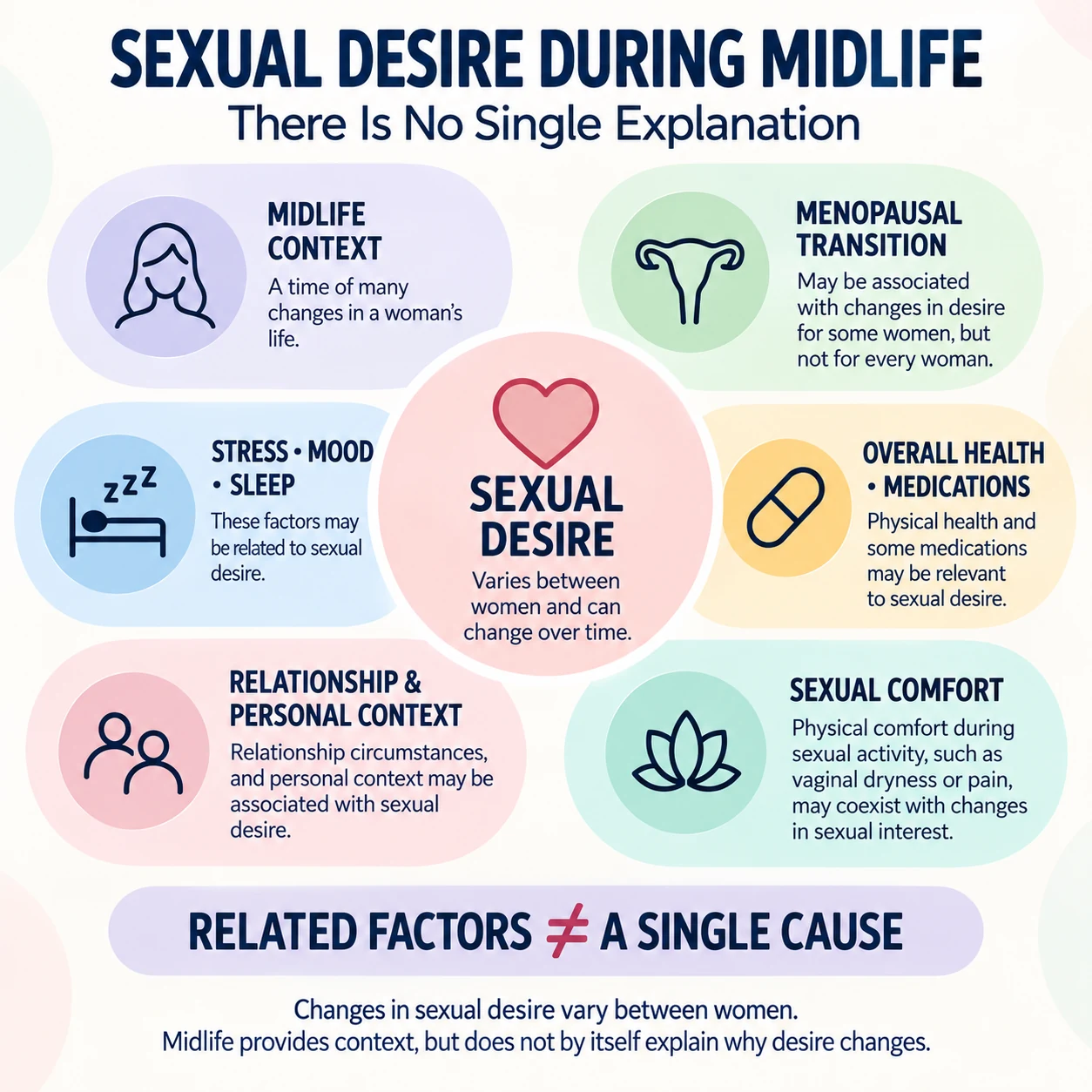
Midlife provides important context for understanding these experiences, but a change that happens during this stage of life does not, by itself, explain why it is happening. Sexual desire is complex, and biological, psychological, health and interpersonal factors may all be relevant.
What Does a Change in Sexual Desire Mean?
Sexual desire broadly refers to sexual interest or desire for sexual activity. A woman may notice that she thinks about sex less often, feels less interested than before or experiences a change in how important sexual activity feels to her.
These experiences do not automatically indicate a medical problem or sexual dysfunction. What feels like an important change for one woman may not be concerning to another, which is one reason sexual desire cannot be judged against a universal amount or frequency.
Sexual Desire Can Change in Different Ways During Midlife
There is no single sexual trajectory that all women follow during midlife.
Research following women through the menopausal transition has found changes in sexual desire in some women, while other research has found that many women report no change over time.
This variability matters. Midlife should not be treated as a stage when women are expected to lose sexual interest. A woman may notice lower desire, little difference from earlier years or a different pattern altogether.
Why Midlife Does Not Point to a Single Explanation
When a change in sexual desire happens during midlife, it can be tempting to attribute it to age or hormones alone. Timing, however, does not establish a cause.
Midlife can coincide with changes in health, sleep, stress, relationships, medications and reproductive aging. These factors may overlap, and their relevance can differ substantially from one woman to another.
Noticing a change during midlife therefore does not reveal what is responsible for it.
How the Menopausal Transition May Be Related to Sexual Desire
The menopausal transition may be associated with changes in sexual desire for some women, but it does not affect every woman in the same way.
Studies following women through this transition have observed changes in desire alongside reproductive aging and a range of health, psychological and interpersonal factors. An individual woman's experience therefore should not automatically be attributed to menopause alone.
Hormonal changes are part of the menopausal transition and may be relevant to sexual health, but hormone levels alone do not explain an individual woman's level of desire. In particular, lower sexual desire should not automatically be interpreted as evidence of low estrogen or low testosterone.
Menopause can be part of the context without being assumed to be the explanation.
Multiple Factors May Be Related to Sexual Desire
Sexual desire exists within a broader physical, emotional and interpersonal context. Research has identified several factors that may be associated with sexual desire or sexual functioning, but their presence does not establish why an individual woman is experiencing a change.
Stress, Mood and Sleep
Stress, emotional well-being and sleep difficulties may be relevant to sexual desire during midlife.
These factors may overlap with changes in desire without necessarily explaining why the change occurred. Their relevance can also differ from one woman to another.
Overall Health and Medications
Physical health and a woman's perception of her overall health may also be relevant to sexual well-being.
Some medications can affect sexual desire or other aspects of sexual function. However, noticing a change in desire does not establish that a medication is responsible.
Medication should not be stopped or changed solely because of information about sexual desire found online. Questions about possible medication effects are better discussed with a healthcare professional.
Relationship and Personal Context
Relationship circumstances, partner factors and a woman's broader personal context may be associated with sexual desire.
Lower desire does not, however, indicate that there is necessarily a problem in a relationship. Sexual interest develops within an individual context, and factors that matter to one woman may have little or different relevance to another.
Sexual Comfort and Pain
Physical comfort during sexual activity may also be relevant.
Vaginal dryness, discomfort or pain may coexist with changes in sexual interest for some women. But discomfort and desire are different experiences, and one should not automatically be used to explain the other.
Women experiencing vaginal dryness may also find our guide on vaginal dryness during midlife useful for understanding that issue separately.
Desire Is Not the Same as Arousal, Orgasm or Sexual Pain
Sexual desire is one aspect of sexual health. It is related to, but distinct from, sexual arousal, orgasm and pain or discomfort during sexual activity.
A woman can experience a change in one area without necessarily experiencing a problem in another. A change in sexual interest, for example, does not by itself establish difficulty with arousal or orgasm, just as discomfort during sexual activity does not automatically mean that a woman has lost sexual desire.
Keeping these dimensions separate helps avoid treating different sexual experiences as though they were interchangeable.
Lower Desire Does Not Automatically Mean Sexual Dysfunction
Having less sexual desire than before does not necessarily mean that a woman has a sexual dysfunction.
Clinical conditions involving low sexual desire require considerations beyond simply how often a woman thinks about or wants sex. Personal distress and the broader individual context are important parts of clinical assessment.
Hypoactive sexual desire disorder, or HSDD, is a specific clinical concept. Lower desire alone is not sufficient to establish that diagnosis, and personal distress alone does not make the diagnosis automatic either.
When Is It Worth Discussing Changes in Sexual Desire With a Healthcare Professional?
If a change in sexual desire is persistent, bothersome or causing personal distress, it may be worth discussing it with a healthcare professional.
A conversation may also be useful when other symptoms, health conditions or medications could be relevant. This does not mean that the change necessarily represents a sexual disorder. Rather, it allows the woman's individual circumstances and any other concerns to be considered.
Sexual desire does not follow one universal pattern during midlife. Understanding a change begins with recognizing the woman's own experience and the broader context around it, rather than assuming a single explanation.
Sources
- The Menopause Society — Sexual Health
- Seattle Midlife Women's Health Study — PubMed
- SWAN longitudinal study of sexual functioning — PubMed
- Prospective study of sexual desire and menopausal status — PubMed
- Low sexual desire, personal distress and HSDD in midlife women — PubMed
- Global Consensus Position Statement on Testosterone Therapy for Women
- ISSWSH Clinical Practice Guideline
- Mayo Clinic — Low sex drive in women