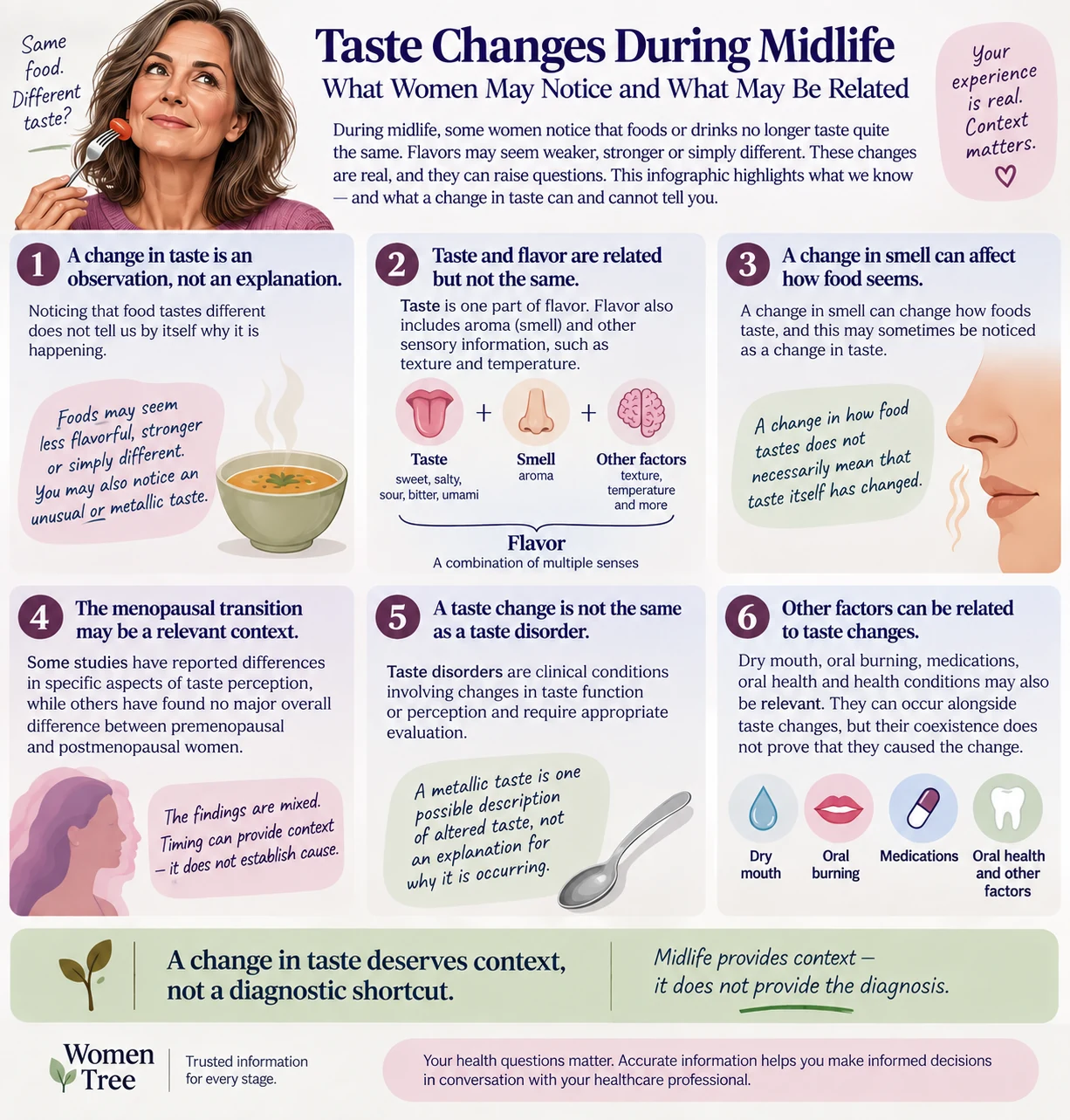
Taste Changes During Midlife: What Women May Notice and What May Be Related
During midlife, some women may notice that foods or drinks no longer taste quite the same. Familiar flavors may seem weaker, stronger or simply different, and some women may notice an unusual or metallic taste.
These experiences can raise understandable questions, especially when they appear around the same time as other midlife changes.
A change in taste is an observation, not an explanation. Noticing it during midlife does not establish that midlife, menopause or hormonal changes caused it.
A change in taste is an observation, not an explanation.
What Do Taste Changes Mean?
Taste changes can be described in different ways. Food may seem less flavorful than before, familiar tastes may seem unusually strong, or something that once tasted normal may suddenly seem different.
Some people describe a persistent or occasional unusual taste, including a metallic sensation.
These descriptions are useful for communicating what someone is experiencing, but they do not identify the reason for the change.
Disliking a food that was previously enjoyable also does not by itself establish that taste perception has changed. Food preferences and the sensory experience of eating are not necessarily the same thing.
Taste Changes Can Become More Noticeable During Midlife
A woman may first become aware of a change in how food tastes during her 40s, 50s or later.
The timing can naturally make her wonder whether the change is connected with perimenopause, menopause or other changes occurring during this stage of life.
Timing, however, does not establish cause.
Taste and flavor can be influenced by sensory, oral, medication-related and health factors, depending on the individual context.
Why Midlife Does Not Point to a Single Explanation
Midlife is a period in which multiple changes can overlap. The menopausal transition may be occurring while medications, oral health, smell, dry mouth, health conditions and other individual factors may also be relevant.
That makes it difficult to assign a taste change to one explanation based on age or timing alone.
Noticing that food tastes different during midlife therefore does not demonstrate that menopause is responsible.
Midlife provides context for the question — not the individual answer.
How the Menopausal Transition May Be Related to Taste Changes
Researchers have investigated taste perception and oral sensory complaints in women during and after the menopausal transition.
The findings are mixed. Some studies have reported differences in specific aspects of taste perception, while others have found no major overall difference between premenopausal and postmenopausal women.
The menopausal transition may therefore be relevant context when a taste change appears during midlife, without identifying the reason that change is occurring in a particular woman.
A hormonal explanation should not be assumed from the symptom alone.
Taste, Flavor and Smell Are Related — but They Are Not the Same
In everyday conversation, people often use the word “taste” to describe the entire experience of how food seems when they eat it.
That experience is broader than taste alone.
Taste and Flavor
Taste contributes to flavor, but flavor also includes aroma and other sensory information.
This is why saying that a meal “doesn't taste the same” does not necessarily tell us that taste itself has changed.
The woman's observation is real, but the observation alone cannot identify which part of the sensory experience is responsible.
Smell and Flavor
Smell contributes importantly to the perception of flavor.
A change in smell can therefore affect how foods seem while eating, sometimes leading someone to interpret the experience as a change in taste.
This does not mean that every perceived taste change is actually a smell problem. It means that a change in how food tastes does not necessarily indicate that taste alone has changed.
A Taste Change Is Not the Same as a Taste Disorder
Noticing that taste seems different is not the same as having a diagnosed taste disorder.
Taste disorders are clinical conditions involving changes in taste function or perception and require appropriate evaluation. A person's description of weaker, stronger, unusual or metallic tastes may help a healthcare professional understand the experience, but it does not establish a diagnosis by itself.
Similarly, a metallic taste is one possible description of altered taste, not an explanation for why the change is occurring.
A perceived taste change should therefore not be used on its own to infer a particular disorder, deficiency or underlying condition.
Taste Changes Can Occur Alongside Other Mouth Symptoms
Taste changes do not always occur in isolation. Some people may notice other oral sensations at the same time.
Their coexistence can provide useful context, but it does not establish that one symptom caused another.
Dry Mouth
Dry mouth and taste changes can occur together.
Dry mouth is one factor that may be considered when someone reports a taste change.
However, experiencing both symptoms does not establish that dry mouth caused the taste change.
Dry mouth is also a distinct symptom and deserves its own evaluation when persistent or bothersome.
Oral Burning
Changes in taste can also occur alongside burning, hot, tingling or other unusual sensations in the mouth.
Altered taste may be reported in people with Burning Mouth Syndrome, but taste change alone does not establish BMS.
Likewise, experiencing both oral burning and a taste change does not identify the underlying explanation or demonstrate nerve damage or dysfunction.
Different Factors May Be Related to Taste Changes
There is no single factor that explains every change in taste.
Different oral, sensory, medication-related, health and individual factors may be relevant depending on the person and circumstances.
Oral and Individual Factors
Oral and dental health can be relevant when taste changes are evaluated.
Changes involving the mouth should not, however, be used to diagnose a dental or gum condition from taste symptoms alone.
Age and other individual characteristics may also provide context without determining the cause of a particular woman's experience.
Medications and Overall Health
Some medications can affect taste, and health conditions may also be relevant when taste changes are investigated.
But a taste change alone cannot identify a medication or medical condition as its cause.
Medication use is therefore information to consider rather than a conclusion. A medication should not be stopped or changed solely because a taste change has appeared without discussing the situation with the appropriate healthcare professional.
Why a Taste Change Alone Cannot Tell You the Cause
A change in taste can occur in different contexts.
Midlife timing, the menopausal transition, changes in smell, dry mouth, oral symptoms, medications and overall health may all be relevant considerations. None of them can be assigned as the individual explanation from a taste change alone.
The same principle applies to specific descriptions such as a metallic taste or food seeming unusually weak or strong.
The experience provides information about what the woman notices. It does not provide a diagnostic shortcut to why she notices it.
A change in taste deserves context, not a diagnostic shortcut.
When Is It Worth Discussing Taste Changes With a Healthcare Professional?
A taste change that persists, is unexplained, becomes bothersome or affects eating may be worth discussing with a healthcare professional or dental professional.
Evaluation can consider the pattern of the change, other oral or sensory symptoms, smell, medications, dental and oral health, and the person's broader health context.
This is particularly useful when the change is interfering with eating or affecting quality of life.
The goal is not to assume that a taste change during midlife has one particular cause, but to understand the individual context more carefully.
Midlife provides context — it does not provide the diagnosis.