What Does Tinnitus Mean?
Tinnitus refers to the perception of sound when there is no external source producing that sound.
Although ringing in the ears is one of the most familiar descriptions, tinnitus does not necessarily sound the same to everyone. People may describe ringing, buzzing, humming, hissing or other perceived sounds.
The sound may be noticed in one or both ears or may seem to come from inside the head.
Describing what tinnitus sounds like can help characterize the experience, but the sound itself does not identify why tinnitus is occurring.
Tinnitus Can Become More Noticeable During Midlife
Some women may first notice tinnitus during midlife, while others may feel that an existing sound has become more noticeable during this period.
Research has examined hearing changes across the menopausal transition, and smaller studies have also explored tinnitus in women around menopause. However, the available evidence does not provide one explanation that applies to every woman.
Other health, hearing-related and individual circumstances may also be present during the same stage of life.
For this reason, experiencing tinnitus during midlife does not establish that midlife itself is responsible for it.
Why Midlife Does Not Point to a Single Explanation
When tinnitus begins or becomes more noticeable during midlife, the timing may make the life stage seem like an obvious explanation.
But timing does not establish cause.
Tinnitus can occur at different ages and may be related to different circumstances. Hearing-related factors, noise exposure, medications, overall health and individual circumstances may all be relevant in different people.
More than one factor may also be present at the same time.
This means that the appearance of tinnitus during midlife cannot, by itself, establish why it is occurring.
How the Menopausal Transition May Be Related to Tinnitus
The menopausal transition is relevant to this discussion because researchers have investigated hearing changes across reproductive aging, while smaller studies have explored tinnitus in women around menopause.
Some studies have examined associations involving menopause, hearing, tinnitus and hormone therapy. However, this research does not establish a single causal pathway that explains tinnitus in an individual woman.
Findings involving hormone therapy have also not provided a simple or consistent explanation that can be applied to every woman.
The available evidence therefore does not establish that menopause, declining estrogen or another particular hormonal change caused tinnitus in an individual woman.
It also does not justify a direct chain in which hormonal changes automatically produce auditory changes that then cause tinnitus.
Tinnitus Can Involve More Than Ringing in the Ears
The word tinnitus describes the perception of sound rather than one particular sound.
Ringing is common language for the experience, but tinnitus may be perceived differently from one person to another.
Recognizing this distinction helps avoid treating “ringing in the ears” as the only way tinnitus can be experienced.
Ringing
Some people describe tinnitus as ringing in one or both ears.
The ringing may differ in how it is perceived from one person to another.
Describing the sound can provide useful context, but ringing alone does not identify what is causing tinnitus.
Buzzing, Humming, Hissing and Other Perceived Sounds
Tinnitus may also be described as buzzing, humming, hissing or other sounds that are perceived without a corresponding external source.
These different descriptions do not, by themselves, identify different causes.
They help characterize what a person is experiencing rather than provide a diagnosis.
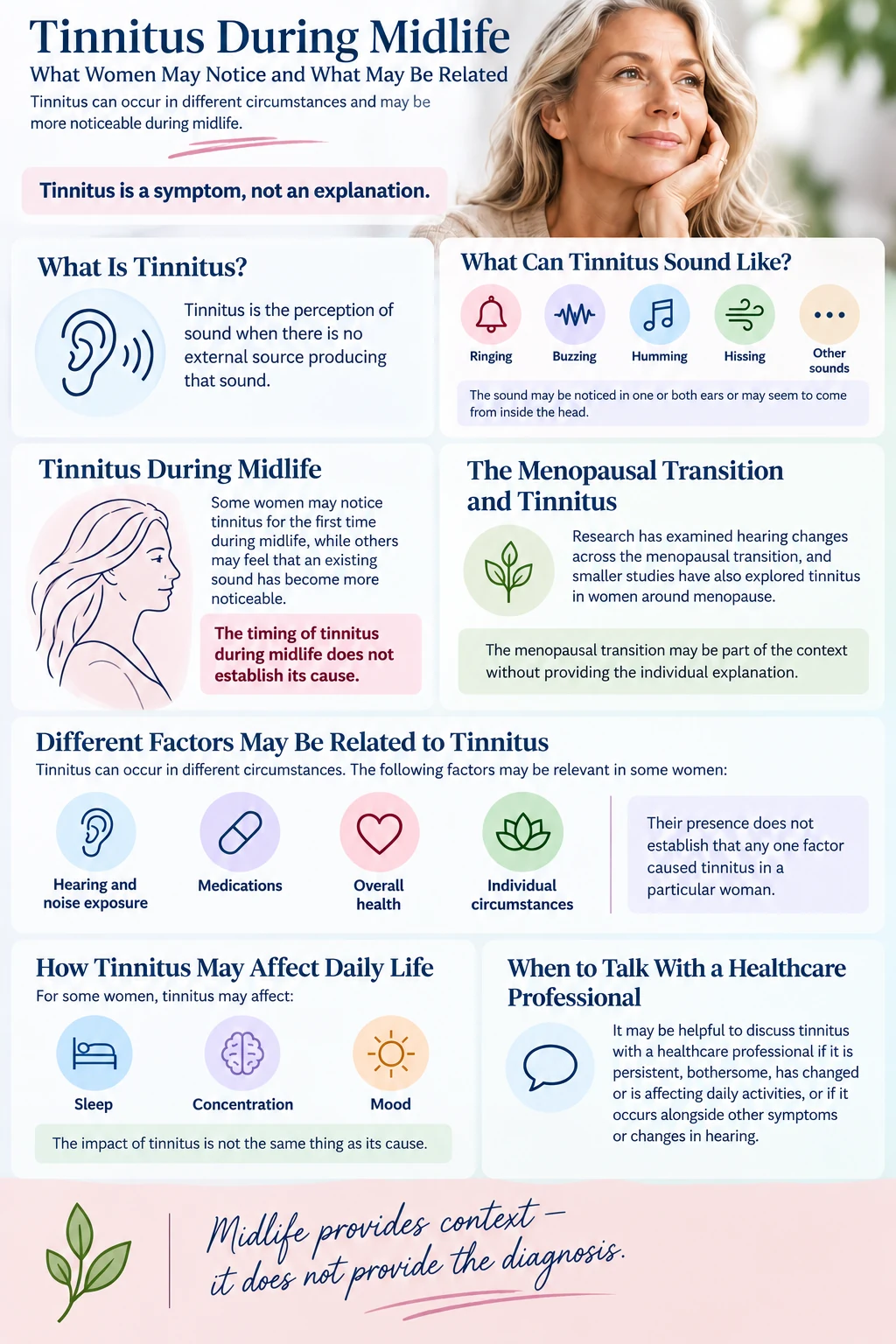
Different Factors May Be Related to Tinnitus
There is no single explanation that applies to every person who experiences tinnitus.
Hearing and noise-related factors, medications, overall health and individual circumstances may all be relevant in different situations.
Their presence does not establish that any one factor caused tinnitus in a particular woman.
Hearing and Noise-Related Factors
Tinnitus is commonly associated with hearing loss, and exposure to loud noise can also be relevant to tinnitus.
However, tinnitus does not by itself establish that hearing loss is present, and not every person with hearing loss experiences tinnitus.
A history of noise exposure may provide useful context, but tinnitus alone cannot establish whether a particular exposure explains the symptom.
These hearing-related factors remain part of the context rather than a diagnosis based on tinnitus alone.
Medications
Tinnitus can occur as an adverse effect of some medications.
This does not mean that a medication is responsible whenever tinnitus occurs while a person is taking it.
Medication history can instead be one part of the context considered when tinnitus is evaluated.
Medication changes should be discussed with an appropriate healthcare professional rather than made solely because tinnitus has appeared.
Overall Health and Individual Circumstances
Different health conditions and individual circumstances may be associated with tinnitus.
Their relevance varies from person to person, and tinnitus does not establish that a particular condition is present.
Other symptoms, health history and the circumstances surrounding the onset or change in tinnitus may provide additional context during an assessment.
For this reason, tinnitus should not be used as a shortcut to diagnose a particular health condition.
Tinnitus May Affect More Than the Perception of Sound
For some people, tinnitus is relatively unobtrusive. For others, it may interfere with aspects of daily life.
Tinnitus may affect sleep, concentration or mood in some people, particularly when the perceived sound is persistent or bothersome.
These effects are important, but they do not automatically explain why tinnitus developed.
For example, noticing that tinnitus and sleep difficulties occur together does not, by itself, establish why either experience is occurring.
The same caution applies when tinnitus occurs alongside changes in mood or concentration.
Why Tinnitus Alone Cannot Tell You the Cause
Tinnitus describes something a person perceives, but the symptom itself does not necessarily explain why it is occurring.
Details such as what the sound is like, when it began, whether it is persistent or intermittent, whether it has changed, medication use, hearing history, noise exposure and other symptoms may provide useful context during an assessment.
A healthcare professional may also consider health history, medications, hearing-related information and findings from an appropriate evaluation.
Those details can help characterize the situation, but they are not diagnostic rules that can be interpreted individually.
Midlife, menopausal stage, hearing changes, medication use or any other single circumstance cannot automatically provide the explanation.
When Is It Worth Discussing Tinnitus With a Healthcare Professional?
If tinnitus is persistent, recurrent, bothersome, has changed or is affecting sleep, concentration or daily activities, discussing it with a healthcare professional may be appropriate.
A conversation may also be useful when tinnitus is new or occurs alongside other symptoms or changes in hearing.
Seeking professional advice does not mean that hearing loss, menopause or another particular health condition is necessarily responsible.
It allows the characteristics of the tinnitus, hearing history, medications, overall health, other symptoms and individual circumstances to be considered together rather than assuming that midlife, menopause, hormones or another single factor provides the explanation.
Tinnitus during midlife can be meaningful without having one universal cause.
This article is for general informational purposes and does not replace individualized medical advice, diagnosis or treatment.