Vaginal Dryness During Perimenopause: Why It Can Happen
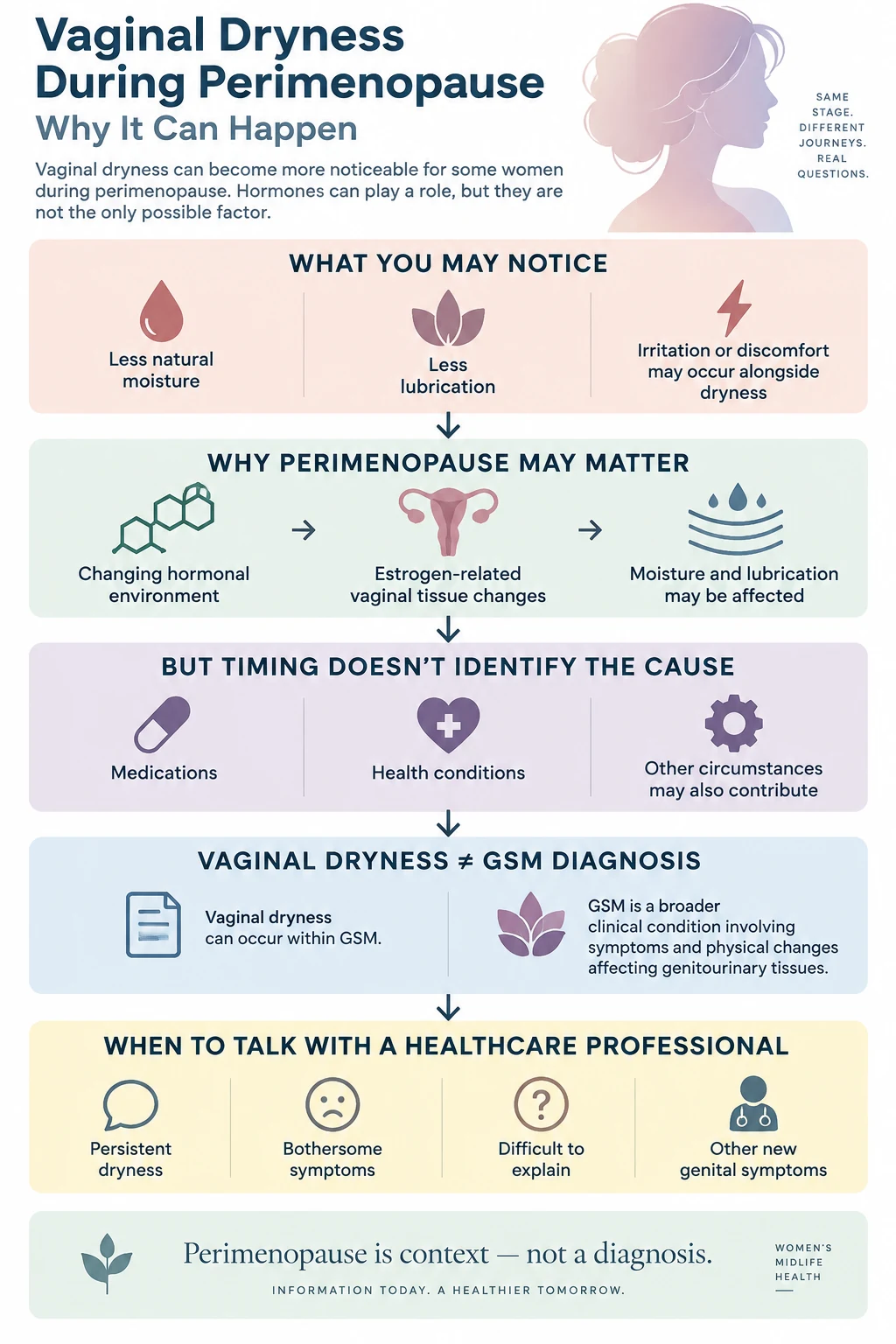
Vaginal dryness can become more noticeable for some women during perimenopause. It may feel like there is less natural moisture or lubrication than before, sometimes along with irritation or discomfort.
Because these changes can appear during the years leading up to menopause, hormones are an important part of the picture. But vaginal dryness is not unique to perimenopause, and its timing alone cannot identify the cause for an individual woman.
Research following women across the menopausal transition has found that vaginal dryness becomes more common during this stage of life. Estrogen-related changes in vaginal tissue can help explain why, while medications, health conditions and other circumstances may also contribute.
What Does Vaginal Dryness Feel Like?
Vaginal dryness describes a reduction in the natural moisture that helps vaginal tissues feel comfortable. Some women notice a clear change, while for others it may be subtle at first.
Dryness Can Feel Like Less Moisture or Lubrication
For some women, the main change is simply a feeling of less natural moisture or lubrication than they were used to.
Dryness may be mild or more noticeable. The sensation describes what a woman is experiencing; it does not identify the reason behind it.
Irritation or Discomfort May Sometimes Occur Alongside Dryness
Dryness does not always occur by itself. Irritation, burning or general discomfort in the vaginal or surrounding vulvar area may sometimes occur alongside it.
Because these symptoms can overlap with other health concerns, persistent or unexplained discomfort should not automatically be attributed to perimenopause.
Why Can Vaginal Dryness Become More Noticeable During Perimenopause?
Perimenopause is part of the menopausal transition, the period leading toward menopause. During this transition, reproductive hormone patterns change, and vaginal tissues are responsive to estrogen.
In the longitudinal Study of Women's Health Across the Nation (SWAN), 2,435 women were followed across the menopausal transition. The reported prevalence of vaginal dryness increased from 19.4% at the beginning of the study to 34.0% at the final assessment, and advancing menopausal stage was associated with developing vaginal dryness symptoms.
These findings show that vaginal dryness became more common across the menopausal transition in this longitudinal cohort. Individual experiences, however, vary considerably.
Estrogen Levels Change During the Menopausal Transition
Estrogen levels can fluctuate during perimenopause rather than following a simple straight-line decline. Lower estrogen levels are clinically relevant to vaginal tissues, but an individual woman's dryness cannot be explained from a hormone pattern alone.
Estrogen-Related Changes Can Affect Vaginal Tissue
Estrogen helps support vaginal tissue characteristics involved in natural lubrication, elasticity and thickness.
When estrogen levels are lower, changes in these tissues can contribute to reduced lubrication and a sensation of dryness. Lower estrogen levels can also be associated with changes in vaginal tissue thickness and elasticity.
These estrogen-related tissue changes provide an established biological context for why vaginal dryness may occur during the menopausal transition.
These Changes Do Not Affect Every Woman in the Same Way
Women do not experience the menopausal transition identically.
Some may notice vaginal dryness during perimenopause, others may notice it later, and some may have little or no difficulty with dryness.
Population-level patterns help show what becomes more common during a life stage, but they do not predict exactly what any one woman will experience.
Does Vaginal Dryness During Perimenopause Always Mean Hormones Are the Cause?
No. Hormonal changes are relevant during perimenopause, but vaginal dryness can occur in other circumstances too.
The important distinction is between recognizing a well-established relationship and assigning an individual cause.
Timing Alone Does Not Establish the Cause
When vaginal dryness begins during perimenopause, the timing makes the menopausal transition relevant. It does not make every other explanation disappear.
The longitudinal SWAN research found menopausal stage to be associated with developing vaginal dryness, while other factors were also associated with the symptom.
“What factors could be contributing to the vaginal dryness I'm noticing during this stage of life?”
That question allows hormonal changes to be considered alongside the rest of a woman's health context.
Other Factors Can Also Contribute to Vaginal Dryness
Vaginal dryness is not exclusive to perimenopause or menopause.
Other circumstances that affect estrogen levels can be relevant, including postpartum and breastfeeding periods and some cancer treatments or therapies that affect estrogen activity. Certain medications and medical conditions can also contribute.
These possibilities do not mean that a woman needs to identify the cause herself. They show why a symptom that appears during perimenopause should not automatically be reduced to a single explanation.
Is Vaginal Dryness the Same as Genitourinary Syndrome of Menopause (GSM)?
No. Vaginal dryness and genitourinary syndrome of menopause, commonly abbreviated GSM, are related concepts, but they are not interchangeable.
GSM is a broader clinical condition involving symptoms and physical changes in genitourinary tissues associated with declining estrogen and androgen concentrations during the menopausal transition.
Vaginal Dryness Can Be One Symptom Within GSM
Vaginal dryness is one of the symptoms commonly described within GSM.
GSM can include symptoms beyond dryness, including genital, sexual and urinary symptoms. Those broader symptoms require their own clinical context and should not be inferred from vaginal dryness alone.
Dryness by Itself Does Not Establish a GSM Diagnosis
Current clinical guidance considers GSM in the context of symptoms, possible physical findings and other potential explanations or coexisting conditions.
“I'm experiencing vaginal dryness” describes a symptom.
“I have GSM” is a clinical conclusion.
An informational article — or the presence of vaginal dryness by itself — cannot make that determination.
When Is Vaginal Dryness Worth Discussing With a Healthcare Professional?
Persistent or bothersome vaginal dryness is worth discussing with a healthcare professional, particularly when it causes significant discomfort, is difficult to explain or occurs with other new genital symptoms.
Irritation, burning and discomfort can overlap with different health concerns, so a new or persistent change should not simply be dismissed as part of perimenopause.
A healthcare professional can consider menopausal stage together with medications, medical history, associated symptoms and other relevant factors to better understand what may be contributing.
The Bigger Picture: Perimenopause Is Context, Not a Diagnosis
The menopausal transition provides meaningful biological context for vaginal dryness. The symptom becomes more common across this stage of life, and estrogen-related changes in vaginal tissue help explain why it may occur.
At the same time, women have different health histories, medications, exposures and circumstances. A symptom appearing during perimenopause does not need to be separated from that context — but it should not be explained by that context alone.
Explore Women's Midlife Health →
Sources
-
Waetjen LE, Crawford SL, Chang PY, et al.
Factors associated with developing vaginal dryness symptoms in women transitioning through menopause: a longitudinal study.
Menopause. 2018;25(10):1094–1104.
PubMed — PMID 29916947 -
Kaufman MR, Ackerman AL, Amin KA, et al.
The AUA/SUFU/AUGS Guideline on Genitourinary Syndrome of Menopause.
Journal of Urology. 2025;214(3):242–250.
PubMed — PMID 40298120 -
American College of Obstetricians and Gynecologists (ACOG).
Experiencing Vaginal Dryness? Here's What You Need to Know.
Reviewed April 2026.
ACOG — Vaginal Dryness -
Simon JA, et al.
Genitourinary syndrome of menopause (GSM): recommendations from the Fifth International Consultation on Sexual Medicine (ICSM 2024).
Sexual Medicine Reviews. 2026;14(1):qeaf055.
PubMed — PMID 40981832