Waking Up at Night During Midlife: Why Sleep Can Change for Women
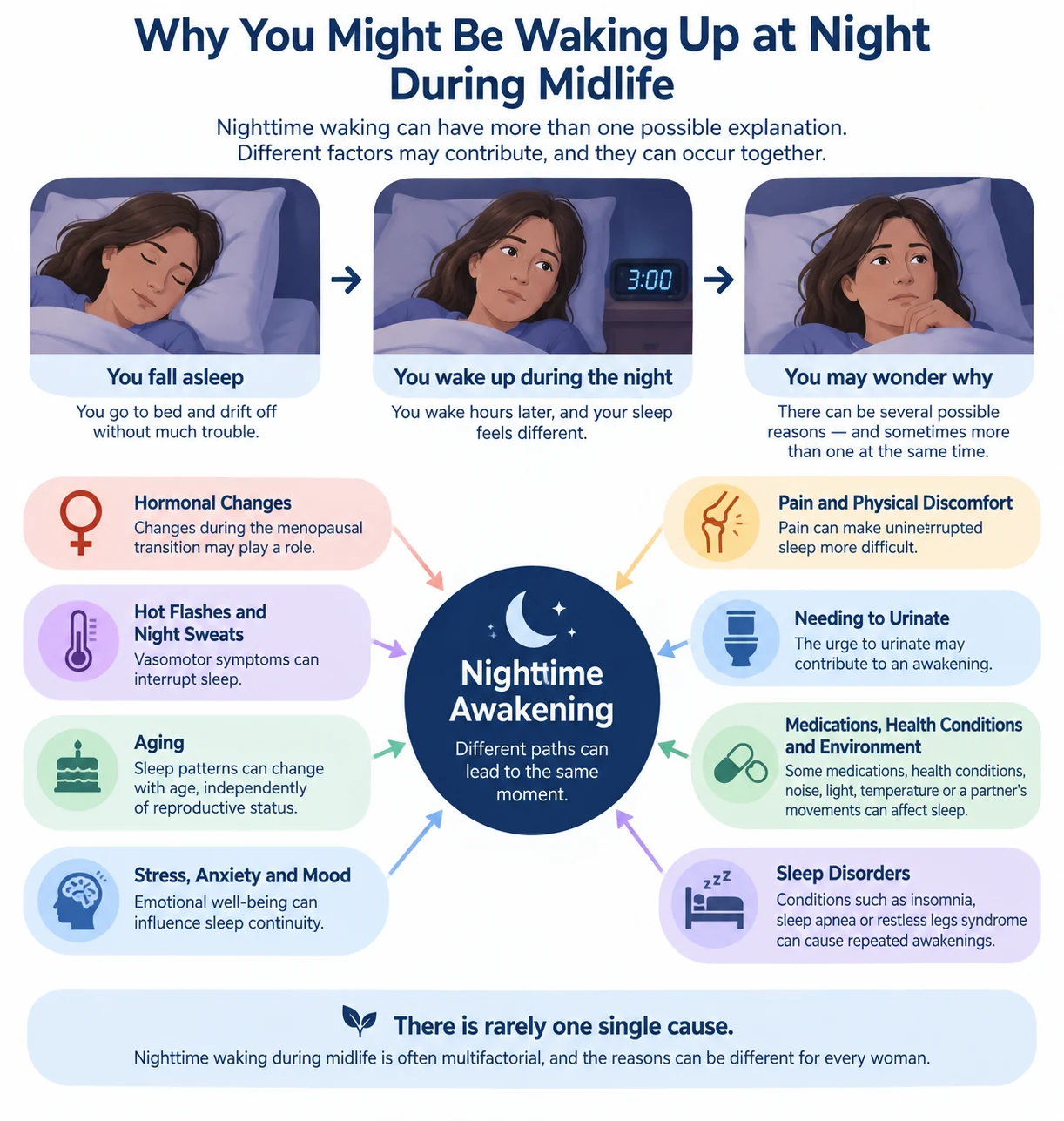
Waking up during the night can be frustrating, especially when it starts happening more often than it used to. You may fall asleep without much trouble, wake a few hours later, and then find yourself wondering why your sleep suddenly feels different.
For women in midlife, nighttime waking can have more than one possible explanation. Changes during the menopausal transition may play a role, particularly when hot flashes or night sweats interrupt sleep. Aging, stress, mood, pain, medications, health conditions, the sleep environment and sleep disorders can also contribute.
Sometimes several factors overlap.
That is why waking at night during midlife should not automatically be assumed to be menopause — or insomnia. Understanding the pattern of the sleep change is a useful place to begin.
Why Am I Waking Up at Night More Often During Midlife?
Nighttime waking can become more noticeable during midlife, but the reason can differ from one woman to another.
Research following women through the menopausal transition has linked nighttime awakenings with a range of factors, including age, stage of the menopausal transition, hot flashes, mood and anxiety symptoms, pain, stress and overall health.
For one woman, hot flashes may be an important contributor. For another, discomfort, stress, medication, a health condition or an underlying sleep disorder may be more relevant. These influences can also occur together.
Waking During the Night Is Different From Trouble Falling Asleep
Not all sleep difficulties follow the same pattern.
Someone who spends a long time trying to fall asleep is experiencing something different from someone who falls asleep easily but repeatedly wakes later.
Sleep research commonly distinguishes patterns such as:
- difficulty falling asleep;
- waking during the night;
- waking earlier than intended.
Studies of women during the menopausal transition have also found that these patterns do not necessarily share the same associations or change in the same way over time.
This guide focuses specifically on waking after you have already fallen asleep.
Why Can Sleep Change During Women's Midlife Years?
Midlife often brings several changes at once. Some may be related to reproductive aging and the menopausal transition, while others reflect aging more generally, physical or emotional health, daily circumstances or existing sleep problems.
Looking at these influences together gives a more useful picture than assuming there is one universal midlife cause.
Hormonal Changes During the Menopausal Transition
Changes in the reproductive hormonal environment occur during the menopausal transition and may be one part of the sleep picture.
Research has found associations between stages of the menopausal transition and certain sleep complaints, including nighttime awakening. But those findings do not mean that a particular hormonal change explains why an individual woman wakes at night.
Sleep is influenced by many processes occurring at the same time. Hormonal and reproductive changes may be relevant without being the only explanation.
Hot Flashes and Night Sweats Can Interrupt Sleep
Hot flashes and night sweats, often called vasomotor symptoms, can interrupt sleep during the menopausal transition.
A woman may wake feeling suddenly hot or sweaty, become uncomfortable under the bedding, or need time to settle again before returning to sleep. Research has found a close relationship between vasomotor symptoms and sleep disruption in many women during this stage of life.
But not every nighttime awakening involves a hot flash.
A woman who wakes without feeling hot or sweaty may have other factors affecting her sleep, and the absence of vasomotor symptoms does not make the awakening unusual.
Aging Can Affect Sleep Too
Menopause and aging occur during overlapping years, which makes them difficult to separate completely.
Sleep patterns can change with age independently of reproductive status. At the same time, the menopausal transition may introduce additional influences, including vasomotor symptoms.
For that reason, sleep changes during midlife should not automatically be attributed to menopause alone.
Other Reasons You May Be Waking Up at Night
Sleep is affected by more than reproductive and age-related changes. Physical comfort, emotional well-being, health conditions and everyday circumstances can all influence whether sleep remains continuous.
Stress, Anxiety and Mood
Stress, anxiety and changes in mood have been associated with sleep difficulties in women during the menopausal transition, including nighttime waking.
The relationship can work in more than one direction. Emotional distress may make sleep harder to maintain, while disrupted sleep can affect how a person feels and functions the next day.
Nighttime waking alone, however, does not indicate an anxiety or mood disorder.
Pain and Physical Discomfort
Pain can make uninterrupted sleep difficult.
Joint pain, back discomfort or other physical symptoms may cause a person to change position, become more aware of discomfort or wake fully during the night. Research in midlife women has found associations between physical pain and nighttime awakening.
The presence of pain does not tell us why the pain is occurring, but it can be one factor affecting sleep continuity.
Needing to Urinate During the Night
Waking during the night to urinate is known as nocturia.
Sometimes the urge to urinate may contribute to an awakening. In other situations, a person may wake for another reason and then notice that she needs to use the bathroom.
This distinction can be difficult to recognize from the awakening alone.
Nighttime urination can fragment sleep, but it does not necessarily reveal what caused the awakening in the first place. Urinary symptoms also have their own possible explanations and should not automatically be attributed to menopause.
Medications, Health Conditions and the Sleep Environment
Health conditions and some medications can affect sleep in different ways. Everyday surroundings can matter too.
Noise, light, room temperature or a partner's movements may turn a brief arousal into a more noticeable awakening. Changes in health or medication use may also coincide with a new sleep pattern.
When waking becomes frequent, considering the broader context can be more informative than looking at reproductive changes alone.
Could a Sleep Disorder Be Causing Frequent Awakenings?
Repeated awakenings can sometimes occur as part of a sleep disorder.
Persistent sleep disruption during midlife therefore should not automatically be dismissed as something women simply have to accept with age or menopause.
Insomnia Is More Than an Occasional Nighttime Awakening
Difficulty staying asleep can occur with insomnia, but waking during the night by itself is not enough to determine whether someone has an insomnia disorder.
An occasional disrupted night and a persistent pattern that affects sleep and daytime functioning are not the same thing.
This is one reason the phrase “menopause insomnia” can be misleading when it is applied to every woman who begins waking during the night.
Sleep Apnea Can Be Overlooked in Women
Obstructive sleep apnea can repeatedly disrupt sleep by interfering with breathing during the night. Some people experience fragmented sleep without remembering each awakening.
Sleep apnea is one of the conditions healthcare professionals may consider when evaluating persistent sleep complaints in women during and after the menopausal transition.
Nighttime waking does not mean that a woman has sleep apnea. It simply means that persistent sleep disruption may sometimes have an explanation other than menopause.
Restless Legs and Other Sleep Disorders
Restless legs syndrome and other sleep-related conditions can also interfere with continuous sleep.
These conditions have their own patterns and symptoms, and nighttime waking alone cannot identify whether one is present.
When sleep disruption is persistent, the surrounding symptoms and the overall sleep pattern provide more useful information than the awakening by itself.
Does Waking Up at 3 A.M. Mean Something Specific?
Seeing the same time on the clock night after night can make that hour seem significant.
But waking at 3 a.m. — or at another particular time — does not, by itself, identify why the awakening occurred.
What is happening around the awakening may be more informative. A person may wake feeling hot or sweaty, needing to urinate, uncomfortable, in pain or suddenly alert. Sometimes there is no obvious trigger at all.
It does not tell you why.
This distinction matters because specific nighttime hours are sometimes given precise hormonal or biological explanations online that cannot be established from clock time alone.
Why Is It Sometimes Hard to Fall Back Asleep?
What wakes you and what keeps you awake are not necessarily the same thing.
Heat, noise, discomfort or a need to use the bathroom may trigger the initial awakening. Once awake, worry, physical discomfort, increased alertness or the surrounding environment may make returning to sleep more difficult.
A woman can therefore fall asleep easily at bedtime and still have difficulty maintaining sleep later in the night.
When that happens frequently, looking at the entire sleep pattern is more useful than focusing only on the moment she woke up.
When Is Waking Up at Night Worth Discussing With a Healthcare Professional?
Occasional disrupted nights are common. A pattern that keeps happening and begins affecting daily life deserves more attention.
It may be worth discussing nighttime waking with a healthcare professional when it becomes persistent or frequent, sleep regularly feels unrefreshing, daytime functioning is being affected, or other symptoms raise the possibility that a health condition or sleep disorder may be contributing.
Rather than assuming that the problem is simply part of menopause or aging, a healthcare professional can consider the broader picture — including the sleep pattern, symptoms, medications, health history and menopausal stage when relevant.
The Bigger Picture: Midlife Sleep Is Often Multifactorial
Waking during the night can become more noticeable for some women during midlife, but there is no single explanation that applies to everyone.
The menopausal transition and vasomotor symptoms can matter. Aging can matter. So can stress, mood, pain, urinary symptoms, medications, health conditions, the sleep environment and underlying sleep disorders.
The useful question is therefore not always:
“What is the one thing causing me to wake up?”
It may be:
“What factors could be contributing to this change in my sleep?”
Midlife provides important context for asking that question.
It does not provide the diagnosis.
Nighttime waking is one part of a broader women's health landscape during midlife.
Explore Women's Midlife Health →Sources
- Woods NF, Mitchell ES. Sleep Symptoms During the Menopausal Transition and Early Postmenopause: Observations from the Seattle Midlife Women's Health Study. Sleep, 2010.
- Baker FC, Lampio L. Sleep and Sleep Disorders in the Menopausal Transition. Sleep Medicine Clinics, 2018.
- Thurston RC, et al. Hot Flashes and Awakenings Among Midlife Women. Sleep, 2019.
- Jakubowski K. Sleep Disturbances in Midlife Women: Prevalence, Correlates, and Treatments. Menopause, 2026.