Weight Gain During Midlife: Why Your Weight May Be Changing
Weight gain can become more noticeable during midlife, and menopause is often assumed to be the reason. The relationship, however, is more complex.
Aging-related changes can influence body weight during these years. At the same time, the menopausal transition can affect body composition and where fat tends to be stored. These processes overlap, which can make it difficult to separate the effects of chronological aging from those associated with reproductive aging.
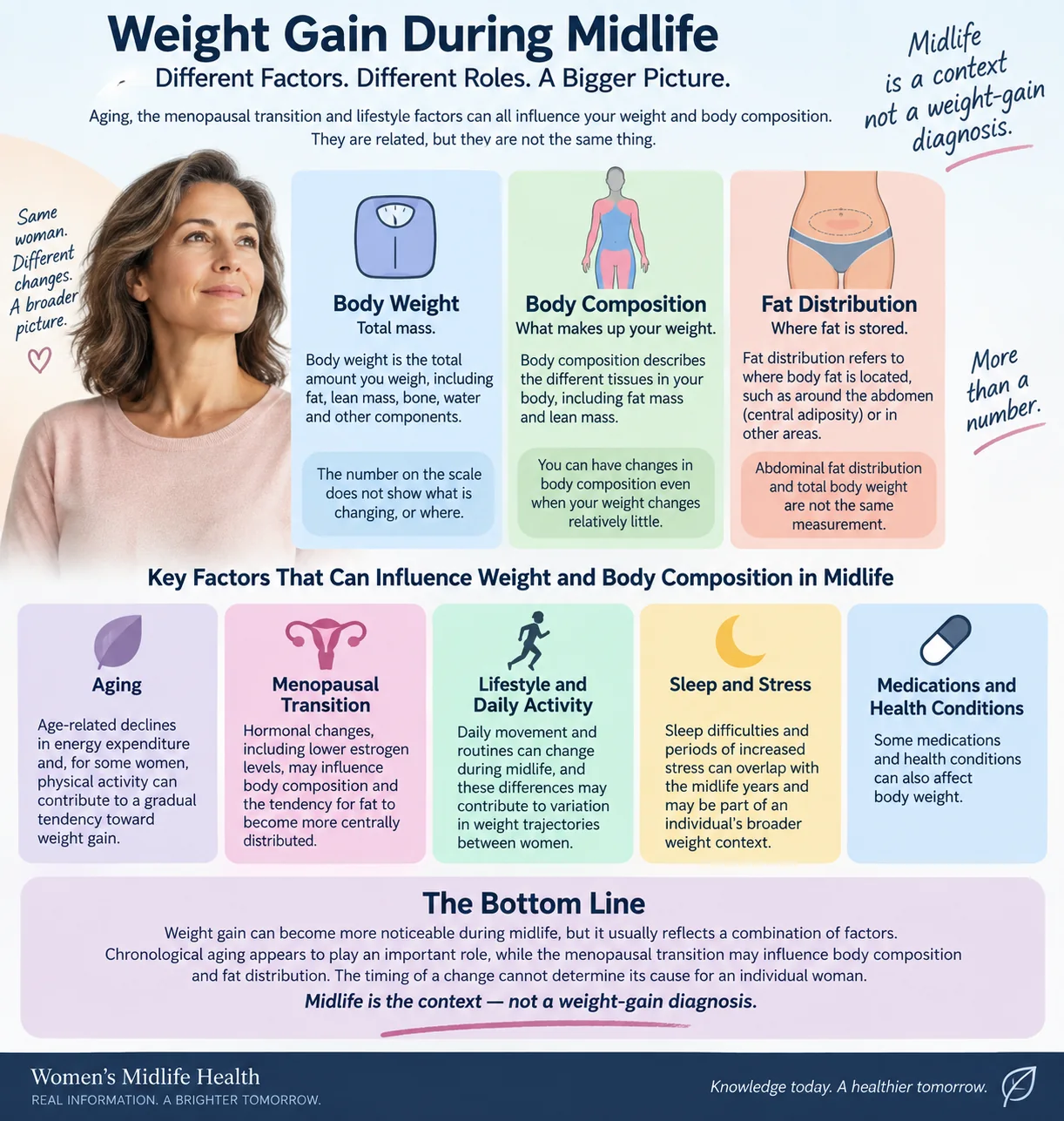
Body weight, body composition and fat distribution are related, but they describe different things. Understanding those differences can help explain why the number on the scale and the way your body looks or feels do not always change in the same way.
Why Can Weight Gain Become More Noticeable During Midlife?
Several factors that influence body weight can shift gradually during the midlife years. Research suggests that age-related changes are important contributors to the tendency to gain weight during this period.
The menopausal transition occurs during many of the same years, adding another layer to the picture. Its effects appear to be particularly relevant to body composition and the distribution of body fat.
Aging-Related Changes Can Affect Energy Balance
Energy balance reflects the relationship between the energy the body takes in and the energy it uses.
Aging-related declines in energy expenditure and, for some women, physical activity can contribute to a gradual tendency toward weight gain during midlife. Changes in body composition may also influence the body's overall energy needs.
These are contributing factors rather than a single explanation. Weight trajectories vary, and gaining weight during midlife is not inevitable.
Lifestyle and Daily Activity Can Change During the Midlife Years
Daily movement and physical activity can also change over time.
Some women remain highly active throughout midlife, while others experience changes in routines that affect how much they move. These differences can contribute to variation in weight trajectories between women.
Lifestyle therefore belongs in the broader picture, without providing a universal explanation for why an individual woman's weight changes.
Does Menopause Cause Weight Gain?
Menopause and weight gain frequently occur during overlapping years, but that does not make them equivalent processes.
Current evidence points to chronological aging as an important contributor to midlife weight gain. The menopausal transition appears to have a particularly important relationship with changes in body composition and the tendency for fat to become more centrally distributed.
Midlife Weight Gain and the Menopausal Transition Can Overlap
Perimenopause is part of the menopausal transition and often occurs during the same period when age-related changes in weight are becoming more noticeable.
A woman may therefore notice weight gain while also experiencing menstrual changes or other features of the menopausal transition.
The overlap is real. What it cannot do by itself is identify which process is responsible for a particular change in weight.
Timing Alone Does Not Show What Caused the Weight Change
When weight begins to increase during perimenopause, hormones may seem like the obvious explanation.
In reality, body weight reflects multiple influences. Aging, energy expenditure, physical activity and individual health circumstances can all matter.
Hormonal changes remain relevant, particularly when considering body composition and fat distribution, but the timing of a weight change cannot establish hormonal causation for an individual woman.
Aging Appears to Play an Important Role in Midlife Weight Gain
Research that has tried to distinguish chronological aging from the menopausal transition supports an important role for aging in changes in body weight.
This distinction can be difficult to see in everyday life because reproductive aging and chronological aging occur simultaneously.
As a result, gaining weight during the menopausal transition does not necessarily mean that menopause itself is the main reason total body weight has increased.
How Can Body Composition Change During the Menopausal Transition?
The number on a scale captures only one aspect of what may be changing during midlife.
Longitudinal research following women across the menopausal transition has documented changes in fat mass and lean mass. These changes can occur alongside changes in body weight, but they do not follow exactly the same pattern.
Body Composition Is Different From Body Weight
Body weight describes total mass. Body composition describes the different tissues that contribute to that mass, including fat mass and lean mass.
A woman's body composition can change even when her weight changes relatively little. Conversely, a change on the scale does not reveal whether that change reflects fat mass, lean mass or other components of body weight.
Keeping the concepts separate helps make sense of research on weight during the menopausal transition.
Fat Mass and Lean Mass Can Change During Midlife
Longitudinal evidence from women followed across the menopausal transition has shown acceleration in fat gain and decline in lean mass around this period.
Lean mass, however, is not synonymous with muscle strength or physical function. A measurement of lean mass alone cannot establish muscle weakness or diagnose a muscle disorder.
Those are separate questions from the one W6 addresses: why body weight and body composition may change during midlife.
Hormonal Changes May Influence Where Fat Is Stored
Changes in estrogen during the menopausal transition appear to play a role in body-fat distribution.
This relationship may be especially relevant to the tendency for fat to become more centrally distributed rather than simply explaining whether total body weight increases.
That distinction helps explain why hormonal changes can matter even when menopause is not treated as the sole cause of midlife weight gain.
Why Can More Fat Accumulate Around the Abdomen?
Some women notice a change in body shape during midlife, including more fat around the abdominal area.
Research has linked the menopausal transition with greater central or abdominal adiposity. This can occur alongside weight gain, but abdominal fat distribution and total body weight are not the same measurement.
Abdominal Fat Distribution Can Change Around Menopause
Fat distribution describes where body fat is stored.
Around the menopausal transition, the pattern of fat storage can shift toward greater central or abdominal accumulation. Changes in estrogen appear to contribute to this shift, although the degree and pattern vary among women.
This is one reason a change in body shape can become noticeable during the same years as other menopausal changes.
Changes in Body Shape Can Occur Without Telling the Whole Story About Weight
A changing waistline does not reveal the complete story of what is happening to total body weight.
Changes in fat distribution and body composition can affect body shape even when the number on the scale changes only modestly. Similarly, gaining weight does not tell us where that additional mass is distributed.
“Belly fat,” body composition and total body weight therefore describe related but distinct aspects of midlife body change.
What Else Can Influence Weight During Midlife?
Chronological aging and the menopausal transition occur within a much broader health and life context.
Sleep, stress, medications, health conditions and changes in everyday routines may also be relevant. Their contribution can differ substantially from one woman to another.
Sleep and Stress Can Be Part of the Picture
Sleep difficulties and periods of increased stress can overlap with the midlife years and may be part of an individual's broader weight context.
Their presence does not establish why weight has changed. Instead, they are among the factors that may be considered alongside activity, aging, the menopausal transition and individual circumstances.
Medications and Health Conditions May Also Affect Weight
Some medications and health conditions can contribute to changes in body weight.
This matters because a new weight change should not automatically be attributed to menopause simply because it occurs during the same years.
Medical history, medications, accompanying symptoms and the pattern of weight change can all provide context that a number on a scale cannot.
When Is a Change in Weight Worth Discussing With a Healthcare Professional?
Gradual changes in weight can occur during midlife, but a new change should not automatically be considered part of normal aging or the menopausal transition.
Weight that changes rapidly, unexpectedly or without a clear explanation may be worth discussing with a healthcare professional, particularly when the change occurs alongside other new or concerning symptoms.
A clinician can consider factors that cannot be determined from weight alone, including medical history, medications, health conditions and menopausal status.
The purpose of evaluation is not to assume that a weight change signals a medical problem. It is to avoid assuming that midlife or menopause explains every change.
The Bigger Picture: Midlife Is Context, Not a Weight-Gain Diagnosis
Weight gain, changes in body composition and changes in abdominal fat distribution can all occur during women's midlife. They are related, but they are not interchangeable.
Chronological aging appears to play an important role in midlife weight gain. The menopausal transition, meanwhile, may influence body composition and the tendency for fat to become more centrally distributed. Physical activity, lifestyle, medications, health conditions and individual circumstances can add further variation.
For an individual woman, the timing of a change cannot determine its cause.
This article is part of our Women's Midlife Health series. Explore the Women's Midlife Health hub →
Sources
- Hurtado MD, Saadedine M, Kapoor E, et al. Weight Gain in Midlife Women. Current Obesity Reports. 2024. View source
- Greendale GA, Sternfeld B, Huang M, et al. Changes in body composition and weight during the menopause transition. JCI Insight. 2019. View source
- Hung S, Adams KE. Midlife weight gain: challenges and solutions. Current Opinion in Obstetrics and Gynecology. 2026. View source
- Vieira-Potter VJ, Mishra G, Townsend KL. Health of adipose tissue: oestrogen matters. 2026. View source