Hearing difficulties are not always easy to describe. You may notice that conversations require more effort, certain sounds seem less clear, or one ear appears to hear differently from the other. A hearing evaluation can help measure hearing more systematically and determine whether additional assessment or follow-up may be appropriate.
One of the most familiar parts of hearing testing is the audiogram — the graph used to record pure-tone hearing thresholds. But an audiogram is not the same thing as a complete hearing evaluation, and the graph alone cannot explain why hearing loss occurred.
Understanding that distinction makes hearing-test results much easier to put into context.
What Is a Hearing Test?
“Hearing test” is a broad term. Depending on the purpose of the visit and the person's needs, hearing may be assessed in different ways.
A brief hearing screening and a comprehensive audiologic evaluation are therefore not interchangeable.
Why a Hearing Screening Is Not the Same as a Comprehensive Hearing Evaluation
A hearing screening is designed primarily to identify people who may be at risk for a hearing problem and who may benefit from additional assessment or referral.
Screening can take place in health care settings, occupational programs and other environments. Remote or online tools may also be used for some forms of adult hearing screening.
A screening result does not provide the same information as a comprehensive audiologic evaluation. When a screening identifies a concern, a more complete evaluation may be recommended.
What May Be Included in a Comprehensive Hearing Evaluation
A comprehensive hearing evaluation looks at hearing in a broader context.
Depending on the individual and the clinical question, an audiologic assessment may include a case history, examination of the ears, pure-tone testing, speech testing and other procedures as appropriate.
Not every person requires every test. The appropriate test battery depends on the person's history, symptoms and findings during the evaluation.
What Is Pure-Tone Audiometry?
Pure-tone audiometry is a behavioral test of hearing sensitivity.
During testing, tones at different frequencies and levels are presented and the person responds when the sounds are heard. The results help establish hearing thresholds across the frequencies tested.
How Hearing Thresholds Are Measured
A pure-tone threshold represents the lowest level at which a particular frequency is detected according to the testing procedure.
Because hearing sensitivity can differ across frequencies, several frequencies are tested rather than relying on one tone.
Those thresholds are then plotted on an audiogram, allowing the hearing pattern across the tested frequencies to be viewed graphically.
Why Air Conduction and Bone Conduction May Both Be Tested
Pure-tone audiometry can include air-conduction and bone-conduction measurements.
With air-conduction testing, sounds are typically delivered through earphones. Sound travels through the usual auditory pathway involving the outer, middle and inner ear.
Bone-conduction testing uses vibration to deliver sound to the inner ear while largely bypassing the outer and middle ear.
The relationship between these measurements can provide useful information when an audiologist characterizes hearing loss. However, the results should be interpreted as part of the overall evaluation rather than used by the reader to diagnose the location or cause of a hearing problem.
What Is an Audiogram?
An audiogram is the graph on which pure-tone hearing-test results are recorded.
It provides a visual representation of hearing thresholds across different frequencies and allows results for the two ears to be documented separately.
How Frequency Is Shown on an Audiogram
The horizontal axis of an audiogram represents frequency, measured in hertz (Hz).
Frequency relates to pitch: lower frequencies correspond to lower-pitched sounds and higher frequencies correspond to higher-pitched sounds.
Testing multiple frequencies helps show whether hearing sensitivity is similar across the tested range or varies between lower and higher frequencies.
How Hearing Level Is Shown on an Audiogram
The vertical axis represents hearing level, generally expressed in decibels hearing level (dB HL).
It is important not to treat dB HL as simply a direct measurement of how loud everyday sounds seem. It is an audiometric reference scale used for hearing testing.
The plotted thresholds show the levels at which tones at the tested frequencies were detected according to the audiometric procedure.
Why the Right and Left Ears Are Recorded Separately
Hearing can differ between the two ears, so results from the right and left ears are plotted separately.
This allows the audiologist to compare hearing sensitivity across frequencies in each ear and identify whether the measured hearing pattern is similar or different between them.
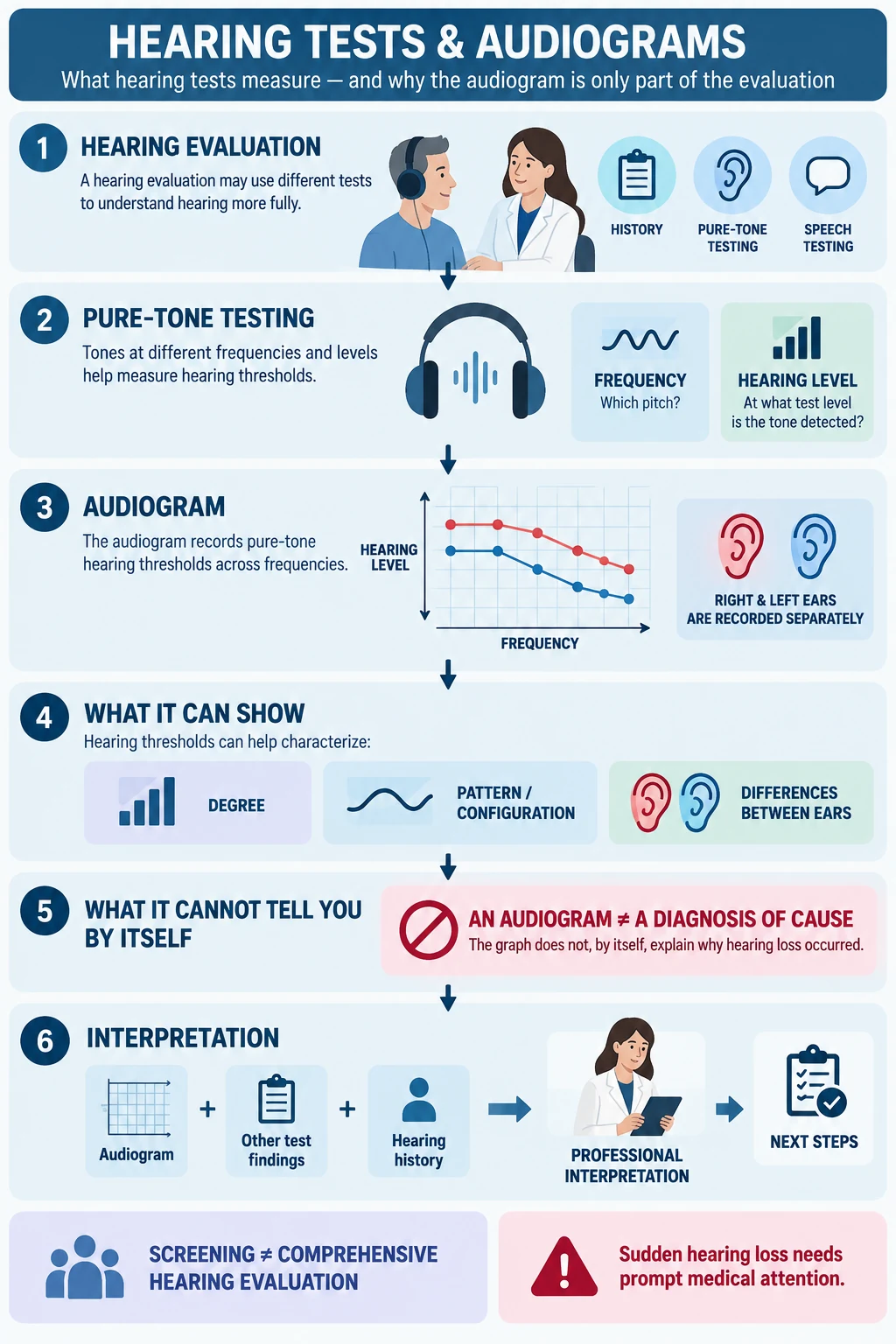
An audiogram records pure-tone hearing thresholds, but the graph is only one part of a broader hearing evaluation.
What Can an Audiogram Tell You About Your Hearing?
An audiogram provides useful information about pure-tone hearing sensitivity.
It can show the thresholds measured at different frequencies and help describe how hearing sensitivity varies across the tested range.
But the graph should be understood as one component of the broader hearing evaluation.
How Hearing Thresholds Help Characterize Hearing Loss
Measured thresholds across frequencies can help audiologists characterize hearing sensitivity and identify patterns consistent with hearing loss.
Audiologists consider factors such as which frequencies are affected, how hearing sensitivity varies across the tested frequencies and whether the findings are similar in both ears.
Air- and bone-conduction results can also contribute to determining the type of hearing loss as part of the complete assessment.
How Hearing Thresholds Help Describe the Degree and Pattern of Hearing Loss
Audiologists may use established threshold ranges to describe the degree of hearing loss, while configuration describes how measured thresholds vary across frequencies.
For example, thresholds may be relatively similar across frequencies or show greater hearing loss in certain frequency ranges.
These descriptions help characterize the audiometric findings, but they do not independently establish why the hearing loss occurred.
What Can an Audiogram Not Tell You by Itself?
An audiogram contains valuable information, but it does not answer every question about hearing.
In particular, a graph of pure-tone thresholds should not be treated as a complete explanation of a person's symptoms, hearing function or underlying condition.
Why an Audiogram Does Not Automatically Identify the Cause of Hearing Loss
Different conditions can affect hearing, and interpretation depends on more than the shape of the audiogram.
Medical and hearing history, ear examination, air- and bone-conduction findings, speech testing and other procedures may contribute information needed to understand the hearing problem.
For that reason, a particular audiogram shape does not automatically establish a specific cause.
Why One Audiogram Pattern Should Not Be Used for Self-Diagnosis
It can be tempting to compare an audiogram with examples found online and assign a diagnosis based on a similar-looking pattern.
That approach can be misleading.
Audiograms help professionals characterize measured hearing sensitivity, but similar-looking patterns do not necessarily have the same explanation. Clinical interpretation depends on the complete findings and the person's history.
Why Are Speech Tests Used During a Hearing Evaluation?
Pure tones provide important information about hearing sensitivity, but everyday communication involves speech rather than isolated tones.
Speech audiometry can therefore add information to an audiologic evaluation.
How Speech Testing Adds Information Beyond Pure Tones
Speech testing can examine different aspects of hearing and speech perception.
Depending on the procedure, it may assess awareness of speech, recognition of speech material or other aspects of speech perception. Results can complement information obtained from pure-tone testing.
Why Speech Testing and Pure-Tone Audiometry Are Not the Same Test
Pure-tone audiometry measures responses to tones at selected frequencies, while speech testing uses speech material to provide complementary information about auditory performance.
The two types of testing therefore provide related but distinct information.
Some evaluations also include speech testing in background noise, but that is a separate aspect of hearing assessment and should not be confused with the basic pure-tone audiogram.
Are Online Hearing Tests the Same as a Clinical Hearing Evaluation?
Online and smartphone hearing tools have become increasingly available.
Some can provide useful screening or self-testing information, but they should not automatically be considered equivalent to a comprehensive clinical hearing evaluation.
What an Online Hearing Screening May Help Identify
Online screening tools may use tones, speech or other methods to look for possible hearing difficulties.
They can increase access to hearing screening and may help identify people who would benefit from further evaluation.
Why Screening Results May Need Professional Follow-Up
Online hearing tools can vary in their methods, equipment requirements and testing conditions.
The listening environment, device and way the test is administered can also affect results. A concerning screening result therefore may warrant professional audiologic assessment rather than self-diagnosis based on the online result alone.
What Happens After a Hearing Test?
What happens next depends on the reason for testing and the findings.
There is no single next step that applies to everyone.
Why Results Are Interpreted Alongside Other Findings
Accurate interpretation of hearing loss relies on the test battery together with the person's medical and hearing history.
The audiogram may be important, but ear examination, speech testing, middle-ear measures and other findings can provide information that pure-tone thresholds alone do not supply.
How Hearing Test Results Can Help Guide Next Steps
Hearing-test results can help determine whether additional audiologic assessment, medical evaluation, monitoring, counseling or hearing support should be considered.
The appropriate next step depends on the pattern and degree of hearing loss, other test findings, symptoms and the person's communication needs.
A particular number on an audiogram does not, by itself, determine which intervention is appropriate.
When Should You Seek Further Hearing Evaluation?
A screening result that raises concern, persistent hearing difficulty or a noticeable change in hearing can be reasons to seek further evaluation.
The urgency, however, depends on the circumstances.
When Screening or Hearing Difficulties Point to Follow-Up
A screening result indicating possible hearing difficulty can lead to referral for a comprehensive audiologic evaluation.
Professional evaluation may also be appropriate when hearing difficulties persist, interfere with communication or everyday activities, or when a person notices meaningful differences between the ears.
Sudden Hearing Loss Needs Prompt Medical Attention
The broader lesson is simple: hearing tests provide measurements, and audiograms organize some of those measurements visually. Their greatest value comes from interpreting those findings in context rather than treating a single graph as a diagnosis.
Sources
Vitality Product Hub prioritizes major professional and government sources for medical and hearing-health content.