Sound is part of everyday life, but sufficiently intense sound can damage structures involved in hearing. The risk depends not only on how loud a sound is, but also on how long and how often a person is exposed to it.
Noise-related hearing changes can happen after a very intense event or develop gradually with repeated exposure. Because hearing difficulty can have different causes, symptoms alone cannot confirm noise-induced hearing loss.
What Is Noise-Induced Hearing Loss?
Noise-induced hearing loss, often shortened to NIHL, is hearing loss associated with exposure to sound intense enough to damage the auditory system.
It can follow a single extremely intense sound or repeated or prolonged exposure to loud sound over time.
How Loud Sound Can Affect the Auditory System
Sound reaches the inner ear, where sensory structures help convert sound vibrations into signals that can be carried along auditory pathways.
Repeated or intense sound exposure can permanently damage sensory cells and other structures involved in hearing, resulting in irreversible noise-induced hearing loss.
Why Noise-Induced Hearing Loss Can Develop Gradually
Not every harmful sound exposure produces an obvious immediate change. When loud sound is encountered repeatedly over time, hearing damage can accumulate and may initially go unnoticed.
This is one reason prevention matters even when a person does not notice an immediate hearing problem.
What Types of Noise Exposure Can Affect Hearing?
Potentially harmful sound exposure can occur in many settings, including workplaces, concerts and other entertainment venues, recreational activities, yard or power-tool use, personal listening, and exposure to very intense impulse sounds.
The relevant issue is the exposure itself — particularly its intensity, duration and repetition — rather than simply the name of the device or activity producing the sound.
One-Time Exposure to Extremely Intense Sound
A single extremely intense sound, such as an explosion or similarly powerful impulse sound, can cause immediate hearing damage.
Hearing changes after a very intense sound exposure should not be self-diagnosed. Sudden hearing loss requires prompt medical evaluation.
Repeated or Prolonged Exposure to Loud Sound
Repeated or prolonged exposure to loud sound can also damage hearing. In these situations, changes may develop gradually rather than after one obvious event.
Many harmful noise exposures can be reduced or avoided, making prevention a central part of protecting hearing.
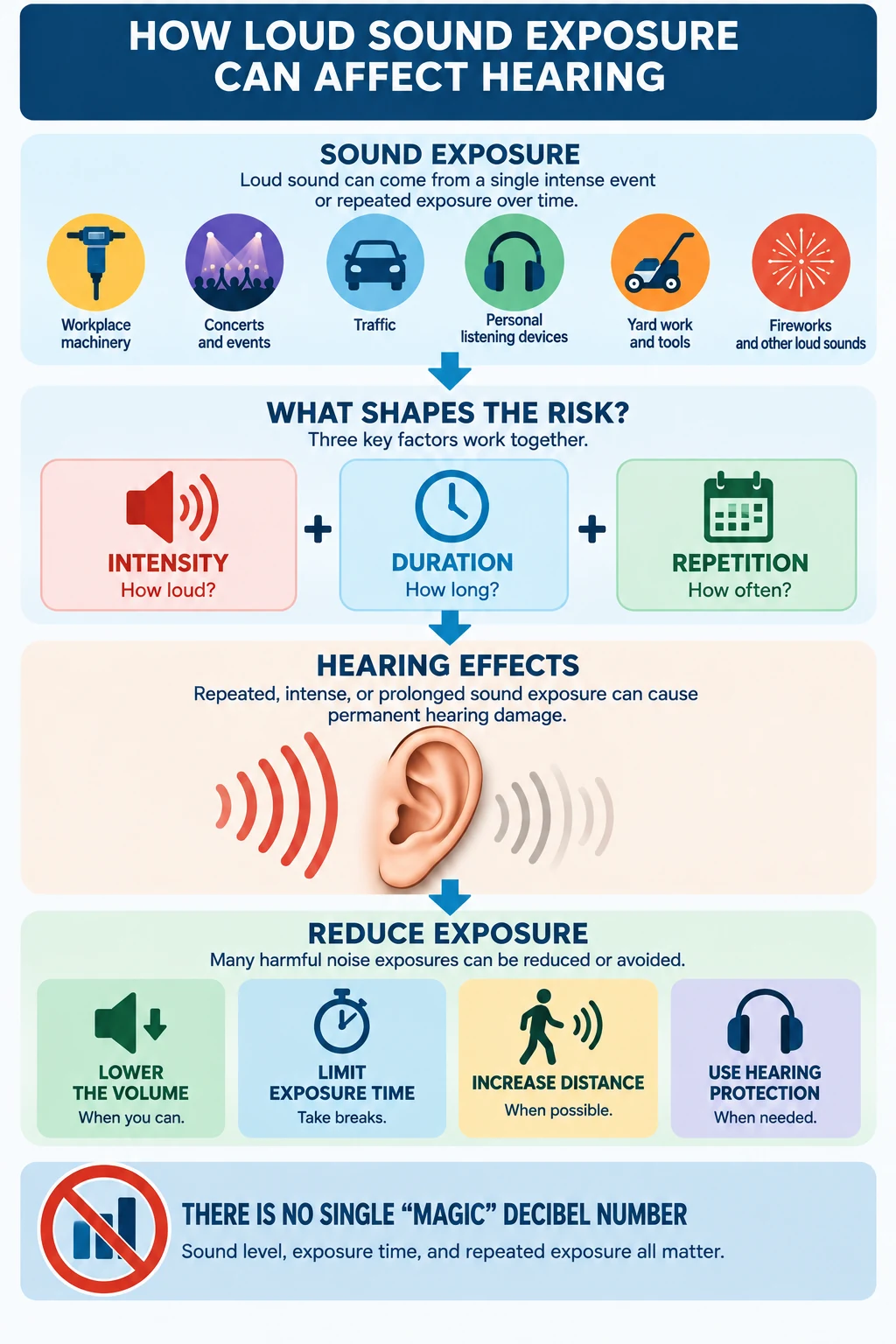
Noise risk depends on more than loudness alone. Sound intensity, exposure time and repeated exposure all matter.
Why Do Sound Level and Exposure Time Both Matter?
Sound exposure is not described adequately by volume alone. How long exposure lasts and how often it occurs are also important when considering risk to hearing.
Why Louder Sound Requires More Attention to Exposure Time
As sound levels increase, allowable exposure times in occupational risk frameworks become shorter. The broader principle is that both sound intensity and exposure duration matter when assessing noise risk.
This does not create a universal personal “safe time” for every sound or every listener.
Why Occupational Noise Limits Are Not Universal Safe-Listening Rules
Occupational noise recommendations are designed for workplace risk management and use defined measurement methods and assumptions.
They should not be treated as a universal calculator that guarantees a particular recreational or personal listening exposure is harmless.
What Are Possible Signs of Noise-Related Hearing Damage?
Possible hearing changes after loud sound exposure can include muffled hearing, reduced hearing clarity, tinnitus, or greater difficulty understanding speech.
These experiences can signal a hearing problem, but none of them alone establishes that NIHL is the cause.
Muffled Hearing or Temporary Hearing Changes After Loud Sound
After intense sound exposure, hearing may temporarily seem muffled or less sensitive. A temporary change is not the same thing as a diagnosis of permanent noise-induced hearing loss.
It is also not evidence that repeated loud-sound exposure is harmless.
Tinnitus and Difficulty Understanding Speech
Tinnitus — hearing ringing, buzzing or another sound without an external source — can occur with noise exposure and hearing loss, but tinnitus is not synonymous with NIHL and does not diagnose it.
Difficulty understanding speech, particularly in challenging listening environments, can also occur with hearing loss. It is a functional difficulty rather than a diagnosis of NIHL by itself.
Can Hearing Seem to Recover After Loud Noise?
Yes. Some hearing changes after loud sound can be temporary, and hearing may seem to improve after the exposure ends.
Why Temporary Improvement Does Not Necessarily Mean No Damage Occurred
Temporary improvement after loud-noise exposure does not mean that repeated or prolonged exposure is harmless. Repeated, intense, or prolonged sound exposure can cause permanent hearing damage.
Persistent or concerning hearing changes deserve professional evaluation rather than assumptions based on whether hearing seemed to improve initially.
How Can You Reduce the Risk of Noise-Induced Hearing Loss?
Reducing harmful sound exposure is the central strategy for protecting hearing from noise-related damage.
Depending on the setting, this can involve reducing sound at the source, limiting exposure time, increasing distance from loud sound and using appropriate hearing protection.
Reduce the Volume, Duration, and Frequency of Loud-Sound Exposure
When you control the sound source, lowering the volume can reduce exposure. Spending less time around loud sound and taking breaks can also reduce the total exposure.
Repeated exposure matters as well, so hearing protection is not only about a single loud event.
Increase Distance From Loud Sound When Possible
Moving farther away from loudspeakers, machinery or other intense sound sources can reduce sound exposure when the situation allows it.
Distance is one practical part of reducing exposure, but it does not replace other controls when sound remains hazardous.
Use Hearing Protection When Exposure Cannot Be Adequately Reduced
Earplugs, earmuffs and other appropriate hearing protectors can help reduce noise exposure when loud sound cannot be adequately avoided or controlled.
Protection must be selected and used correctly. In workplaces, personal protective equipment is part of a broader hierarchy of controls and should not replace feasible measures that reduce hazardous noise at its source.
Is Noise-Induced Hearing Loss the Same as Age-Related Hearing Loss?
No. Noise-induced hearing loss and age-related hearing loss can both affect hearing, but they describe different processes.
Age-related hearing loss, or presbycusis, generally develops gradually as people grow older. NIHL is associated with harmful sound exposure.
How Noise Exposure and Aging Can Both Affect Hearing
A person can have a history of noise exposure and also experience age-related auditory changes. The two can therefore contribute to hearing difficulty across a lifetime without being the same condition.
For a fuller explanation of presbycusis, see our guide to age-related hearing loss.
When Should You Have Your Hearing Checked?
Persistent hearing changes, difficulty understanding speech or other hearing concerns are reasons to consider professional evaluation.
Persistent Hearing Changes Deserve Professional Evaluation
A hearing evaluation can help identify hearing loss and guide appropriate next steps.
Evaluation is particularly important when hearing changes persist, interfere with communication or everyday activities, or are accompanied by other ear symptoms.
Sudden Hearing Loss Needs Prompt Medical Attention
Sources
Vitality Product Hub prioritizes government and major public-health sources for medical and hearing-health content.