Bone is living tissue. Throughout life, older bone is removed and new bone is formed in a continuous process called bone remodeling.
Diabetes can affect skeletal health and is associated with increased fracture risk. But fracture risk is not explained by bone mineral density alone.
This is especially important in type 2 diabetes, where bone mineral density can be relatively high compared with people without diabetes, yet fracture risk may still be greater than BMD alone would suggest.
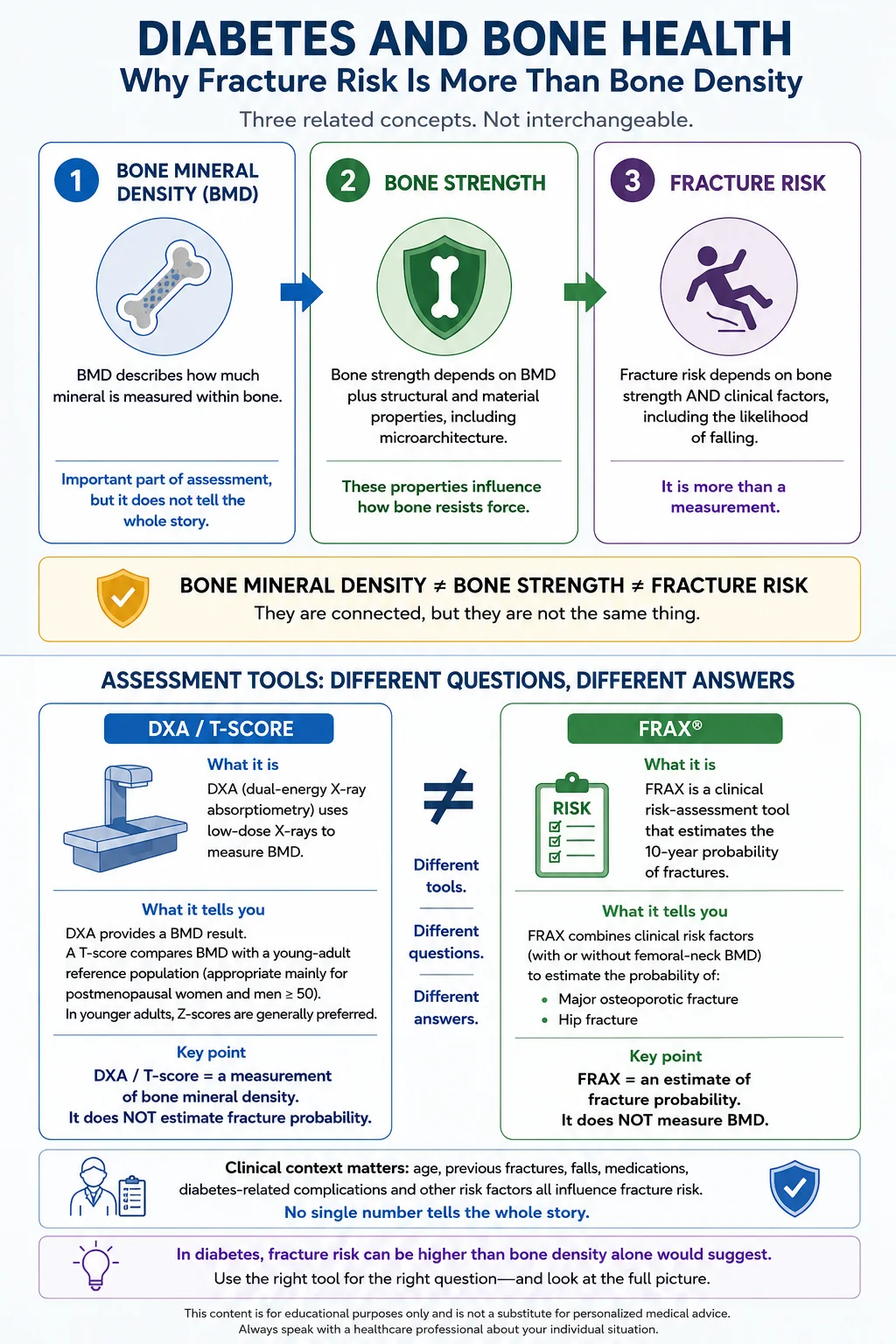
The key is to keep three related concepts separate: bone mineral density, bone strength and fracture risk.
They are connected, but they are not interchangeable.
How Does Healthy Bone Maintain Itself?
Bone is constantly renewed.
Bone Is Living Tissue
Specialized cells help maintain the skeleton.
Osteoclasts remove older bone tissue, while osteoblasts form new bone.
What Is Bone Remodeling?
The coordinated cycle of bone removal and formation is called bone remodeling.
This is a normal process that helps maintain skeletal structure over time.
What Is Bone Mineral Density?
Bone mineral density (BMD) describes the amount of mineral measured within bone.
BMD is an important part of fracture-risk and osteoporosis assessment, but it does not describe every property that contributes to bone strength.
Bone Density Is Not the Same as Bone Strength
Bone strength depends partly on mineral density, but also on structural and material properties.
One of those properties is bone microarchitecture—the microscopic organization of bone.
BMD matters. It simply does not tell the whole story.
How Can Diabetes Affect Bone Health?
Type 1 and type 2 diabetes do not have identical skeletal patterns.
Type 1 Diabetes and Bone Density
Type 1 diabetes is associated with increased fracture risk, and lower BMD can be part of the skeletal pattern.
But BMD does not fully explain the higher fracture risk seen in type 1 diabetes.
Why BMD Does Not Tell the Whole Story in Type 2 Diabetes
Type 2 diabetes is different.
People with type 2 diabetes can have relatively high BMD while still having reduced bone strength, impaired microarchitecture and increased fracture risk.
That does not mean DXA or BMD is unreliable. It means a BMD result should be interpreted as one part of a broader fracture-risk picture.
Why Can Fracture Risk Increase Even When BMD Is Not Low?
A fracture depends on more than bone density.
Bone Strength Includes More Than Mineral Density
Microarchitecture and other structural properties influence how bone responds to force.
Diabetes-related skeletal changes may affect some of these properties in ways that are not fully captured by a conventional BMD measurement.
Falls Also Matter
Fracture risk depends not only on the skeleton but also on the likelihood of falling.
Diabetes-related complications such as peripheral neuropathy, vision problems, hypoglycemia and impaired balance can increase fall risk in some people.
Within bone health, their role is simple: they can affect exposure to falls, and therefore influence overall fracture risk.
How Is Bone Mineral Density Measured?
The standard technique used to measure BMD is dual-energy X-ray absorptiometry, usually abbreviated DXA.
What Is a DXA Scan?
DXA uses low-dose X-rays to estimate bone mineral density at clinically relevant skeletal sites.
It measures BMD. It does not directly measure every aspect of bone strength or predict an individual's future fracture by itself.
What Does a T-Score Mean?
In populations where T-scores are appropriate, a T-score compares measured BMD with a young-adult reference population.
T-scores are preferred for postmenopausal women and men age 50 and older. In younger adults, Z-scores are generally preferred for BMD reporting.
A T-score describes BMD relative to a reference. It is not the same as a direct measurement of fracture probability.
Why BMD Results Need Context in Diabetes
In type 2 diabetes, a BMD or T-score may not fully reflect all of the factors that contribute to fracture risk.
The result remains useful; it simply needs clinical context.
What Is FRAX?
FRAX is a clinical risk-assessment tool that estimates the probability of certain fractures over the next 10 years.
FRAX Estimates Fracture Probability
FRAX combines clinical risk factors and, when available, femoral-neck BMD to estimate the probability of:
- a major osteoporotic fracture
- a hip fracture
FRAX Has Limitations in Type 2 Diabetes
Standard FRAX does not directly include type 2 diabetes as an independent risk factor.
Current diabetes guidance notes that FRAX can underestimate fracture risk in people with type 2 diabetes.
Clinicians may take that limitation into account when interpreting risk. This is not something readers should try to “correct” by modifying FRAX inputs on their own.
How Is Fracture Risk Assessed in Someone With Diabetes?
No single measurement tells the whole story.
BMD provides information about mineral density.
A T-score describes BMD relative to a reference population when that scoring system is appropriate.
FRAX estimates fracture probability using clinical risk factors.
A person's history—including previous fractures, falls, age, medications and diabetes-related complications—adds information that none of those measurements can replace.
Previous Fractures Matter
A previous low-trauma or fragility fracture is an important predictor of future fracture risk.
For that reason, fracture history is part of clinical bone-health assessment, not simply an event to record after the fact.
When Should Bone Health Be Discussed With a Healthcare Professional?
Bone-health assessment depends on age, sex, fracture history and other clinical risk factors.
Current diabetes guidance recommends fracture-risk assessment as part of routine care in older adults with diabetes and BMD monitoring with DXA in adults age 65 and older, as well as selected younger adults with multiple risk factors.
ISCD guidance also bases BMD testing on age, fracture history and clinical risk factors rather than diabetes alone.
That means there is no single universal DXA schedule for every person with diabetes.
A previous fracture, recurrent falls or additional risk factors may justify earlier or more focused evaluation.
The Bigger Picture: Bone Density, Bone Strength and Fracture Risk
BMD describes how much mineral is measured within bone.
BONE STRENGTH
Bone strength depends on BMD plus structural and material properties that help bone resist force.
FRACTURE RISK
Fracture risk depends on bone strength and clinical factors, including the likelihood of falling.
BONE MINERAL DENSITY ≠ BONE STRENGTH ≠ FRACTURE RISK
The assessment tools also answer different questions:
DXA → measures BMD
T-score → describes BMD relative to a reference population
FRAX → estimates fracture probability
These are related concepts and tools, not interchangeable measurements and not stages of bone disease.
That distinction is especially useful in diabetes, where fracture risk can be higher than bone density alone would suggest.
Sources & Medical References
- American Diabetes Association — Standards of Care in Diabetes—2026: Comprehensive Medical Evaluation and Assessment of Comorbidities
- International Society for Clinical Densitometry — Official Adult Positions
- NIDDK — Can Diabetes Lead to Bone Problems?
Published: September 1, 2026 · Last reviewed: September 1, 2026