Bad breath is easy to notice as a concept but not always easy to interpret.
Breath odor can change temporarily after certain foods or under other everyday circumstances. Persistent or recurrent unpleasant breath odor, however, raises a different question: where is the odor actually coming from?
That question is more complicated than it may appear.
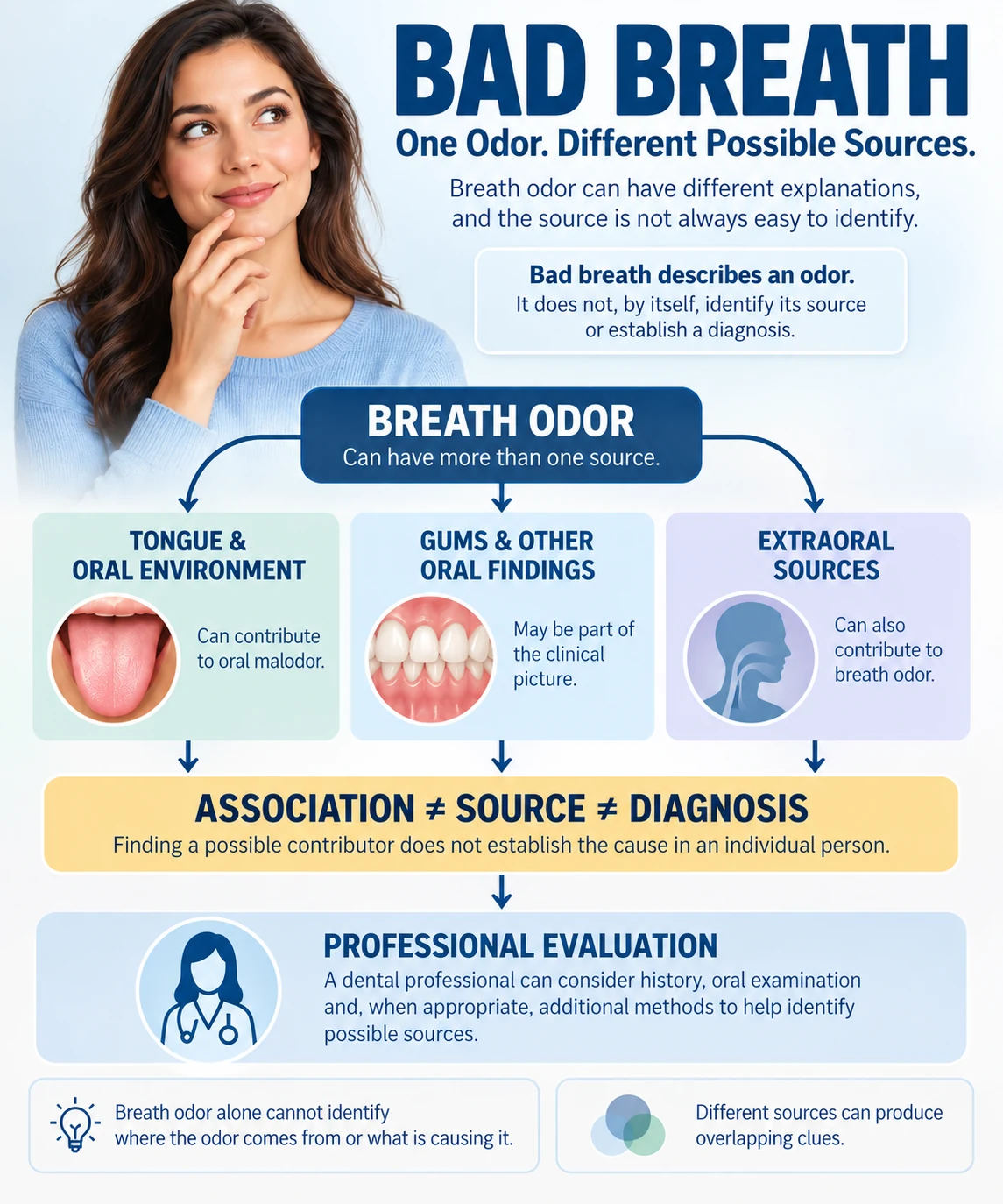
Different oral conditions can contribute to malodor, and extraoral sources are also possible. Tongue coating, periodontal conditions, changes in saliva, and other factors may enter the clinical picture, but finding one possible contributor does not establish the cause in an individual person.
What Is Halitosis?
Halitosis is a term used for unpleasant breath odor. The terms bad breath and oral malodor are also commonly encountered, although clinical classification can distinguish different forms and origins of the problem.
That matters because not every episode of unpleasant breath represents the same situation.
Is Bad Breath the Same as Halitosis?
In everyday language, bad breath is commonly used broadly.
Halitosis is the clinical term frequently used when discussing unpleasant breath odor, its classification, causes, diagnosis, and management.
The terminology should not be turned into a home diagnostic threshold. Someone noticing temporary breath odor after a particular exposure has not thereby established that they have a persistent clinical problem.
Temporary Breath Odor vs. Persistent Halitosis
Breath odor can be temporary. Food and other short-lived influences may change how breath smells.
When malodor is persistent or recurrent, its pattern and possible source become more relevant to clinical evaluation.
Where Does Bad Breath Come From?
Halitosis does not have one universal source.
In many situations, malodor originates within the oral cavity. Clinical literature also recognizes extraoral origins, making it important not to assume that every person with bad breath has the same underlying explanation.
Oral Sources of Breath Odor
Several oral factors can contribute to malodor.
The tongue dorsum and periodontal environments are among the sites considered during evaluation, while saliva, oral deposits, and microbial metabolism can influence the conditions in which odor-related compounds are produced.
This does not mean that seeing plaque, noticing tongue coating, or having another oral finding proves where an individual's breath odor originates.
What Are Volatile Sulfur Compounds (VSCs)?
Volatile sulfur compounds, or VSCs, are among the substances frequently studied in oral malodor.
Certain sulfur-containing gases produced through microbial metabolism can contribute to unpleasant breath odor.
VSCs are among the compounds commonly measured in halitosis research and assessment. Their measurement can provide information about selected odor-related compounds, but it does not identify the underlying cause of bad breath.
Can Bad Breath Have an Extraoral Source?
Yes. Although oral origins are common, extraoral sources of malodor are recognized.
That distinction is important because it prevents two opposite mistakes:
Determining whether a suspected source is oral or extraoral requires clinical context rather than interpreting the odor alone.
Why Can the Tongue Contribute to Bad Breath?
The tongue provides a large and complex oral surface.
Material and microbial communities can accumulate particularly on its dorsal surface, and tongue-associated biofilm is one recognized contributor to intraoral malodor.
That relationship, however, should not be simplified into a rule that visible coating automatically explains a person's bad breath.
Tongue Coating and Oral Malodor
Microbial metabolism within tongue-associated deposits can contribute to compounds involved in oral malodor.
This makes the tongue relevant when oral sources are being considered.
It does not mean that every coated tongue produces clinically important halitosis, nor that every person with halitosis has tongue coating as the primary source.
Why Tongue Coating Does Not Prove the Cause
A visible finding and an etiologic conclusion are different things.
Someone can have tongue coating while other oral factors are also present. Likewise, the intensity or appearance of a coating cannot be converted into a reliable home test for the source of breath odor.
Can Plaque or Gum Problems Be Associated With Bad Breath?
Yes.
Periodontal disease can be associated with persistent bad breath. That relationship needs careful interpretation.
Bad breath is not a diagnostic test for periodontal disease, and periodontal disease cannot be established from breath odor alone.
Why an Association Does Not Establish the Individual Cause
Different oral conditions can coexist.
A person may have plaque, gingival changes, tongue coating, dry mouth, or other findings at the same time. Identifying one of those findings does not establish that it is responsible for the odor.
Periodontal diagnosis requires evaluation of the gums and supporting tissues rather than diagnosis from odor.
Can Dry Mouth Be Associated With Bad Breath?
Yes, but the relationship should not be reversed.
Dry mouth can occur alongside changes in the oral environment and may be associated with bad breath.
That does not mean bad breath establishes that someone has dry mouth.
Why Bad Breath Does Not Mean You Have Dry Mouth
Saliva has several roles in the mouth, including moistening oral tissues and helping clear food particles.
Changes in salivary conditions can therefore affect the oral environment, but bad breath has multiple possible explanations.
Determining whether dry mouth is present and why it is occurring belongs to a separate clinical assessment.
Why Can Bad Breath Persist Even After Brushing?
Brushing the teeth addresses only part of the oral environment.
Because breath odor can have different sources and contributors, the fact that odor remains after brushing does not identify what is responsible.
It also does not prove that brushing was ineffective or that the person has poor oral hygiene.
Why Brushing Response Does Not Identify the Source
If breath odor improves after brushing, that does not prove exactly what produced it.
If breath odor remains after brushing, that does not prove that it comes from the tongue, gums, dry mouth, stomach, or another specific source.
Why Masking Breath Odor Is Different From Identifying Its Cause
An odor can sometimes be temporarily changed or masked without its source being identified.
That distinction matters because what makes breath smell different and what explains why the odor was present are separate questions.
A temporary change in smell therefore should not be used as evidence that an underlying cause has been found or resolved.
Does Bad Breath Mean the Problem Comes From Your Stomach?
No such conclusion can be made from breath odor alone.
The idea that persistent bad breath automatically indicates a stomach problem is too simplistic.
Clinical classifications distinguish intraoral from extraoral halitosis. Extraoral sources do exist, but they form a different diagnostic territory.
Oral vs. Extraoral Sources of Halitosis
When the source is intraoral, the relevant factors originate within the mouth.
When an extraoral origin is suspected, the evaluation may need to consider other clinical information and, depending on the situation, medical assessment.
The distinction cannot be made simply by deciding that an odor “smells like” it comes from a particular organ.
Why Breath Odor Cannot Identify an Internal Disease
Odor is not a disease-specific diagnostic code.
Different substances can contribute to breath odor, and different conditions can produce overlapping observations.
For that reason, this article does not use rules such as “this smell = this disease.”
A particular odor cannot by itself diagnose a gastrointestinal, metabolic, respiratory, renal, hepatic, or other systemic condition.
Can You Reliably Tell If You Have Bad Breath Yourself?
Self-perception has limitations.
A person's concern about breath odor does not always correspond closely with findings obtained through clinical assessment or instrumental measurement.
That does not mean a person's concern should be dismissed. It means perception and measurement answer different questions.
Why Self-Perception Has Limitations
Judging one's own breath consistently can be difficult. Research comparing self-perceived and clinically assessed halitosis also shows that perception and measured findings do not always align.
At the same time, another person's impression is still an observation, not an explanation of the source.
Neither self-perception nor feedback from someone else can establish why malodor is present.
Why Smell Does Not Reveal the Cause
Smelling an odor answers a limited question: Is an odor perceived?
It does not independently answer: Where did it originate? or What clinical condition, if any, explains it?
That distinction is central to evaluating halitosis responsibly.
How Is Halitosis Professionally Evaluated?
Halitosis assessment can involve more than one type of information.
Clinical guidance emphasizes classification, history, etiologic assessment, and diagnostic methods rather than reliance on a single observation.
History and Oral Examination
A professional assessment may consider when the odor occurs, whether it is persistent or intermittent, relevant oral symptoms and findings, health history, and other circumstances.
Oral examination can help identify findings that may be relevant.
The presence of a possible contributor still needs to be interpreted in context.
Organoleptic Assessment
Organoleptic assessment involves an examiner evaluating perceived breath odor using the sense of smell.
Organoleptic assessment has commonly been used as a reference method in halitosis research and clinical assessment, but it remains subjective and method-dependent.
Its role should therefore not be interpreted as examiner smells breath → cause diagnosed. Those are two different steps.
VSC Measurement and Gas Analysis
Instrumental approaches can measure gases associated with oral malodor.
Sulfur monitors and gas-chromatography-based methods can provide quantitative information about particular volatile compounds.
But a device measures what it was designed to detect. It does not automatically identify every odor-producing compound or determine the underlying clinical cause.
Studies comparing instrumental measurements with organoleptic assessment have found that the methods do not correspond perfectly.
Why One Measurement Does Not Provide the Whole Explanation
Different assessment methods capture different pieces of information.
An organoleptic assessment evaluates perceived odor. Some instruments quantify selected gases. Clinical examination searches for relevant findings. History provides context.
Those pieces may complement one another. They are not interchangeable.
One measurement ≠ complete explanation.
When Should Persistent Bad Breath Be Professionally Evaluated?
Persistent or recurrent bad breath can be discussed with a dental professional, particularly when the source is unclear or when other oral changes or symptoms are present.
The purpose is not simply to confirm that an odor exists. Evaluation can help determine whether there is an oral source that requires attention and whether additional assessment is appropriate.
Persistent bad breath can occur in periodontal disease, for example, but its presence does not diagnose periodontal disease. Bad breath can also accompany dry mouth without establishing dry mouth as its cause.
The clinically useful question is therefore not:
“What disease does this smell mean?”
It is:
The Bottom Line
Bad breath can have different explanations.
Halitosis can have intraoral or extraoral origins, with intraoral sources playing a major role in clinical classifications and evaluation.
Tongue-associated biofilm, periodontal conditions, salivary changes, and other factors can contribute to the clinical picture without any single finding automatically identifying the individual cause.
Likewise, neither brushing response, tongue appearance, dry mouth symptoms, gum problems, self-perception, nor one breath measurement should be converted into a stand-alone diagnostic rule.
Sources & References
- Clinical Practice Guideline for the Diagnosis and Treatment of Halitosis — PubMed
- Systematic review of halitosis prevalence and possible risk factors — PubMed
- Tongue coating and its relationship with oral malodor — PubMed
- Systematic review comparing halitometers with organoleptic assessment — PubMed
- National Institute of Dental and Craniofacial Research — Gum Disease
- National Institute of Dental and Craniofacial Research — Dry Mouth
Last updated: September 20, 2026.