Grinding your teeth or realizing that you frequently clench your jaw can raise an obvious question: does this mean you have bruxism?
Bruxism is commonly associated with teeth grinding, but the concept is broader than grinding alone. It includes jaw-muscle activities that can occur while a person is awake or during sleep, and those two forms are defined separately because their patterns of activity differ.
Some people become aware of grinding or clenching themselves. Others may notice jaw discomfort, changes in their teeth, or learn about nighttime grinding from someone else. None of these findings, however, establishes bruxism or its cause on its own.
Understanding bruxism therefore requires separating the activity itself from the symptoms, dental changes, and possible associated factors that may accompany it.
What Is Bruxism?
Bruxism is an umbrella term for jaw-muscle activities that can occur during sleep or wakefulness.
Sleep bruxism and awake bruxism are defined separately because their patterns of muscle activity differ.
Grinding and clenching are two familiar ways bruxism may be described, but the concept should not be reduced to teeth repeatedly grinding against each other.
Why Bruxism Is More Than Teeth Grinding
The everyday phrase teeth grinding captures only part of the bruxism spectrum.
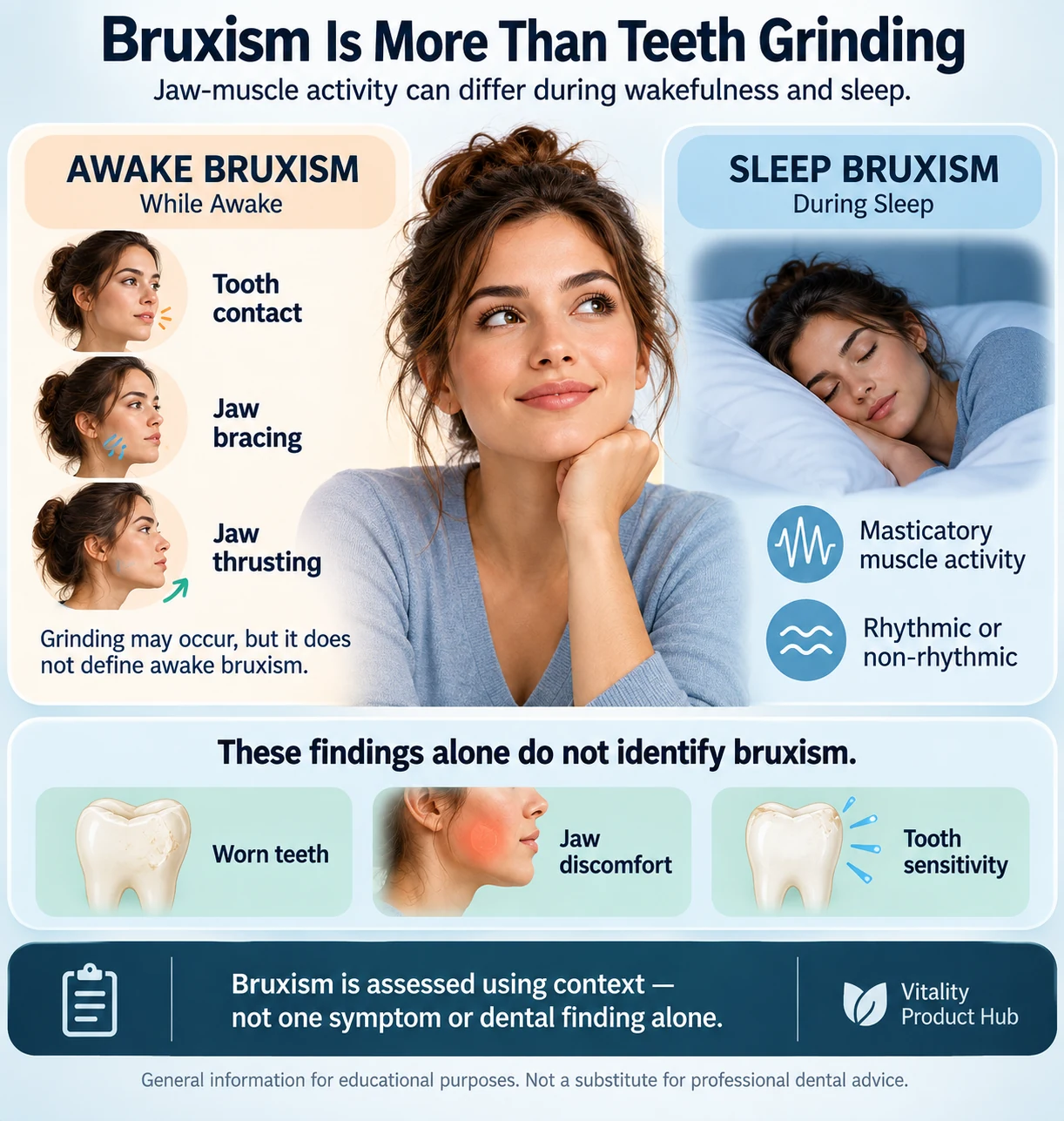
Clenching can occur without obvious grinding. During wakefulness, bruxism-related activity can also involve repetitive or sustained tooth contact or bracing or thrusting of the jaw.
Grinding appears to be much less prominent in awake bruxism than the popular phrase teeth grinding might suggest.
For that reason, someone does not have to hear or notice grinding for bruxism-related jaw-muscle activity to be relevant.
At the same time, noticing tooth contact, jaw tension, or another isolated behavior does not by itself establish clinically relevant bruxism.
Awake Bruxism vs. Sleep Bruxism: What’s the Difference?
Awake bruxism occurs during wakefulness and can involve repetitive or sustained tooth contact and/or bracing or thrusting of the jaw.
Sleep bruxism occurs during sleep and involves masticatory muscle activity that may be rhythmic or non-rhythmic.
These definitions describe different patterns of jaw-muscle activity rather than simply dividing one identical behavior into “day” and “night.”
This is why teeth grinding at night should not be used as a complete definition of bruxism.
What Can Bruxism Look Like?
Bruxism does not have one presentation that applies to everyone.
Grinding may be noticeable in some people. Clenching or other jaw-muscle activity may be more relevant in others. Some people may have no obvious symptoms and may not initially be aware that the activity is occurring.
Possible consequences and associated complaints can also vary.
Grinding, Clenching, and Other Jaw-Muscle Activity
Current bruxism terminology extends beyond the familiar descriptions of grinding and clenching.
Particularly in awake bruxism, bracing or thrusting of the jaw may occur without tooth contact.
This helps explain why defining bruxism only by visible or audible grinding can miss part of the activity being described.
Why You May Not Realize It Is Happening
Sleep bruxism occurs when a person is asleep, so awareness can be limited. Another person may sometimes notice grinding sounds before the individual does.
During wakefulness, people may also become aware of clenching, sustained tooth contact, or jaw bracing only after paying attention to when the activity occurs.
Dental findings or symptoms may sometimes lead to further evaluation.
But lack of awareness does not establish that bruxism is present, just as becoming aware of jaw tension does not establish it on its own.
What Factors May Be Associated With Bruxism?
There is no single explanation that accounts for bruxism in every person.
Research has examined psychosocial, behavioral, biological, sleep-related, medication-related, and substance-related factors, among others. Which factors are relevant may differ between awake and sleep bruxism and between individuals.
That makes statements such as “stress causes teeth grinding” too simple to describe the evidence.
Why There Is Not One Single Cause of Bruxism
Bruxism is understood within a multifactorial context rather than as the result of one universal cause.
A factor associated with bruxism does not necessarily explain why the activity occurs in a particular individual. Multiple influences may also coexist.
The distinction between awake and sleep bruxism matters here as well, because findings associated with one form should not automatically be assumed to apply identically to the other.
Stress, Sleep, Substances, Medications, and Other Associated Factors
Stress and anxiety are frequently discussed in relation to bruxism, particularly awake bruxism, but an association is not proof that stress caused an individual's grinding, clenching, or jaw activity.
Sleep-related factors are also relevant when sleep bruxism is being considered.
Alcohol, caffeine, tobacco use, and certain medications have been identified or investigated as possible associated factors in some contexts.
These associations should not be converted into individual causal conclusions. A person who drinks coffee, takes a particular medication, feels stressed, or has disrupted sleep cannot determine from that fact alone why bruxism-related activity may be occurring.
Can Bruxism Affect the Teeth?
Dental wear or damage can occur in people with bruxism.
These findings, however, are not specific to bruxism and do not establish what caused the dental change.
Tooth Wear, Cracks, and Other Possible Dental Effects
Dental professionals may consider findings such as tooth wear, cracks, chips, or other damage when evaluating someone with suspected bruxism.
Those findings need to be interpreted within the broader clinical context.
A worn or damaged tooth is therefore a finding that deserves explanation — not evidence of one predetermined explanation.
Why Worn Teeth Do Not Prove Bruxism
Tooth wear has more than one possible contributor.
Chemical and mechanical influences can occur separately or interact, and the appearance of worn tooth structure does not reliably identify which process produced it.
Our guide to tooth erosion and erosive tooth wear explains how acid-related processes can contribute to structural tooth wear and why not every worn tooth represents erosion.
The same diagnostic boundary works in the other direction: not every worn tooth represents bruxism either.
Can Bruxism Cause Jaw Pain or Headaches?
Jaw soreness, tightness, muscle fatigue, and headache can occur in people with bruxism.
These symptoms are clinically relevant, but they are not specific to bruxism.
A person experiencing jaw pain or recurrent headaches therefore cannot determine from the symptom alone whether grinding, clenching, another jaw-related condition, or something else is responsible.
Jaw Soreness, Tightness, and Muscle Fatigue
Because bruxism involves masticatory muscle activity, discomfort or fatigue in the jaw muscles may sometimes accompany it.
Some people may notice tightness or soreness in association with grinding or clenching.
But the presence of muscle discomfort does not establish its source.
Why Jaw Pain or Headache Cannot Identify the Cause
Jaw pain and headache have multiple possible explanations.
Even when they occur in someone who grinds or clenches, that coexistence does not automatically establish that bruxism produced the symptom.
Professional assessment can consider the timing and pattern of symptoms, dental findings, jaw function, health history, and other relevant information rather than treating pain as a stand-alone diagnostic marker.
Can Bruxism Make Teeth Feel Sensitive?
Tooth sensitivity can occur in a person who also has bruxism, particularly when dental wear or damage is present.
But sensitivity is not a defining sign of bruxism.
The symptom can arise for multiple dental reasons, so its presence cannot identify grinding or clenching as the cause.
How Dental Wear or Damage May Be Relevant
When dental wear or damage and tooth sensitivity occur together, those findings need to be interpreted in the broader dental context.
That is different from concluding that bruxism explains every sensitive tooth.
Why Tooth Sensitivity Does Not Mean You Have Bruxism
Cold, heat, sweetness, acidity, air, or touch can provoke sensitivity for different reasons.
Our guide to sensitive teeth and dentin hypersensitivity explains why a trigger cannot identify the underlying dental cause.
The same boundary applies here: sensitive teeth do not diagnose bruxism.
Is Sleep Bruxism the Same as Sleep Apnea?
No.
Sleep bruxism and obstructive sleep apnea are different phenomena.
Research has examined possible relationships and coexistence between sleep bruxism and sleep-related breathing disorders, but the presence of one should not be used to establish the other.
Why These Are Different Conditions
Sleep bruxism concerns masticatory muscle activity during sleep.
Obstructive sleep apnea involves repeated episodes of upper-airway obstruction during sleep and has its own clinical assessment and diagnostic framework.
The fact that both occur during sleep does not make them equivalent.
Why Teeth Grinding Cannot Diagnose a Sleep Disorder
Grinding sounds can indicate that jaw activity is occurring during sleep.
They cannot establish whether a sleep-related breathing disorder is present.
Concerns about a possible sleep disorder require appropriate professional assessment.
That keeps an observation about the teeth or jaw from being converted into a medical diagnosis.
How Is Bruxism Evaluated?
Bruxism assessment can draw on more than one type of information.
Self-report, clinical assessment, observations from others, and instrumental methods can provide different kinds of evidence. Which methods are appropriate depends on the situation and whether awake or sleep bruxism is being evaluated.
No single symptom or visible dental change should be treated as a universal home test for bruxism.
What Dental and Health History Can Contribute
A clinician may consider information about grinding or clenching, jaw discomfort, dental changes, sleep, medications, substances, and other health or behavioral factors that could be relevant.
A dental examination can also provide information about the teeth, restorations, oral structures, and jaw-related findings.
These pieces of information provide context. They should not be converted into a checklist in which a certain number of findings automatically establishes bruxism.
Clinical Assessment, Self-Report, and Instrumental Methods
Self-report can provide information about behaviors a person notices while awake or events reported by someone else during sleep.
Clinical findings provide another type of information.
Instrumental approaches can be used in some settings to measure aspects of muscle activity or sleep-related events more directly.
These approaches provide different forms of evidence rather than interchangeable versions of a single test.
Do Night Guards Stop Bruxism?
Oral appliances are commonly discussed when bruxism is associated with concern about dental damage.
But an important distinction is often lost:
Protecting the Teeth Is Not the Same as Eliminating Bruxism
An oral appliance may be used to help protect teeth from damage by separating opposing dental surfaces.
That protective role should not automatically be described as eliminating the underlying jaw-muscle activity.
A night guard therefore should not be presented as a guaranteed “cure” for bruxism.
Why Management Depends on the Individual Situation
Not every person with bruxism has the same symptoms, consequences, associated factors, or clinical needs.
Whether an oral appliance or another management approach is appropriate depends on the individual clinical situation.
The goal is to address what is actually relevant to that person rather than assuming that everyone described as having bruxism requires the same intervention.
When Should Teeth Grinding or Jaw Clenching Be Professionally Evaluated?
Grinding or clenching associated with persistent or concerning jaw discomfort, dental damage, increasing tooth wear, significant sensitivity, or other concerning symptoms is a reasonable reason to discuss the issue with a dental professional.
Evaluation may also be useful when someone repeatedly notices — or is told about — grinding or clenching and is concerned about possible effects.
When symptoms raise questions beyond dentistry, such as concern about a possible sleep disorder, an appropriate health professional may also need to be involved.
The purpose of evaluation is not simply to attach the label bruxism to a symptom or worn tooth. It is to understand the pattern of activity, possible consequences, and whether further assessment or management is appropriate.
The Bottom Line
Bruxism is an umbrella term for jaw-muscle activities that can occur during wakefulness or sleep. Teeth grinding is one familiar manifestation, but bruxism is broader than grinding alone.
Sleep bruxism should not be treated as another name for sleep apnea. Likewise, protecting teeth with an oral appliance is not the same as demonstrating that bruxism has been eliminated.
Understanding those distinctions provides a more useful foundation for professional assessment than trying to identify bruxism from a single symptom, behavior, or visible dental change.
Sources & References
- PubMed PMID 40312776 — Updating the Bruxism Definitions: Report of an International Consensus Meeting
- PubMed PMID 29926505 — International consensus on the assessment of bruxism
- PubMed PMID 36597658 — Standardised Tool for the Assessment of Bruxism (STAB)
- PubMed PMID 36079013 — Current knowledge on awake bruxism assessment
- National Institute of Dental and Craniofacial Research — Bruxism
- PubMed PMID 41192107 — Sleep-related bruxism and the ICSD-3-TR framework
Last updated: September 18, 2026.