Changes in the surface, shape, or sensitivity of a tooth can raise a simple question: is the enamel wearing away?
One possible explanation is tooth erosion. But erosion is not another name for every kind of enamel loss, tooth wear, or tooth decay.
Tooth erosion involves an acid-related process affecting mineralized tooth structure. In clinical discussions, you may also see terms such as dental erosion, enamel erosion, and erosive tooth wear. These terms are related, but understanding what they describe — and what they do not — can make the topic much clearer.
This article explains how tooth erosion develops, what can contribute to it, how it differs from tooth decay and demineralization, and why changes in a tooth's appearance or sensitivity cannot identify the cause on their own.
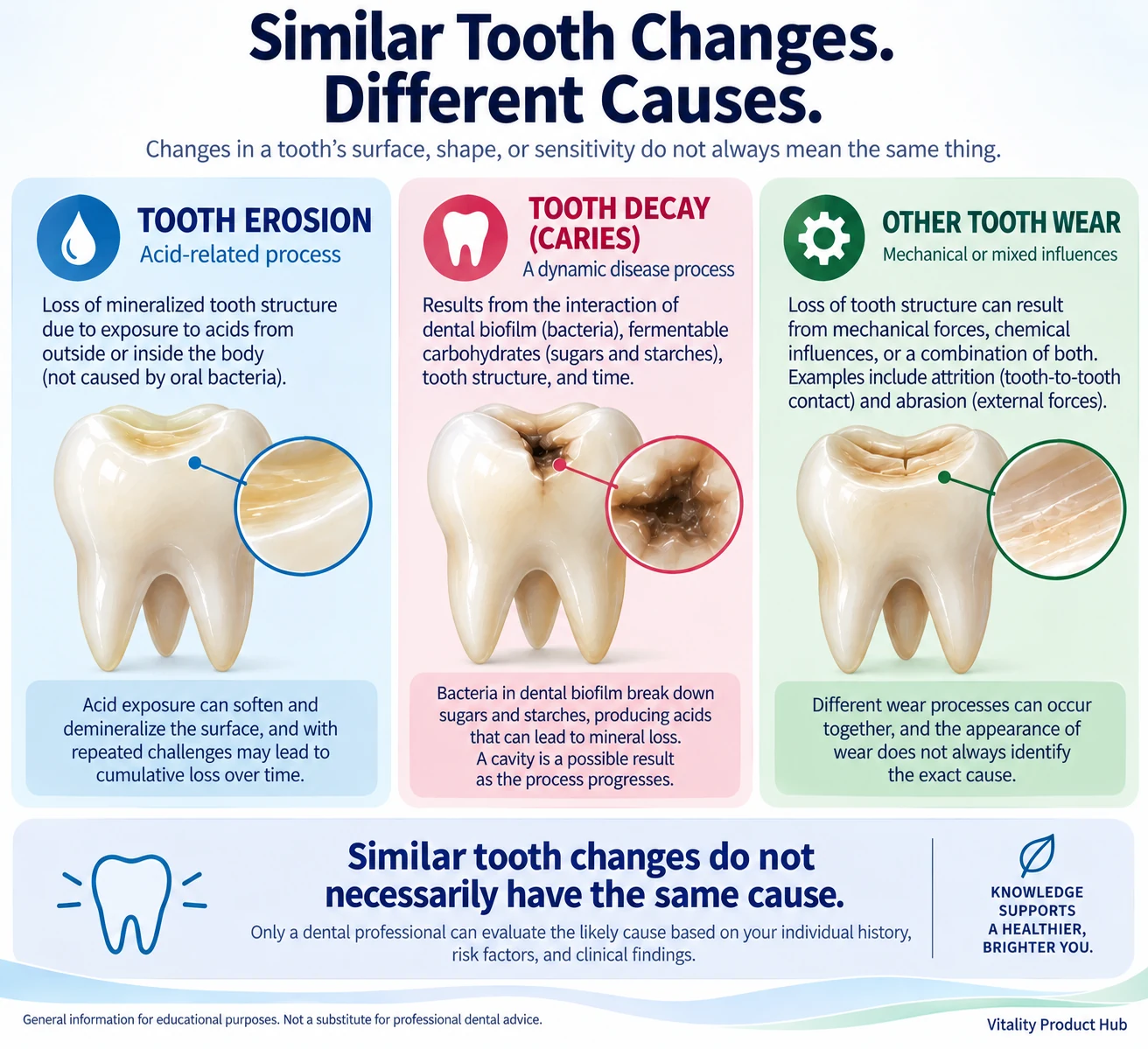
What Is Tooth Erosion?
Dental erosion, also called tooth erosion, involves chemical loss of mineralized tooth structure associated with exposure to acids that are not produced by oral bacteria.
The process can begin with acid-related softening and demineralization of the tooth surface. With repeated erosive challenges and mechanical influences, this can contribute to cumulative loss of hard dental tissue.
That distinction matters because tooth erosion is not simply another term for tooth decay or a cavity.
Why “Enamel Erosion” Is Commonly Used
Enamel is the hard outer layer covering the crown of a tooth, so the phrase enamel erosion is often used when discussing acid-related surface changes.
But the effects of erosive tooth wear are not necessarily limited to enamel. As structural loss progresses, dentin can become involved as well. More advanced erosive wear may therefore be associated with changes in tooth shape and, in some people, dentin hypersensitivity.
For that reason, tooth erosion or erosive tooth wear can describe the broader process more accurately than thinking only about enamel.
What Erosive Tooth Wear Means
Experts use the term erosive tooth wear to describe cumulative loss of hard dental tissue in a process involving chemical and mechanical influences.
This wording is useful because what ultimately becomes visible on a tooth is not necessarily the result of acid acting in isolation. Mechanical forces can interact with an acid-softened surface and contribute to tissue loss.
How Does Tooth Erosion Develop?
Tooth erosion should not be understood simply as the formation of a cavity or a visible hole in a tooth.
Instead, acidic exposure can alter mineralized tooth surfaces. The early process includes surface softening and erosive demineralization. Repeated challenges can eventually contribute to loss of surface volume and natural tooth contour.
What Acid Exposure Does to the Tooth Surface
When an erosive acid contacts the tooth, mineral can dissolve from hard dental tissue.
But there is no single pH number that tells us whether every food, beverage, or exposure will produce erosion. The erosive potential of an exposure depends on more than pH alone, including chemical composition and buffering characteristics. Frequency and pattern of exposure also matter.
So a simple rule such as “anything acidic erodes enamel” does not accurately describe the process.
From Surface Softening to Structural Tooth Wear
An early erosive challenge can leave the tooth surface softened.
If erosive challenges continue, and the softened surface is repeatedly exposed to mechanical forces, progressive tissue loss may occur. Over time, the natural morphology and contour of affected teeth can change.
Once mineralized tooth structure has been physically lost, that established structural loss should not be confused with a surface that still has potential for mineral gain.
What Can Contribute to Tooth Erosion?
Tooth erosion is considered multifactorial. Acid exposure may come from outside the body or from inside the body, and the presence of one possible contributor does not establish why an individual tooth has changed.
Dietary and Other External Acid Exposures
Diet is an important source of extrinsic acid exposure.
Frequent exposure to some acidic beverages and foods can increase erosive challenges to the teeth. Consumption pattern, frequency, duration of contact, and the chemical properties of what is consumed can all influence erosive potential.
Environmental or occupational exposure to acidic substances can also contribute in some circumstances.
This does not mean that eating or drinking something acidic proves that erosion is occurring. Individual risk depends on a combination of exposures and modifying factors.
Gastric Acid and Other Internal Sources
Acid can also reach the mouth from the stomach.
Gastroesophageal reflux and recurrent vomiting are among the recognized possible sources of intrinsic acid exposure associated with erosive tooth wear.
However, tooth erosion cannot diagnose reflux, recurrent vomiting, an eating disorder, or another medical condition.
A dental professional may consider health history, clinical findings, and potential risk factors when evaluating erosive tooth wear. A pattern seen on the teeth alone does not establish the underlying medical cause.
Tooth Erosion vs. Tooth Decay: What’s the Difference?
Tooth erosion and tooth decay can both involve mineralized tooth structure, but they are not the same process.
Dental erosion is characterized by acid dissolution in which acids of bacterial origin are not the defining cause. Dental caries is a dynamic disease process involving interactions among tooth structure, dental biofilm, fermentable carbohydrates, and time.
That distinction is why erosion should not be used as another word for tooth decay or cavities.
Why Erosion and Caries Are Different Processes
In erosion, the erosive acid challenge comes from intrinsic or extrinsic sources rather than bacterial acid production being the defining mechanism.
In dental caries, acids produced within dental biofilm following metabolism of fermentable carbohydrates can contribute to repeated episodes of mineral loss.
Both processes involve mineral changes, but their biological context is different.
For a closer look at the caries process, see our guide to tooth decay and cavities.
Why a Cavity Is Not Another Name for Tooth Erosion
Dental caries is a dynamic disease process. A cavity is one possible structural result of that process.
Erosive tooth wear can also result in structural loss, but that does not make an area of erosive wear a caries cavity.
Visible loss of tooth structure therefore does not, by itself, tell you which process produced it.
Is Tooth Erosion the Same as Enamel Demineralization?
No.
Demineralization describes mineral loss from dental tissue. Tooth erosion involves an erosive process in which acid exposure can cause surface demineralization and softening and, with continued challenges and wear, contribute to structural loss.
That means the concepts overlap, but they are not interchangeable.
Where Demineralization Fits Into the Erosive Process
During an erosive challenge, acids can dissolve mineral from the enamel surface and near-surface region.
This mineral loss is part of the erosive process. But demineralization is a broader concept and also occurs in other dental processes, including caries.
So the presence of demineralization does not automatically establish tooth erosion.
Why Mineral Loss Does Not Always Mean Tooth Erosion
The context of mineral loss matters.
Its cause, location, pattern, surrounding oral environment, and whether structural wear has occurred all contribute to understanding what may be happening.
For a deeper explanation of mineral loss and mineral gain in enamel, see our guide to tooth enamel demineralization and remineralization.
What Changes May Be Seen With Tooth Erosion?
As erosive tooth wear progresses, dental professionals may observe changes in the natural texture, contour, and shape of affected teeth.
Clinical assessment may include findings such as smoother or glossier surfaces, flattening, shallow defects, or cupping on some biting surfaces. Dentin may become exposed in more advanced cases.
These findings can contribute to professional assessment, but they are not a home diagnostic checklist.
Changes in Tooth Shape, Surface, and Appearance
Changes associated with erosive tooth wear may become more apparent as tissue loss accumulates.
However, a tooth that looks smoother, flatter, thinner, or different in color does not prove that erosion is responsible.
Other processes can change the appearance and shape of teeth, which is one reason clinical assessment considers more than appearance alone.
Why Tooth Sensitivity Does Not Identify the Cause
Some people with progressive erosive tooth wear can develop dentin hypersensitivity, particularly when dentin becomes exposed.
But sensitivity is a symptom, not a diagnosis of tooth erosion.
Sensitive teeth can have different explanations, and the fact that cold, heat, touch, or another stimulus causes discomfort cannot establish which process is responsible.
For more on that distinction, see our guide to sensitive teeth and dentin hypersensitivity.
Is All Tooth Wear Caused by Erosion?
No.
Tooth wear is a broader concept than tooth erosion.
Chemical and mechanical influences can contribute to loss of tooth structure. Terms such as attrition, abrasion, and erosion have traditionally been used to describe different contributors to tooth wear, but real-world wear does not necessarily fall into isolated categories.
Why Tooth Wear Can Have More Than One Explanation
Teeth experience mechanical forces throughout life.
Tooth-to-tooth contact, external mechanical influences, and erosive chemical challenges can contribute in different ways to wear.
Therefore, observing worn tooth structure does not establish that acid erosion caused it.
Why Different Wear Processes Can Occur Together
Different contributors to tooth wear can interact.
Acid-softened tooth surfaces may be more vulnerable to subsequent mechanical effects, which helps explain why the term erosive tooth wear acknowledges interaction between chemical and mechanical influences.
This is also why determining likely contributors requires more than identifying a worn-looking area.
Can Lost Enamel Grow Back?
Enamel does not simply regrow after established tooth structure has been physically lost.
That does not mean remineralization is irrelevant. Mineral can be gained in enamel that is still present under appropriate conditions, but remineralization and regeneration of lost enamel structure are different biological concepts.
Remineralization Is Not the Same as Regrowing Lost Enamel
Remineralization concerns mineral gain within enamel that is still present.
It does not mean that missing enamel structure is recreated after it has been physically lost.
Evidence that enamel can undergo remineralization therefore does not mean established erosive tooth wear can simply rebuild itself.
Why Early Surface Changes and Established Structural Loss Are Different
An early erosive challenge can involve softening and demineralization of the tooth surface. Continued erosive and mechanical challenges can eventually remove softened tissue and alter tooth volume and contour.
The important distinction is between mineral changes occurring in tooth tissue that remains present and tooth structure that has already been physically lost.
When Should Tooth Changes Be Evaluated by a Dental Professional?
Changes in tooth shape or surface, persistent or increasing sensitivity, pain, or concern about tooth wear are reasonable reasons to discuss the issue with a dental professional.
Professional evaluation can combine the appearance of the teeth with dental and medical history, possible acid exposures, risk factors, symptoms, and clinical examination. Early erosive tooth wear can also be difficult to recognize because obvious symptoms may be absent.
The purpose of evaluation is not simply to attach the label “erosion” to a worn tooth. It is to understand what processes may be contributing and what next steps, if any, are appropriate. Depending on the individual findings and history, a dental professional may also determine whether assessment outside dentistry should be considered.
The Bottom Line
Tooth erosion is an acid-related process affecting mineralized tooth structure, and erosive tooth wear describes cumulative structural loss that can result as chemical and mechanical influences interact.
Likewise, established structural enamel loss should not be confused with enamel remineralization, and the appearance of erosive wear cannot diagnose reflux or another underlying medical condition.
Understanding those distinctions is more useful than trying to identify the cause from a single symptom or visible change.
Sources & References
- American Dental Association — Dental Erosion
- American Dental Association — Nutrition and Oral Health
- PubMed PMID 27142130 — European consensus on erosive tooth wear
- PubMed PMID 31610535 — Consensus terminology for erosive tooth wear
- National Institute of Dental and Craniofacial Research — Tooth Decay
- National Institute of Dental and Craniofacial Research — The Tooth Decay Process
- PubMed PMID 33350551 — Best evidence consensus on tooth wear
Last updated: September 18, 2026.