A cracked tooth can be difficult to recognize because cracks do not always produce the same symptoms. Some people may notice pain while chewing or sensitivity to temperature, while others may have symptoms that come and go or are difficult to trace to a particular tooth.
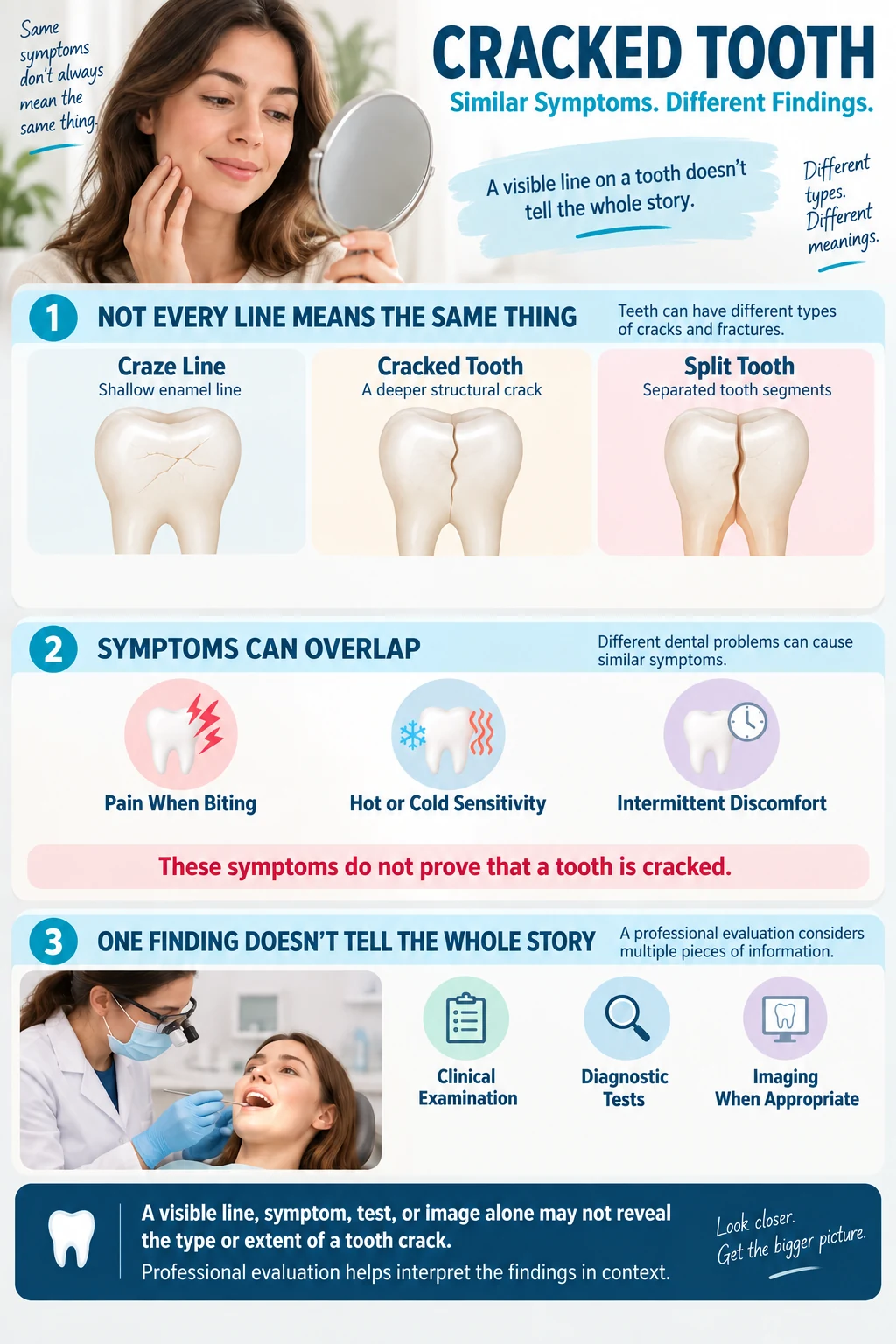
Those symptoms do not prove that a tooth is cracked. Pain when biting and temperature sensitivity can occur in other dental situations, and a visible line does not by itself reveal the type, location, or extent of a crack.
Understanding cracked teeth therefore requires separating three questions: What kind of structural change is present? What symptoms, if any, accompany it? And what can a professional evaluation establish?
What Is a Cracked Tooth?
Dental professionals distinguish among several types of cracks and fractures based on features such as where they occur and how much of the tooth is involved. Common classifications include craze lines, fractured cusps, cracked teeth, split teeth, and vertical root fractures.
What Does a Crack in a Tooth Actually Mean?
The location and extent of a crack matter. Some changes are limited to enamel, while others extend farther into the tooth.
For that reason, simply seeing what looks like a line on a tooth does not establish what kind of structural change is present or what it means clinically.
Why Not Every Visible Line Is the Same Type of Crack
A superficial enamel line and a deeper crack are not equivalent findings.
The distinctions used in dentistry exist precisely because cracks and fractures can represent different structural situations. A mirror inspection cannot reliably establish those differences.
What Is the Difference Between a Cracked Tooth and Other Types of Tooth Cracks or Fractures?
Words such as crack and fracture are often used loosely in everyday conversation—and terminology has not always been consistent even in the dental literature.
The categories below are useful for understanding why not every line or break in a tooth means the same thing.
Craze Lines
Craze lines are very shallow cracks affecting the outer enamel. They are common in adult teeth and are generally described as painless.
A craze line is therefore not automatically the deeper structural problem usually meant by a cracked tooth.
Fractured Cusps
A fractured cusp involves a portion of a cusp breaking away from the tooth. It is considered separately from a cracked tooth in commonly used classifications.
Cracked Teeth and Split Teeth
A cracked tooth and a split tooth are not interchangeable terms.
In the AAE framework, a cracked tooth has not completely separated into distinct pieces, whereas a split tooth has separable segments. A split tooth can represent progression of a cracked tooth, but that does not mean every cracked tooth will follow that course.
Vertical Root Fractures
Vertical root fractures involve the root and are distinguished from the typical cracked-tooth pattern in commonly used classifications.
They cannot be reliably distinguished from other dental problems by symptoms alone.
What Can a Cracked Tooth Feel Like?
Cracked teeth can have variable presentations. Possible symptoms include intermittent pain during chewing and sensitivity to hot or cold, but not every cracked tooth produces the same experience.
Pain When Biting or Chewing
Some cracked teeth are associated with erratic pain during chewing, including discomfort when biting down or when biting pressure is released.
That is a possible presentation—not proof of a crack.
Sensitivity to Hot or Cold
Temperature sensitivity can also occur with cracked teeth. But sensitivity has multiple possible explanations and cannot establish that a crack is present.
Our guide to sensitive teeth and dentin hypersensitivity explores that symptom territory separately.
Why Symptoms Can Be Intermittent or Difficult to Locate
Symptoms associated with cracked teeth may come and go, and sometimes even identifying which tooth is responsible can be difficult.
That variability helps explain the diagnostic challenge. It does not provide a shortcut for identifying a crack at home.
Does Pain When Biting Mean You Have a Cracked Tooth?
Not necessarily.
Pain during biting or chewing can occur with a cracked tooth, but the symptom does not identify its cause by itself.
Even when biting pain raises clinical suspicion, it cannot establish whether a crack exists, where it is located, or how far it extends.
Does Tooth Sensitivity Mean a Tooth Is Cracked?
No. A cracked tooth can be sensitive, but a sensitive tooth is not automatically cracked.
Temperature or pressure may reveal that a tooth is sensitive, but the trigger itself does not explain why.
The cause needs to be interpreted in the broader dental context rather than inferred from the trigger alone.
Why Can Tooth Cracks Be Difficult to Diagnose?
Symptoms can vary, crack terminology has not always been used consistently, and different methods of detecting cracks have different limitations.
Most importantly, detecting a crack and understanding its clinical significance are not necessarily the same task.
Why the Location and Extent of a Crack Matter
A crack may involve different parts of a tooth and extend to different depths. Those differences matter when the finding is interpreted clinically.
A visible line therefore does not tell the whole story.
Why Symptoms Alone May Not Reveal the Crack
Pain with chewing, sensitivity, or intermittent discomfort can contribute useful information, but these symptoms do not form a simple diagnostic checklist.
Cracked tooth syndrome is a term that has been used in the dental literature, but cracked teeth can present in different ways and their symptoms do not form a simple checklist that reliably identifies a crack.
Why No Single Test Answers Every Question
A 2026 systematic review found considerable variation in the performance of methods used to detect dental cracks. Conventional clinical methods remained useful, but had limited diagnostic accuracy when used alone, and no single method showed consistently high accuracy across all types of cracks studied.
The authors concluded that current evidence supports combining clinical examination with additional diagnostic methods when indicated, while also noting that the available evidence remains heterogeneous.
How Is a Suspected Cracked Tooth Evaluated?
Professional evaluation may combine the history of the problem, clinical examination, and additional diagnostic methods when appropriate.
The exact approach depends on the clinical situation. AAE professional guidance describes multiple examination methods rather than one universal crack test.
Dental History and Clinical Examination
A dental professional can consider the pattern of symptoms together with what is found during examination.
The important point is that the suspected crack is interpreted as part of the overall clinical picture rather than from one symptom or visible line alone.
What Visual Examination, Magnification, and Transillumination Can Contribute
Visual examination, magnification, and transillumination can contribute to detecting or visualizing structural details.
Their usefulness does not mean that visualization alone establishes the full extent or significance of a crack.
What Biting Tests Can and Cannot Show
Biting tests may also form part of a professional examination for a suspected cracked tooth.
A biting test used during a dental examination should not be interpreted as a reliable home test for a crack. Its findings need to be considered together with other clinical information.
What Dental Imaging Can and Cannot Show
Imaging may contribute to evaluation, but different imaging methods have different strengths and limitations.
The 2026 systematic review found substantial variation among the methods studied and did not identify a single universally reliable method for detecting every type of dental crack.
An image therefore should not be treated as an infallible yes-or-no crack detector.
Is a Cracked Tooth the Same as “Cracked Tooth Syndrome”?
Not exactly.
Cracked tooth syndrome is a term that has been used in the dental literature, but cracked teeth can present in different ways and their symptoms do not form a simple checklist that reliably identifies a crack.
For that reason, this guide uses cracked tooth as the primary structural concept rather than treating cracked tooth syndrome as a symptom checklist for self-diagnosis.
Can Teeth Grinding or Clenching Cause a Tooth to Crack?
Mechanical forces, including forces associated with grinding or clenching, may be considered as part of the broader clinical context when cracked teeth are evaluated. AAE professional materials discuss bruxism and other repetitive forces among potential contributors to tooth cracks.
But that does not establish the cause of an individual crack.
The presence of both bruxism and a cracked tooth does not prove that grinding or clenching produced that particular crack.
Our guide to bruxism, teeth grinding, and jaw clenching covers that territory separately.
Can a Cracked Tooth Get Worse Over Time?
Some cracks may become more extensive over time. AAE materials describe progression from a cracked tooth toward a split tooth as one possible structural pathway.
Why Different Cracks Do Not Follow the Same Course
Cracks are not all structurally identical. Their type, location, and extent can differ, so they should not be assumed to have one universal course.
Why Symptoms Cannot Predict How a Crack Will Progress
Pain intensity, sensitivity, or intermittent symptoms do not reveal the full structural extent of a crack.
Those symptoms therefore should not be used to predict the future course of an individual tooth.
Can You Tell How Serious a Tooth Crack Is by Looking at It?
Not reliably.
A visible line can be part of the clinical information, but appearance alone cannot establish everything that matters about a suspected crack.
Why Appearance Does Not Reveal the Full Extent
Different crack-detection methods have different limitations, and some structural details can be difficult to identify. Current evidence favors interpreting multiple findings together rather than relying on one observation alone.
Why Symptoms and Appearance Cannot Determine Prognosis or Treatment
Clinical decisions depend on more than how a tooth looks or feels. The type, location, and extent of a crack can all matter.
A mirror inspection, photograph, or symptom description therefore cannot determine the prognosis or appropriate treatment for an individual tooth.
When Should a Possible Cracked Tooth Be Professionally Evaluated?
Persistent or recurring tooth pain, discomfort with chewing, dental trauma, or a concerning change in a tooth are reasons to seek professional dental evaluation.
These findings do not prove that a tooth is cracked. Their importance is that evaluation can help determine what is actually causing the problem rather than assigning a diagnosis from symptoms alone.
The Bottom Line
A cracked tooth is a structural dental problem, but not every visible line, episode of biting pain, or sensitive tooth means that a tooth is cracked.
Craze lines, fractured cusps, cracked teeth, split teeth, and vertical root fractures describe different structural situations. Symptoms can provide useful information, but they do not reliably establish the type, location, or extent of a crack.
Professional evaluation may combine clinical history, examination, and other diagnostic methods when appropriate. Current evidence does not support treating any single symptom, visual finding, clinical test, or imaging method as a universally reliable answer for every dental crack.
Sources & References
- American Association of Endodontists — Cracked Teeth
- American Association of Endodontists — Cracking the Cracked Tooth Code
- American Association of Endodontists — Cracked Teeth and Vertical Root Fractures
- PubMed PMID 19024251 — Cracked tooth syndrome: diagnosis, treatment and correlation between symptoms and post-extraction findings
- PubMed PMID 42645456 — Systematic review of diagnostic methods for dental cracks
Last updated: September 18, 2026.