The surface of the tongue can change in color, texture, and appearance for many different reasons. One distinctive condition is geographic tongue, also known as benign migratory glossitis.
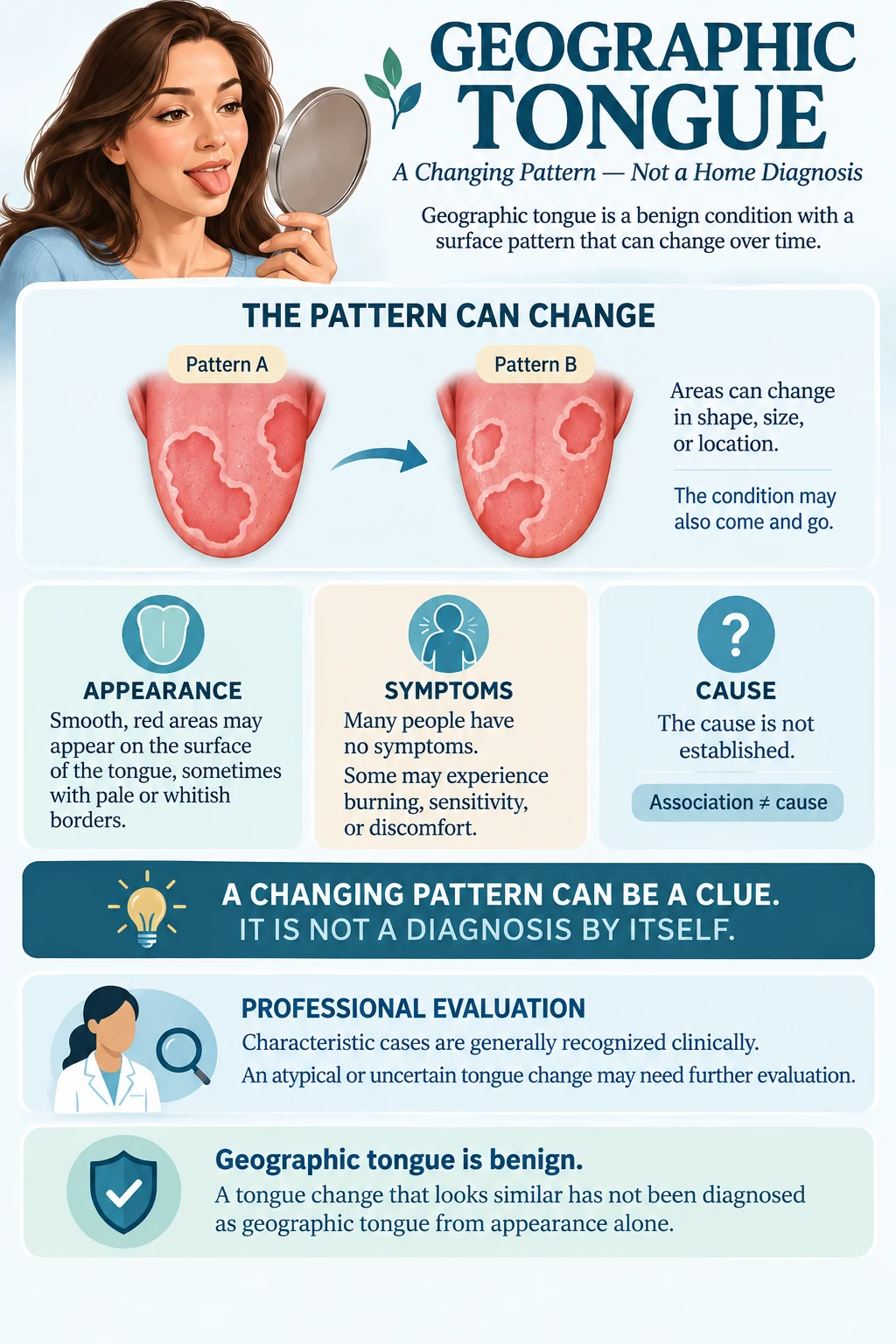
Geographic tongue is characterized by smooth, red areas that can change in shape, size, and location over time. This shifting appearance can create the map-like pattern that gives the condition its name.
Geographic tongue is considered benign, but that description applies to the recognized condition. A tongue change that resembles geographic tongue has not been established as geographic tongue simply from the way it looks.
Understanding the condition therefore requires separating three questions: What is geographic tongue? Why can its pattern change? And what can — and cannot — be concluded from those changes?
What Is Geographic Tongue?
Geographic tongue is a benign inflammatory condition affecting the surface of the tongue. It is characterized by areas where the normal filiform papillae are reduced or absent, producing smooth, red areas that may be surrounded by pale or whitish borders.
These areas can change in size, shape, and location. The condition can also recur, with periods when the pattern is more noticeable and others when it becomes less apparent or disappears.
Why Is It Called “Geographic” Tongue?
The name comes from the irregular, map-like appearance of the affected areas.
Rather than remaining as one completely fixed pattern, the visible areas can change their borders or appear in different locations over time. This migratory behavior contributes to the characteristic geographic appearance.
The name describes a recognized pattern. It does not mean that every irregular red area on the tongue represents geographic tongue.
Is Geographic Tongue the Same as Benign Migratory Glossitis?
Yes. Benign migratory glossitis is another name commonly used for geographic tongue.
The terminology reflects two important characteristics: the condition is recognized as benign, and its visible pattern can migrate or change over time.
The word benign, however, describes geographic tongue once the condition has been recognized. It should not be used to classify an unexplained tongue change solely because it looks similar.
What Does Geographic Tongue Look Like?
Geographic tongue typically involves smooth, red areas associated with loss of filiform papillae. The areas may have pale or whitish borders and commonly appear on the dorsal and lateral surfaces of the tongue.
The appearance can vary between people and can also change in the same person over time.
Appearance is therefore one part of the clinical picture rather than a stand-alone diagnostic test.
Why Can the Pattern Change in Shape or Location?
Geographic tongue is a migratory and recurrent condition.
Individual areas may change in shape and size, disappear, and later become visible elsewhere. Periods when the pattern is more or less noticeable can also occur.
This changing pattern is a recognized feature of geographic tongue, but it does not by itself establish the diagnosis.
Where on the Tongue Can Geographic Tongue Appear?
The dorsal and lateral surfaces of the tongue are commonly affected.
Location can contribute to the overall clinical picture, but the presence of an unusual area in a typical location does not determine what that area represents.
Can Geographic Tongue Come and Go?
Yes. Geographic tongue can recur and change over time.
Areas may become less visible or disappear and later reappear. Their shape, size, and location can also change.
That behavior helps explain why the tongue may look different at different times.
Why Can the Appearance Change Over Time?
Migration and recurrence are recognized characteristics of geographic tongue. The underlying cause of the condition, however, remains uncertain.
These are two different questions.
We can describe how the visible pattern behaves without assuming that the biological reason for the condition has been fully established.
Does a Changing Pattern Prove It Is Geographic Tongue?
No.
A changing pattern can be characteristic of geographic tongue, but one feature alone does not establish the diagnosis.
The history of the change and the broader oral examination provide additional context, particularly when the presentation is not typical.
Does Geographic Tongue Cause Pain or Discomfort?
Geographic tongue is often asymptomatic.
Some people, however, report burning, pain, sensitivity, or other discomfort. Symptoms vary, and their presence is not required for geographic tongue to occur.
Is Geographic Tongue Always Painful?
No.
Many people with geographic tongue have no pain. The appearance of the tongue may be the main reason the condition is noticed.
Pain — or the absence of pain — therefore cannot establish the diagnosis.
Can Some People Experience Burning or Sensitivity?
Yes. Burning or sensitivity can occur in symptomatic geographic tongue.
But the relationship should not be reversed:
Burning sensations in the mouth can occur in different clinical contexts and should not be treated as a geographic-tongue test.
What Causes Geographic Tongue?
The cause of geographic tongue is not established.
Different biological mechanisms and possible associations have been investigated, but the reason the condition develops remains uncertain.
That uncertainty matters when research findings about geographic tongue are interpreted.
Why Associations Are Not the Same as Causes
Research has reported associations between geographic tongue and several health conditions, including psoriasis.
An association does not establish that one condition caused the other, and it does not explain why geographic tongue developed in an individual person.
Does Geographic Tongue Mean You Have Another Health Condition?
No such conclusion can be made from geographic tongue alone.
Research into associations can help scientists investigate possible relationships between conditions. It does not turn geographic tongue into a diagnostic marker for another disease.
The presence of geographic tongue therefore cannot, by itself, establish that someone has psoriasis or another systemic condition.
Is Geographic Tongue an Infection?
Geographic tongue itself is not classified as an infectious disease.
However, some oral conditions that may enter the differential diagnosis of an atypical tongue change are different from geographic tongue and can have different causes.
The practical distinction is important: recognizing that geographic tongue itself is not an infection does not establish what an unexplained tongue change represents.
Is Geographic Tongue the Same as a Mouth Ulcer?
No.
Geographic tongue and aphthous ulcers are different clinical entities, although oral changes can sometimes require differentiation when their presentation is not typical.
Our separate guide to canker sores and mouth ulcers covers that territory in more detail.
Is Geographic Tongue Cancer?
Geographic tongue is considered a benign condition.
But that statement applies to geographic tongue — not automatically to every tongue change that resembles it.
An unexplained or atypical tongue change may require evaluation before its nature is established. For that reason, the benign nature of geographic tongue should not be used to classify an unknown tongue finding from appearance alone.
Why Can Geographic Tongue Be Confused With Other Tongue Changes?
Different oral conditions can alter the color, texture, or surface of the tongue.
When a presentation is atypical, clinicians may need to consider other explanations. The purpose of differential evaluation is not to create a visual checklist for identifying those conditions at home, but to determine which explanation best fits the complete clinical picture.
Why Appearance Alone May Not Identify the Condition
A single look at the tongue provides only part of the information.
The history of the change, whether its pattern has shifted, accompanying symptoms, the appearance of surrounding tissues, and other clinical findings can provide additional context.
For that reason, photographs or isolated visual characteristics should not be treated as diagnostic tests.
Why Atypical Changes May Need Further Evaluation
Characteristic cases of geographic tongue are usually recognized clinically.
When the presentation is atypical or another diagnosis needs to be considered, additional evaluation may sometimes be appropriate.
This does not mean that geographic tongue routinely requires extensive testing. It means that the approach can change when the clinical picture is not characteristic.
How Is Geographic Tongue Professionally Evaluated?
Geographic tongue is primarily evaluated clinically.
A dental or medical professional can consider the appearance of the tongue together with its history and other relevant findings rather than interpreting one feature in isolation.
The Role of History and Oral Examination
History can provide information that a single observation cannot.
Whether the pattern has changed over time, whether symptoms are present, and how the finding developed can all contribute context.
An oral examination allows the tongue to be considered together with surrounding oral tissues and other relevant findings.
Why Additional Evaluation May Sometimes Be Needed
Characteristic cases are generally recognized clinically. When the presentation is atypical or the diagnosis remains uncertain, additional evaluation may be considered.
That distinction is important: additional investigation is not a routine requirement for every case of geographic tongue.
Does Geographic Tongue Need Treatment?
Geographic tongue that does not cause symptoms generally does not require treatment.
Some people do experience symptoms, however, and those symptoms can be discussed with a dental or medical professional.
This guide does not provide a treatment protocol.
When Should a Tongue Change Be Professionally Evaluated?
A tongue change that is not clearly recognized, has an atypical presentation, or raises clinical concern may need professional evaluation.
The reason is not that geographic tongue itself is considered dangerous. It is that an unknown tongue change first needs to be understood before the benign nature of a specific condition can be applied to it.
Professional evaluation can consider the history, oral examination, and other findings to determine whether the presentation is characteristic or whether another explanation should be considered.
The Bottom Line
Geographic tongue, also called benign migratory glossitis, is a benign condition characterized by changing areas on the surface of the tongue.
Its map-like pattern can change in shape, size, and location and may recur over time. Many people have no symptoms, while some experience burning, sensitivity, or discomfort.
The cause remains uncertain. Although geographic tongue has been associated with other health conditions in research, an association does not establish cause or provide an individual diagnosis.
Understanding that distinction makes it possible to explain geographic tongue without turning a photograph, symptom, or changing pattern into a home diagnostic test.
Sources & References
- NCBI Bookshelf — Geographic Tongue (StatPearls)
- PubMed PMID 29903400 — Geographic tongue: clinical characteristics of a systematic review
- PubMed PMID 29982968 — Treatment of symptomatic geographic tongue: a systematic review
- PubMed PMID 30739339 — Association between geographic tongue and psoriasis: systematic review and meta-analysis
Last updated: September 20, 2026.